Posts Tagged ‘Robert Scoble’

February 21, 2013

What is a “Cultural Object”?

Send to Kindle

rob 1302 001j

[More thoughts on The Racks­pace Book…]

6. ROB LA GESSE

Rob La Gesse is the groovy cat who first hired gaping­void at Rackspace.

He’s also the guy who hired my friend, Robert Sco­ble.

He’s a lot like me and Sco­ble, i.e. very much his own man, very much an individual.

I sup­pose that’s why we get along.

Above is a T-shirt design I’ve never sho­wed Rob before– he’s seeing it for the first time here on the blog, the same as you and ever­yone else. He may like it, he may not.

That’s how Rob and I work together. Like I said in my last blog post, “he lets me just post stuff without get­ting pre-approval. We like doing that way because it lets him see the work for the first time in the wild, which keeps the thin­king fresher, somehow.…”

The thing is, there’s a method to the mad­ness. If the idea fails, hey, it’s just a wee car­toon on a blog post. We can quickly and easily try something else the same day. It’s not like we blew money on a Super­bowl ad that ended up bombing…

But if the idea works, it works REALLY well. The idea gets emai­led around, both inside and outside the com­pany, to emplo­yees, sha­rehol­ders, cus­to­mers and non-customers alike. It sud­denly takes on a life of its own, on its own merit.

In other words, it sud­denly beco­mes a cul­tu­ral object (i.e. a social object that arti­cu­la­tes the  com­pany cul­ture), as oppo­sed to just a usual piece of com­mer­cial, “Here’s-why-you-should-give-us-your-money” mes­sa­ging (You know, the kind that nobo­day actually cares about).

Rob and I never plan­ned it this way, we just star­ted tal­king and this is kinda how it evol­ved. That’s kinda how we both roll. Rock on.

February 20, 2013

The Rackspace Book

Send to Kindle


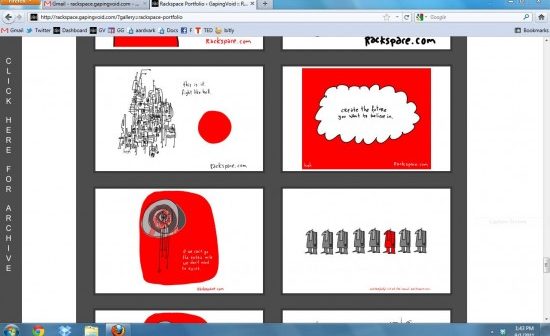
 [Screenshot of the car­toon show­case page we did for Racks­pace etc.]

I’ve star­ted wri­ting a book about gapingvoid’s expe­rience wor­king with Racks­pace. Here are some ini­tial thoughts, some more for­med than others:

i. WE’VE LEARNED A TON IN THE PROCESS.

I thought I’d share what we’ve lear­ned about Racks­pace along the way, about how this small little web-hosting com­pany from San Anto­nio, Texas tur­ned their uni­que take on “just being social” into a billion-dollar business.

ii. CAN A BILLION-DOLLAR COMPANY ACTUALLY BE “SOCIAL”?

I know. Right?

We’ve all been bom­bar­ded with the Social Media catchph­ra­ses, we’ve all seen the hype spe­wing out of every Inter­net ori­fice out there, we’ve heard every cliché and pla­ti­tude known to man, we’ve all rolled our eyeballs.

The num­ber of peo­ple calling them­sel­ves “Social Media Gurus” on Twit­ter num­bers over a hun­dred thou­sand. “Busi­ness is Social!” “Join the con­ver­sa­tion!” “Don’t sell, engage!”

“Hire me!” “I’m avai­la­ble for con­sul­ta­tion!” “Write me a big, fat check and I’ll solve all your Social Media problems!”

Like I said, we’ve all rolled our eyeballs.

And yet… what if it actually works?

iii. “DEATH BY COMMODITY”.

Racks­pace basi­cally sells a com­mo­dity i.e. web hos­ting and cloud services.

They basi­cally sell a lot of ones and zeroes, that they move through a lot of pipes, back and forth bet­ween their cus­to­mers and their servers.

Not sexy, and highly com­pe­ti­tive. What’s more, they’re com­pe­ting with a lot of blue chip com­pa­nies A LOT Lar­ger than them: Ama­zon, Mic­ro­soft, IBM etc

It’s an easy place to get your lunch eaten by the big boys.

It’s an easy envi­ron­ment to be killed in.

And yet, they thrive.

iv. THE SECRET WEAPON: “FANATICAL SUPPORT” THE CREATION MYTH.

Two young guys start a web-hosting com­pany, with Graham Wes­ton as an inves­tor. Graham gets an email from an irate cus­to­mers. “Guys, we have to offer our cus­to­mers Fana­ti­cal Sup­port or this isn’t going to work. An ethos is born…

v. SOME MORE IDEAS TO PLAY WITH:

“IF YOU LOVE YOUR CUSTOMERS ENOUGH, YOU WILL HAVE A GREAT PRODUCT, END OF STORY…”

“DON’T TALK TO ME ABOUT R.O.I., TALK TO ME ABOUT HOW WHAT WE”RE DOING IS ACTUALLY BEING HELPFUL TO OUR CUSTOMERS.”

“HOW THE OPEN CLOUD CHANGES EVERYTHING”

HIRE THE CRAZIES e.g. SCOBLE, LA GESSE, MACLEOD

“A SHOPPING MALL CAN BECOME A CASTLE”

“COMMODITY? ODDITY? OR BOTH?

“PRODUCT IS THE PEOPLE…”

“TAKE HUMAN BITES”

“LEADERSHIP IS ABOUT CREATING MEANING, NOT TELLING THEM WHAT TO DO”

“RACKSPACE HAS TO BECOME A PLACE WHERE PEOPLE’S HIGHEST NEEDS ARE MET, OR WE’RE WASTING OUR TIME.”

“IT’S WHAT RACKSPACE MUST BECOME THAT’S INTERESTING. IT’S WHAT ALL BUSINESS MUST BECOME THAT’S EVEN MORE INTERESTING.”

[To be continued…]

[UPDATE:] Rob La Gesse, the guy who hired me at Racks­pace (and also hired Robert Sco­ble) left the follo­wing com­ment below:

I’ll be inte­res­ted in seeing how this series pro­gres­ses. Not sure ever­yone here knows this, but I don’t vet Hugh’s work  —  I see it when you see it. And that is pretty cool to me. I expe­rience his work when you do. No preconceptions.

Yep. It’s what makes it fun– he lets me just post stuff without get­ting pre-approval. We like doing that way because it lets him see the work for the first time in the wild, which keeps the thin­king fresher, somehow.…

October 12, 2012

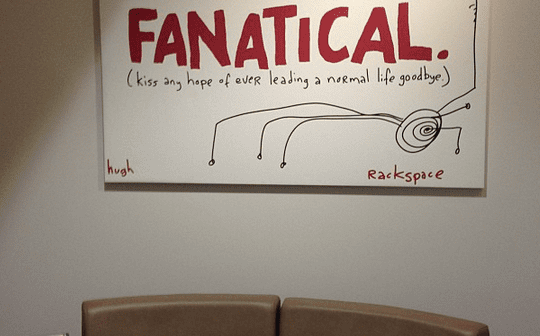
“Kiss any hope of ever leading a normal life good-bye”

Send to Kindle

This made me so happy: My friend, Robert Sco­ble sent me a photo of the big gaping­void print they have up on the wall in the Racks­pace cus­to­mer brie­fing room. This is just one of twelve giant 6 foot can­va­ses that adorn the walls.

Aside from being thri­lled that they used our work, what is inte­res­ting to me is that they had the choice of using lots of dif­fe­rent kinds of art. They could have used pho­tos of happy Rac­kers, cus­to­mers, data cen­ters, etc. But they chose to broad­cast their beliefs by using mes­sa­ges that speak to their beliefs.

This par­ti­cu­lar car­toon about one of the fun­da­men­tal aspects of the busi­ness: “Fana­ti­cal sup­port In all we do”. I tried to pre­sent it in a way that I hope is both memo­ra­ble and refreshingly disar­ming. Hope­fully it touches a nerve.

As time goes by, one of the things that I rea­lize is that having well cho­sen mes­sa­ges on offi­ces walls is really power­ful. They speak to peo­ple every day of the year, and bro­da­cast what you stand for.

That’s what we think about more and more around our office, anyway.

August 16, 2012

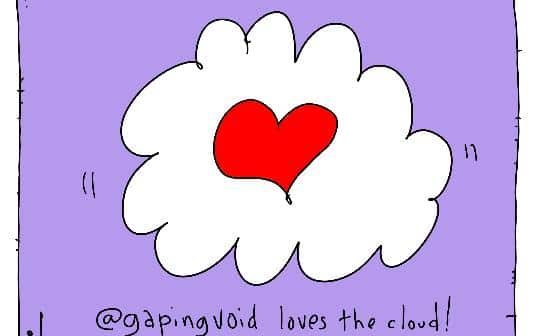
gapingvoid Loves The Cloud

Send to Kindle

I drew this quick car­toon ear­lier today; I was thin­king about how many of the com­pa­nies we’ve wor­ked with over the last year or two have serious inte­rest in The Cloud, and its future: Racks­pace, HP, Cisco, SAP etc etc.

Though we do a lot of work around star­tup cul­ture (e.g. Techc­runch and Moven­back) we also do a TON of work in the Enter­prise space. Maybe that’s because some of our big­gest fans are aslo in that space– Sigurd Rind, Den­nis How­lett, James Gover­nor etc.

Enter­prise work can be fairly dry, we take pride in making it A LOT more fun than most. Rock on.

April 5, 2011

“Forget Google…”

Send to Kindle


[Down­load the prin­ta­ble ver­sion here etc.]

Another Rackspace-sponsored car­toon

I like this car­toon. It’s something that Sco­ble would would say.

Sco­ble works for Racks­pace, too. Do the math.

[Com­mis­sion your own car­toon here…]

April 3, 2011

cube grenade: jeff sandquist

Send to Kindle

Jeff Sand­quist, Robert Scoble’s old boss at Microsoft’s Chan­nel Nine, com­mis­sio­ned me to design this busi­ness card for him.

He wan­ted a design that wor­ked for both techies and non-techies alike. Something that made him appear both good at his job, but still a human being etc.

Fun! Thanks, Jeff!

[Com­mis­sion your own Cube Gre­nade here…]

March 24, 2011

does your schtick have a good creation myth? if not, maybe it needs one?
Send to Kindle

1. Sili­con Valley was born in 1939, when Mes­sieurs Hew­lett & Pac­kard star­ted their com­pany in a small garage in Paulo Alto.

2. In his book, “Deli­ve­ring Hap­pi­ness”, Zap­pos CEO Tony Hsieh speaks of  in great length about “The Loft”, a place where all his friends used to hang out and party, and how this sense of “mea­ning­ful gathe­ring” went on to inform the core values of his now-famous shoe company.

3. A very dated-looking pho­to­graph from 1978. Ele­ven young, goofy-looking techies. They turn out to be the foun­ding mem­bers of Mic­ro­soft, inc­lu­ding Bill Gates.

4. Michael Dell foun­ding his com­pu­ter empire in his dorm room at the Uni­ver­sity of Texas.

5. Ben & Jerry’s star­ted making ice cream in a con­ver­ted gas sta­tion in Vermont.

6. The busi­ness guru, Tom Peters often wri­tes about how his time as a young man ser­ving in the US Navy hel­ped evolve his now-famous worldview.

7. Rock star phy­si­cists, Brian Cox talks pas­sio­na­tely about the Big Bang Theory.

8. How a des­pon­dent, burned-out, second-rate adver­ti­sing copyw­ri­ter FINALLY got his groove when he star­ted dra­wing car­toons on the back of busi­ness cards.

9. The Beat­les pla­ying those early gigs at The Cavern Club in Liverpool.

10. The famous tech blog­ger, Robert Sco­ble tal­king about his job wor­king in a dis­count camera store, back when he was a kid.

11. How a bunch of young, angry social mis­fits start a small nightc­lub, the Caba­ret Vol­taire, in 1916 Zurich [at the height of World War One] and in the pro­cess invent Dada, one of the 20th Century’s most influen­tial art movements.

12. Abe Lin­coln was born in a log cabin.

So… What do these all have in common?

They’re all Crea­tion Myths. That’s right; just like The Gar­den of Eden.

We humans seem to need them, somehow. They manage to arti­cu­late who we really are, somehow. The help explain our core values, somehow.

And for wha­te­ver rea­son, REALLY suc­cess­ful peo­ple are even more likely to have them, even more likely to need them, somehow.

Does your sch­tick have a good crea­tion myth? If not, maybe it needs one?

Think about it.

January 25, 2011

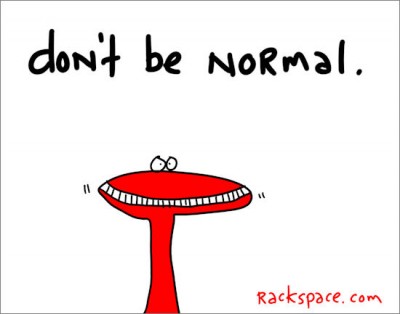
“don’t be normal”

Send to Kindle

There seems to be a con­ver­sa­tion hap­pe­ning inter­nally at my client, Racks­pace. Spearhea­ded by peo­ple like Robert Sco­ble and the guy who hired him (and who also hired me), Rob La Gesse.

“Don’t be normal”.

Who wants a “nor­mal” job, anyway?

Who wants a “nor­mal” emplo­yer, anyway?

Who wants a “nor­mal” life, anyway?

Exactly.

So why not say it, loud and proud?

So I drew some car­toons on the subject.

I’m thin­king they’d make great rec­rui­ting posters…

[P.S. At the time of pos­ting this, Rob hasn’t seen these car­toons yet. He lets me post my ideas “live”, without having to go through him first. THAT IS WHY I’m psyched to be wor­king with Rob and Racks­pace. Just so you know.]

January 24, 2011

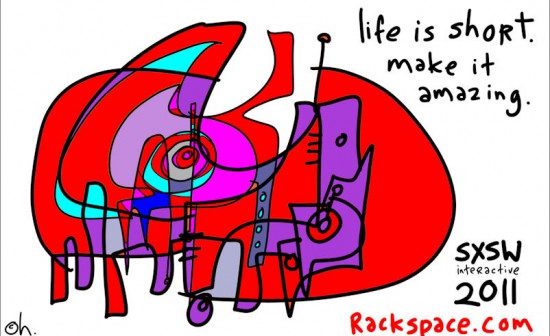
how rackspace needs to talk to people at sxsw
Send to Kindle


[Down­load the prin­ta­ble ver­sion here etc.]

““South-By” is almost upon us, and so here I am thin­king up new SXSW Inte­rac­tive ideas for my client, Racks­pace, who will have a pre­sence there.

We have a basic idea what we’ll be doing– I know Sco­ble is invol­ved– but that’s all still under wraps.

Nonethe­less, I drew the car­toon above.

As with my usual approach, the mes­sage is less about, “This is what we do and this is how much it costs”, and more about, “We hold these truths to be self-evident”.

Think about it: Racks­pace is a fast-growing com­pany. It needs to hire really good peo­ple. Lots of them.

And to do that, it has to con­vince a lot these really good peo­ple to relo­cate to their main cam­pus in San Anto­nio, Texas.

Have you ever been to San Anto­nio? Exactly.

Now, don’t get me wrong, San Anto­nio is a per­fectly lovely Texas town, hugely unde­rra­ted com­pa­red to say, Aus­tin, 80 miles to the North.

But still, it isn’t one of those towns where “Every­body” goes to, like New York, Chi­cago, Aus­tin or San Fran­cisco. It’s not a capital.

So in order to get some of the best brains in the country to move there, you have to offer them something else. Affor­da­ble hou­sing, good schools, high qua­lity of life, high stan­dard of living etc. etc.

But you also have to offer them, as Racks­pace Chair­man, Graham Wes­ton said in 2010, the chance to be on “on a win­ning team, on an ins­pi­ring mission.”

Peo­ple don’t go to South-By in order to buy stuff, to buy Racks­pace hos­ting. They go there to see their friends, to com­mune with their tribe, and yes, to look for oppor­tu­ni­ties that allow them to play on the afo­re­men­tio­ned win­ning team.

THAT is how Racks­pace needs to talk to peo­ple at South-By.

Doing something that mat­ters. On a win­ning team. That’s why I wrote the car­toon the way I did.

Life is short. Make it amazing.

And so there y’are…

January 11, 2011

c.e.s. postscript: “intel processors are smaller than a postage stamp. intel has 80,000 employees. how do you fit so many people into an object so tiny? that’s what amazes me.”

Send to Kindle

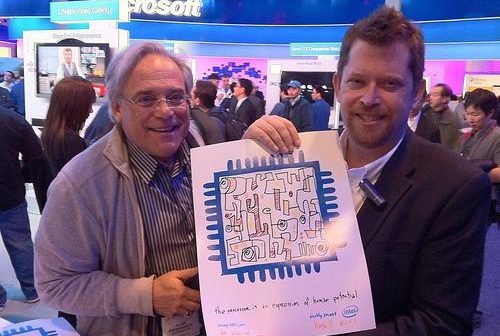
[Alan Wein­kranz- an old Texas con­nec­tion of mine– and myself at CES last Satur­day etc.]

“Intel Pro­ces­sors are sma­ller than a pos­tage stamp. Intel has 80,000 emplo­yees. How do you fit so many peo­ple into an object so tiny? That’s what ama­zes me.”

I am wri­ting this from home in Miami Beach, a day after retur­ning from the Con­su­mer Elec­tro­nic Show in Vegas. Here are some notes:

1. CES is big. Very, very big. We’re tal­king roughly TEN times the size of SXSW Inte­rac­tive. To give you a sense of just how big CES is, my friend, Robert Sco­ble wal­ked through the entire CES venue with a video camera run­ning the who time. It took him 45 minu­tes just to get from one end to the other [I make a brief cameo appea­rance about 16’30″ into it].

2. Alan Wein­kranz also made videos at CES. Here’s one he did of me. Excuse the sound qua­lity etc:

3. My time at CES was spent pretty much exc­lu­si­vely at the Intel stand, sig­ning prints. It was great. Just… great. I tur­ned up in Vegas with over 500 of them. By day three we had run out. We took a lot of pic­tu­res– a cou­ple of hun­dred of them. You can see them on Flickr here.

4. Intel was at CES, of course, to intro­duce their new 2nd Gene­ra­tion Intel® Core™ pro­ces­sor. It’s sma­ller than a pos­tage stamp. Intel has 80,000 emplo­yees. How do you fit so many peo­ple into an object so tiny? That’s what ama­zes me. That’s what I kept thin­king about the whole time I was there. We live in inc­re­di­ble times…

5. Yes, I’m exhaus­ted. Yes, I’m  a wreck. Yes, it was worth it. Intel was an fabu­lous client. A spe­cial thanks to Mar­cia Han­sen for get­ting me involved.

November 27, 2010

the futility of “keeping up with the e-joneses”

Send to Kindle

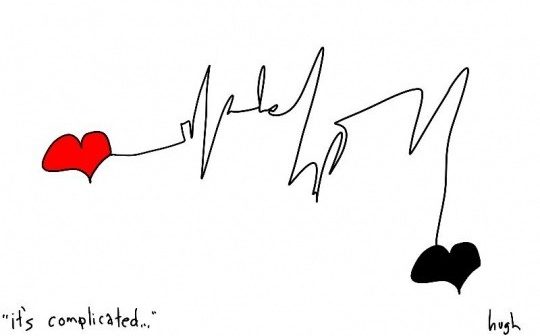
[“It’s Com­pli­ca­ted”. You can buy the print here etc.]

So somehow or other you found your­self online in a big way.

Somehow or other you deci­ded, like millions of other peo­ple, that if the future is online, it would be silly not to join in. So you decide to get with the program.

And so you get your­self hoo­ked up with the usual stuff… a blog, Twit­ter, Face­book, Flickr, Tumblr, and wha­te­ver Robert Sco­ble is using that week. And then wait for that afo­re­men­tio­ned future thing to start happening.

While you’re wai­ting for that future thing to begin, you can’t help noti­cing that cer­tain peo­ple in the same field as you– peo­ple far more suc­cess­ful and well-known than you, peo­ple who you aspire to be like one day– have fifty times the amount of Twit­ter follo­wers as you do. Or whatever.

So you spend the next two years of your life trying to get as many Twit­ter follo­wers as those peo­ple. Not only do you fail, meanwhile, your wife lea­ves you, your car is repos­ses­sed, and you have to move back in with your parents.

The futi­lity of “Kee­ping up with the e-Joneses”. You’re bet­ter off spen­ding that time and energy trying to have a “smar­ter con­ver­sa­tion”. Of course you are.

[Bonus link:] Seth has a few thoughts on the sub­ject, as well. Well worth a look.

October 18, 2010

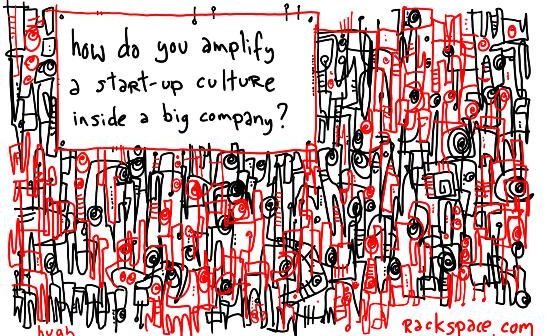
“how do do you amplify a start-up culture inside a big company?”

Send to Kindle

[Down­load the prin­ta­ble ver­sion here.]

A cou­ple of days ago my buddy, Robert Sco­ble (him­self a Racks­pace emplo­yee) twit­te­red the ques­tion, “How do do you amplify a start-up cul­ture inside a big company?”

A damn good ques­tion, Robert. I thought it would make a good piece of art, hence the car­toon above. More spe­ci­fi­cally, I thought it would make a good image to go on the back of  a Racks­pace busi­ness card.

Racks­pace is a big com­pany (3,000 emplo­yees), but not big enough where they can no lon­ger remem­ber when they were a small com­pany. So maybe it’s bet­ter to start a con­ver­sa­tion (which is what han­ding out a busi­ness card does, ideally) with a per­ti­nent ques­tion, rather than the usual “Here’s why you should buy our stuff” shpeel…

September 29, 2010

rackspace cube grenade 01

Send to Kindle

A cube gre­nade I drew for Rob La Gesse, Scoble’s boss over at Racks­pace. [UPDATE: Rob blogs about it here as well.]

[Feel free to down­load the high-res ver­sion here.]

Disc­lo­sure: I’m currently doing a wee bit of con­sul­ting work for Racks­pace. This car­toon was ins­pi­red after tal­king to La Gesse the other day. He tells me that with all their assets– and with over 3,000 emplo­yees, they have many– their cul­ture is the thing that they’re collec­ti­vely most proud of. Rock on.

[#Smar­ter­Con­ver­sa­tions]

August 16, 2010

“object-idea”: is your product a talisman?

Send to Kindle

One eve­ning Father Ste­ven, the elderly priest who bap­ti­zed more than one of my nephews and nie­ces, came over to my mother’s house for din­ner. I was there, too.

Father Ste­ven is a lovely guy. Deeply spi­ri­tual and very smart. Very lear­ned in theo­logy and the his­tory of the Roman Catho­lic Church, though not Catho­lic myself I always loo­ked for­ward to dis­cus­sing “The Big Stuff” with Father Ste­ven for hours on end.

That eve­ning over wine and cheese, I was telling Father Ste­ven how during a par­ti­cu­larly rough patch in my twen­ties, somehow I got into the habit of carr­ying a small Bible around with me everywhere in my day pack. Not quite sure why. Being the good for­mer choir­boy, I’ve always read the Bible in bits and bobs, here and there, all my life. I told Father Ste­ven I thought it was rather odd, even though at the time the Bible accom­pa­nied me everywhere, I didn’t read it any more than I did in my non-day-pack days. I just liked having it around, as it were.

“Ah, that’s quite com­mon,” said Father Ste­ven. “Peo­ple have always carried The Bible around as a talisman.”

From Wiki­pe­dia: A talis­man (from Ara­bic طلاسم tilasm, ulti­ma­tely from Greek telesma or from the Greek word “telein” which means “to ini­tiate into the mys­te­ries”) is an amu­let or other object con­si­de­red to pos­sess super­na­tu­ral or magi­cal powers.

Basi­cally, a talis­man is an object that has been given mea­ning that far exceeds any actual func­tion. A good luck charm. Or a cru­ci­fix. A St. Christopher’s medal. A Star of David. Or that friendship bra­ce­let your girl­friend gave you when you took off to France without her for six months “in order to find your­self” or wha­te­ver. A remin­der of an idea or an identity.

As is that $150 pair of snea­kers that you think are going make your exer­cise more often, that too is a talis­man; that too has tote­mic power. Or that $400 smartphone that’s going to get you more orga­ni­zed and focu­sed about your career. Or the author’s sig­na­ture inside the jac­ket of your favo­rite book. Or yes, that gaping­void print that’s going to hang in your office and help you to stay upbeat and moti­va­ted when you’re having a blah day. Or get­ting “Linch­pin” tat­tooed on your arm.

And this is no dif­fe­rent than watching some well known tech blog­ger like Sco­ble wal­king out of an iStore, waving his latest Apple gizmo to the video pho­nes and chee­ring crowd, after he spent three night wai­ting in line, in order to be fist in the store to buy one. Right then and there, the Apple gizmo has tre­men­dous talis­ma­nic power.

And of course, so does your “Object-Idea”, if you’re for­tu­nate enough to have one. Huge power.

Why do we seem to have this insa­tia­ble and irra­tio­nal desire to surround our­sel­ves with talis­mans, totems and Object-Ideas? Because they repre­sent mea­ning to us. And like the the car­toon above says, we have an infi­nite need for that.

[The Object-Idea archive is here.]

June 21, 2010

daily bizcard 042: robert scoble

Send to Kindle

Today’s “Daily Biz­card”, goes to my old blog­ging buddy, Robert Sco­ble.

Sco­ble was the pretty much the first cele­brity blog­ger to be wor­king at Mic­ro­soft. I thought what he did for the com­pany then was tre­men­dous– he really tried to shake the com­pany cul­ture up for the bet­ter, and he often suc­cee­ded. He now works for Racks­pace, the big hos­ting com­pany. There he pretty much does the same thing that he always has– talk to geeks and entre­pre­neurs, and try to be the first one on the block to get his hands on the latest bright & shiny object. Oh, and try to shake the com­pany cul­ture up while he’s at it.

I don’t think this car­toon really applies to Robert, but he has a sense of humor and I think he’ll get the joke. I can cer­tainly see him han­ding it out at tech con­fe­ren­ces, just for a giggle…

[Daily Biz­card archive]

[Com­mis­sion a “Cube Gre­nade” from Hugh]

[Robert, we’ll be in touch soon via gapingvoidbizcard@gmail.com to collect your details for the back of the card, so we can print & ship a free box of 100 to you etc. Thanks!]

June 1, 2010

“entrepreneurial agitprop”

Send to Kindle

[This is a “Cube Gre­nade” I desig­ned for myself ear­lier today, as a little thought expe­ri­ment etc.]

My friend, Robert Sco­ble wrote an inte­res­ting blog post recently, about why he was wor­king for Racks­pace, the big San Anto­nio web hos­ting service.

“To Help Entre­pre­neurs”. Appa­rently Racks­pace allows him a lot of lee­way to do just that,

And I also remem­ber Michael Arring­ton saying something simi­lar on The Gill­mor Gang about his busi­ness. Hel­ping the entre­pre­neu­rial com­mu­nity is a big dri­ving force behind Techc­runch.

Then I was thin­king to myself, “To Help Entre­pre­neurs” is ALSO a big part why I like desig­ning Cube Gre­na­des, why the idea can func­tion as a pro­per business.

How? Because they work as “Entre­pre­neu­rial Agit­prop” (That’s a phrase I just coi­ned ear­lier today).

“To Help Entre­pre­neurs”. “Entre­pre­neu­rial Agit­prop” . Both those ideas are reso­na­ting with me right now. Expect to see more from me on them both in the near future. Thanks.

The Cube Gre­nade archive is here.]

[Com­mis­sion your own Cube Grenade.]

February 28, 2010

“boring” is underrated

Send to Kindle

[“George”, which I sent out in the news­let­ter recently. You can get the sig­ned print here etc.]

I was thin­king back to “The Gol­den Age of Blog­ging”, whe­ne­ver that was. Say, six or seven years ago… when it hit that sweet spot bet­ween still fee­ling like vir­gin terri­tory, yet just on the verge of reaching cri­ti­cal mass.

Back then the Blo­gosphere was TINY. We blog nerds were a mino­rity. We were cul­tu­ral weir­dos. But we knew we were on to something, even if the rest of the world didn’t see it yet.

And we were loo­king VERY HARD for busi­ness models to sup­port our new, belo­ved medium…

I remem­ber when a guy lan­ding a well-paying job just on the merits of his blog, was con­si­de­red big news.

I remem­ber when a girl lan­ding a book deal just from her blog, was con­si­de­red big news.

I remem­ber when Robert Sco­ble blog­ging on behalf of Mic­ro­soft was con­si­de­red big news.

I remem­ber when Gaw­ker or Techc­runch making $10K a month on adver­ti­sing, was con­si­de­red big news.

A blog­ger making good money selling art– Well, that’s what I do now for a living- back then that would have been con­si­de­red HUGE. Now we take that kind of thing for gran­ted. Book deals, $10K monthly adver­ti­sing reve­nues, dream jobs, cele­brity Mic­ro­soft blog­gers, nowa­days that’s no big deal, either.

I remem­ber when blogs first became “News”, when that Busi­ness­week story hit in early 2005. It was a very exci­ting, vali­da­ting, heady time for us early-adoptors.

Even­tually the buzz and the hype died down, of course. Along came Twit­ter, Face­book, MyS­pace and wha­te­ver; the story moved on. “Blog­ging” got boring.…

But to paraph­rase Clay Shirky, a tech­no­logy doesn’t become truly use­ful until it beco­mes boring, until it’s no lon­ger “News”.

We may miss those early days, when blog­ging was new, exci­ting and “Hot”.

But for me and a lot of my early-adoptor friends, our blogs are making us A LOT more money now, than they ever did then.

“Boring” is underrated…

January 29, 2010

“selling by giving”, or, “gift economics”

Send to Kindle

Seth Godin does it.

Brian Clark does it.

Gary Vee does it.

Esther Dyson does it.

James Gover­nor does it.

Kathy Sie­rra does it.

Den­nis How­lettt does it.

John T. Unger does it.

Robert Sco­ble does it.

Fred Wil­son does it.

These eight smart, kind, great peo­ple, some more well-known than others,  are mas­ters at what I call “Selling by Giving”.

They put stuff out there, as gifts. Great con­tent, great ideas, great insights, great per­so­nal con­nec­tion. By giving so much of them­sel­ves, for free, every day, they build up huge sur­plu­ses of good­will, so when you’re finally in the mar­ket for something they’re selling (and they’re ALL selling something, trust me), they’re first on your list.

I do it, too, just not as well as these guys. I’ve published thou­sands of car­toons on this blog over the years, and that’s got­ten me a lot of busi­ness. And not just fine art prints, either. It’s got­ten me con­sul­ting gigs, full-time salary jobs, book deals, paid spea­king gigs, mar­ke­ting  jobs, I could go on…

Selling by giving. Any­body who’s been watching any of these guys for a long time will know exactly what I’m tal­king about.

But here’s what’s inte­res­ting to me: I can remem­ber not that long ago, say 5 years, when this type of mar­ke­ting see­med pretty freaky to most peo­ple. Now it’s con­si­de­red nor­mal, at least to smart mar­ke­ters. FIVE years. That’s all.

I could see that in another five years, ANYONE who wants to mar­ket ANYTHING suc­cess­fully– be they small mom n’ pop shops to large com­pa­nies, will have to be fluent in Gift Eco­no­mics, to a level that see­med COMPLETELY alien only a few years ago.

This inc­lu­des you. Are you ready for it?

[About Hugh. Car­toon Archive. Com­mis­sion HughSign up for Hugh’s “Daily Car­toon” News­let­ter.]

January 6, 2010

scoble’s art

Send to Kindle

Heh. My red “We Need To Talk” print makes a cameo appea­rance on the BBC, cour­tesy of my buddy, Robert Sco­ble

[About Hugh. Car­toon Archive. Com­mis­sion Hugh. Sign up for Hugh’s “Daily Car­toon” News­let­ter.]

January 4, 2010

evil plans and big companies

Send to Kindle

I have a fee­ling that I’m going to be asked the follo­wing ques­tion a lot in the next cou­ple of years:

“How do I exe­cute my EVIL PLAN within the limits of my current job at a big company?”

I’m pro­bably the wrong per­son to ask– I’ve never fit­ted into cor­po­rate cul­ture very well. But I did write few ini­tial thoughts below, just to get the gears tur­ning. Feel free to add your own in the com­ments. I’m going to be thin­king about this for a while, Thanks.

1. An EVIL PLAN’S suc­cess is 90% the peo­ple around you. This so true whether we’re tal­king small busi­ness or large, sala­ried or free­lance, boss or emplo­yee. So if you have smart, nice, dyna­mic, suc­cess­ful peo­ple around you– both collea­gues and cus­to­mers– I don’t see why you can’t exe­cute it from anywhere. It all depends how alig­ned your EVIL PLAN with the peo­ple you work with and sell to.

2. If your EVIL PLAN is not alig­ned with what your com­pany is doing, you have two choi­ces. Quit and go do something else, or give up your EVIL PLAN.

3. Patience is a vir­tue. Things tend to hap­pen more slowly at big com­pa­nies, espe­cially the more edgy stuff. A lot more time and effort is nee­ded to corral your allies into cri­ti­cal mass. That’s just reality.

4. Risk. I always liked Robert Scoble’s line, “If what you’re doing doesn’t risk get­ting you fired, it pro­bably isn’t that inte­res­ting.” Peo­ple who are very risk averse don’t get to play in the EVIL PLANS sand­box. That, too is just rea­lity, and no crazy-ass cartoonist’s blog post will change that.

5. Create your own luck. Create your own job desc­rip­tion. None of the best jobs in large cor­po­ra­tion are ever crea­ted by your boss. They’re crea­ted by you taking the ini­tia­tive. And there’s a defi­nite art to that.

6. Prac­tice. Fail. Prac­tice some more. Fail some more. Keep prac­ti­cing and fai­ling. Even­tually you’ll get there.

[UPDATE:] Ian Wallace left a com­ment below.  Samuel Beckett’s advice to anyone who dares to follow their own EVIL PLAN:

‘Ever tried. Ever fai­led. No mat­ter.
Try again. Fail again. Fail better.’

[About Hugh. Car­toon Archive. Com­mis­sion Hugh. Sign up for Hugh’s “Daily Car­toon” News­let­ter.]

August 30, 2009

ten questions for shel israel

Send to Kindle

twitvilee0909A.jpg
Shel Israel and I have known each other since 2005, when he inter­vie­wed me for his semi­nal book on blog­ging, “Naked Con­ver­sa­tions”, that he co-authored with Robert Sco­ble. Since then he’s been run­ning around, wri­ting books and con­sul­ting with large com­pa­nies on all things to do with social media. His second book, “Twit­ter­vi­lle: How Busi­nes­ses Can Thrive in the New Glo­bal Neigh­borhoods” is launching Sep­tem­ber 3rd. As he and I have the same publisher, they sent me an advance copy to read, which I was really impres­sed with. I asked him ten ques­tions, and he kindly agreed to ans­wer them below.
TEN QUESTIONS FOR SHEL ISRAEL
1. Con­grats on Twit­ter­vi­lle coming out. Please tell us all about it.
In many ways, Twit­ter­vi­lle is the de facto sequel to Naked Con­ver­sa­tions. The older book gave the argu­ment of why busi­nes­ses should blog. Twit­ter­vi­lle does the same thing, except it goes beyond busi­ness to inc­lude govern­ment, non­pro­fits and media.
Essen­tially, I tell the sto­ries of peo­ple who use Twit­ter in inte­res­ting and use­ful ways. The hope is peo­ple will read the book and get ideas for using Twit­ter to help them in wha­te­ver it is they wish to do.
2. This book was actually a long time coming. After Naked Con­ver­sa­tions, you had a wee bit of trou­ble get­ting your second book up and run­ning. A symp­tom, I believe, not so much of your talents as an author, but of the inhe­rent sub­ject mat­ter itself. A book takes about a good year and a half to write and pro­duce, often far lon­ger. Social Media chan­ges over­night on a regu­lar basis. Please ela­bo­rate.
There are two pie­ces of con­ven­tio­nal wis­dom for busi­ness books: A. Take one bone-dead sim­ple idea and repeat it with some varia­tions for 16 – 20 chap­ters such as The World is Flat. B. Write about a sub­ject that will not change while you are wri­ting it such as Tho­mas Edi­son and the mar­ke­ting of elec­tri­city.
Obviously, I’m bad at follo­wing con­ven­tio­nal wis­dom. I take a dif­fe­rent approach in that I like for something that is just taking off which can be endu­ring. I inter­view a ton of peo­ple and I look for sto­ries that may main­tain value for a few years even as they age.
Social media does change over­night, but peo­ple don’t and busi­ness rarely does. So I look for sto­ries that deal with enduing issues such as pro­fi­ta­bi­lity, the long slow death of tra­di­tio­nal mar­ke­ting ethics, access to infor­ma­tion, making govern­ment more accoun­ta­ble and so on.
3. You wrote in your book about South By South West 2007, which has now become legend in social media circ­les. It was there and then that Twit­ter launched their web­site to the public, and every­body went crazy for it. I remem­ber– I was there. The first thing that struck me about SXSW ’07 was that sud­denly, unlike a lot of the Web 2.0 con­fe­ren­ces I had been to before, the star of the show wasn’t some per­so­na­lity, web celeb, “A-Lister” etc… but an actual, non-living, non-breathing, digi­tal web­site. At the time, I felt like a real shift in Web 2.0 was taking place. From hie­rarchi­cal, personality-driven, to something else. You?
I think SXSW 07 is the clas­sic story of a star is born over­night, except in this case the star was a fla­wed little social media plat­form ori­gi­nally desig­ned to solve an inter­nal pro­blem.
I have always felt A-List focus was vastly over rated. When you look at lumi­nary num­bers and put them against the growth rate of Twit­ter every day, those who are pro­mi­nent reach a sma­ller per­cen­tage of the entire Twit­ter uni­verse every day. Each of them is in fact beco­ming influen­tial to a sma­ller – not lar­ger– share of the mains­tream.
Twit­ter is decen­tra­li­zing by its very nature. Of course there are dra­ma­tic sto­ries from Twit­ter­vi­lle– @JamesBuck arres­ted in Egypt; @jkrums taking a photo on the Hud­son. But just the drama and lumi­nary angle is much sma­ller than how Twit­ter ser­ves every­day peo­ple, who just have a few follo­wers, who just post a few times every day. Yet Twit­ter is chan­ging their lives and their busi­ness, all the time.
4. Like your­self, I can totally see the value of Twit­ter (Very cheap, very fast and very easy– even com­pa­red to blogs or Face­book etc). Yet, like blogs before it, mains­tream adap­ta­tion seems to be taking its own sweet time, yet again. As Ben Ham­mers­ley said about new media in gene­ral back at Reboot 2005, it’s not because the tech­no­logy is hard to use (it isn’t), or that it’s inte­llec­tually hard to get one’s head around (it isn’t), but that to use it pro­perly requi­res lear­ning A NEW SET OF MANNERS, a new set of social codes. And get­ting peo­ple to do that is really, really hard. As a Web 2.0 con­sul­tant with cor­po­rate clients , get­ting these folks to “learn some new man­ners” must be the har­dest part of your job, I’m gues­sing. Yes?
Ben has a point, but I would take issue with both of you on just how fast Twit­ter –and social media in gene­ral– is chan­ging the world. If you sit on the equa­tor, sip­ping a beve­rage with an umbre­lla in it, watching a coco­nut tree sway in a soft breeze, it feels motion­less; like nothing is hap­pe­ning.
But as you sit there, you are spin­ning around the world at something like 2400 mph. You are orbi­ting the Sun at a speed much fas­ter than that and you are hurt­ling through the uni­verse at a speed humans can­not yet cal­cu­late.
Yet, sit­ting on that porch it may feel like not much is hap­pe­ning.
Those of us who are pas­sio­nate about social media; who stand in front of rooms where some of the senior peo­ple have there arms cros­sed and there heads going from side to side, often vastly unde­rrate the speed of change.
To unders­tand that, I advise peo­ple to go speak to some young peo­ple. Watch their habits; watch how they get influen­ced on what to buy, watch, lis­ten to; where to work. Watch young peo­ple going to the work­place and how they use social media as com­mu­ni­ca­tions and infor­ma­tion and pro­duc­ti­vity tools.
I main­tain that we are at the very begin­ning of a fun­da­men­tal glo­bal social revo­lu­tion. And it is moving at a blin­dingly rapid speed.
5. Like Naked Con­ver­sa­tions before it, Twit­ter­vi­lle is rich in case stu­dies. You tal­ked to a LOT of peo­ple. As a fellow author, allow me to pick your brains. When an inte­res­ting story was brea­king in the “Twit­tersphere”, one that might have made an inte­res­ting case study at some point, did you make a note, put it on file and save it for later? Or did you just rely on memory (and Goo­gle) when it came time to write the book?
Orga­ni­zing for Twit­ter­vi­lle was like taking a speed tour through Dante’s Inferno. I am a poor orga­ni­zer to begin with. I crea­ted 17 Word docu­ments on topic and kept drop­ping links into it. I had post its on my wall and in my reporter’s note­books. Then something would break like Mum­bai and that wouldn’t fit into any of my pro­po­sed chap­ters, but how could I not cover it. While pon­de­ring that, Gaza – Israel broke, so then I had to rew­rite Tables of Con­tents.
The other thing that is a cha­llenge is that I try to be more of a story teller, and most busi­ness books are not writ­ten that way. In the end, I follo­wed the sto­ries and built chap­ters around them and then res­truc­tu­red– and res­truc­tu­red the flow of the book to res­pect the peo­ple whose sto­ries I told.
6. It’s the worst-kept sec­ret in publishing: Books RARELY make a lot of money for their authors. That being said, since my book came out in June, the num­ber of emails I get, asking about art com­mis­sions or other paid gigs has risen NOTICEABLY. I’m utterly swam­ped. As I’ve been saying fore­ver, “Blogs are a good way to make things hap­pen indi­rectly”. It turns out, the same is true with books. It’s all about “Leve­rage”. What’s been your expe­rience?
You and I have dis­cus­sed this before, but on the fame-fortune con­ti­nuum, we are both much stron­ger so far on the fame side. I made much more money last time by advi­sing com­pa­nies and through spea­king enga­ge­ments.
With less than a week to go before Twit­ter­vi­lle is avai­la­ble, I of course have dreams of being a #1 Best seller. It is far more likely that once again I’ll do bet­ter with spea­king and busi­ness advi­sing than from actual book sales.
When I first star­ted, someone advi­sed me that you write a book to get the spea­king enga­ge­ments. You use spea­king enga­ge­ments to set the stage for your next book. That’s what my stra­tegy will be.
7. Your back­ground is in Sili­con Valley PR. With Naked Con­ver­sa­tions, your focus morphed towards Social Media. What drove this per­so­nal evo­lu­tion, do you think?
I am very curious by nature. For a long time I was simply ama­zed at the dis­rup­tion and inno­va­tion that explo­ded from Sili­con Valley. Now, the tech­no­logy of the last 30 years has become part of every­day lives in the deve­lo­ped world.
My curio­sity is very much focu­sed on how this tech­no­logy is chan­ging the lives of the world’s peo­ple. If given the choice of follo­wing social media’s role in Iran’s elec­tion lar­ceny, or the beta glitches in the iPhone bat­tery, I’ll spend my time follo­wing Iran.
8. When Naked Con­ver­sa­tions came out, blog­ging was new. Web 2.0 was new. Now it’s mains­tream. I often get nos­tal­gic for those early days, when the blo­gosphere was tiny, every­body knew each other, and a brave new world see­med to lie just a few pixels beyond the hori­zon. Now I find myself caring much less about “the future of media” or wha­te­ver, and fin­ding I care a lot more about what I can do TODAY with social media, to help MY busi­ness. Has social media grown up? Has it become “like our parents”?
Every endu­ring tech­no­logy has been intro­du­ced with an asso­cia­ted mania. The inven­tors are bri­lliant, the early adop­ters are pas­sio­nate, and the media is exci­ted because it’s all so new.
This was true pro­bably of every inno­va­tion going back to the wheel. But then comes the lon­ger, slo­wer, stea­dier period of mass adop­tion, when peo­ple adopt these revo­lu­tio­nary con­cepts just to get their job done. There was a time when hea­ring a human voice on a telephone must have been mind-boggling. But, over time, the phone just became an every­day tool to let you use in your life and work.
Social Media, dra­ma­tic, explo­sive, dis­rup­tive period is now coming to an end, if you ask me. It is nor­ma­li­zing. It is chan­ging more of the world, but is doing it in less dra­ma­tic ways.
We are pro­bably star­ting to get to the stage of deve­lop­ment that inte­rests you and I the least. That’s where best prac­ti­ces get esta­blished, mea­su­re­ment sys­tems become relia­ble, bean coun­ters can esti­mate cost and value. Social media cham­pions are no lon­ger rebels rat­ting on the gates of large ins­ti­tu­tions. We have got­ten past the barriers. We will soon start taking our right­ful pla­ces on the org chart, with our own bud­get allo­ca­tions.
This is good for busi­ness and the world. It’s just a little boring for dis­rup­tors like you and me.
9. As a for­mer PR flack, you’ll obviously have more than your fair share of opi­nions about PR and how that world is chan­ging, fue­led on by social media. Anything you feel more strongly than most?
I think when I prac­ti­ced PR I thought about ten per­cent of my peers were true pro­fes­sio­nals who unders­tood that com­mu­ni­ca­tions is not buzz; that lis­te­ning is valua­ble; that cus­to­mers need to be res­pec­ted and that those who cover news need to not be on your side if they are to main­tain cre­di­bi­lity.
I think all of that is true today and the per­cen­tage as pretty much remai­ned cons­tant.
But those who prac­tice PR and are ski­lled at social media – peo­ple like Shel Holtz, Brian Solis, Steve Rubel, Kami Huyse, Richard Binham­mer, Scott Monty, Todd Defren [the list is long] have dis­co­ve­red that Con­ver­sa­tio­nal tools are far more valua­ble to com­mu­ni­ca­tions pro­fes­sio­nals than the aging and inef­fi­ciency broad­cast tools that I had to use when I was a PR prac­ti­tio­ner.
I think this is a great time to be a Com­mu­ni­ca­tions pro. You no lon­ger need to be the nicely dres­sed nobody sch­lep­ping press kits and whis­pe­ring into the ear of the offi­cial spo­kes­per­son. Now you can be the cre­di­ble spo­kes­per­son your­self.
All you have to do is watch clo­sely what the peo­ple I just named are doing, and learn from it. It sounds so easy, but I doubt more than 10 % of the com­mu­ni­ca­tions pro­fes­sion will end up doing that.
10. So now you’ve got a nice little side-career there as a book author. I’m gues­sing a lot of blog­gers rea­ding this wouldn’t mind having the same, one day. What advice would you give to a blog­ger who one day hopes to get into the book publishing game?
All of it to me cen­ters on the same issue: he abi­lity to find a story and tell it simply and cre­dibly. You do that with car­toons on the back of busi­ness cards, for exam­ple.
One other tip: wri­ting a book is hard work. If you price it out in dollars per hour, you might do bet­ter in the res­tau­rant ser­vice industry. I strongly advise you to love wri­ting before you start.
[Twit­ter­vi­lle comes out Sep­tem­ber 3rd, 2009.]
[The “Ten Ques­tions” archive is here.]

[Backs­tory: About Hugh. Twit­ter. News­let­ter. Book. Inter­view One. Inter­view Two. EVIL PLANS. Limi­ted Edi­tion Prints. Pri­vate Com­mis­sions. Cube Gre­na­des.]

July 27, 2009

the web 2.0 conference

Send to Kindle

web20conf.jpg
From the “Social Mar­ker” blog post:

When I visit San Fran­cisco I am always sur­pri­sed how often the name of my friend, Robert Sco­ble comes up in ran­dom con­ver­sa­tion, unpromp­ted by myself. Why is that? Why is he so well known? Is his blog REALLY that good? Is he REALLY that smart and inte­res­ting?
Well, I could give a whole stack of rea­sons to explain why I think Robert’s suc­cess is well-deserved. But one major rea­son that his blog’s traf­fic is so high, and his name so well-known, is that his per­so­nal brand has somehow mana­ged to become a Social Mar­ker inside the Sili­con Valley ecosys­tem. The same could also be said for Mike Arring­ton, Loic Le Meur or Mark Zuc­ker­berg. Drop­ping their names into ran­dom con­ver­sa­tions allows peo­ple to quickly and effi­ciently con­tex­tua­lize themselves.

[Thanks to @scobleizer and @arrington etc.]

[Backs­tory: About Hugh. Twit­ter. News­let­ter. Book. Inter­view One. Inter­view Two. Limi­ted Edi­tion Prints. Pri­vate Com­mis­sions. Cube Gre­na­des.“EVIL PLANS”.]

November 9, 2008

blue monster: why social objects are the future of marketing

Send to Kindle

BlueMonster350px.jpg

As a mar­ke­ting blog­ger, I get asked a lot, “What is the future of mar­ke­ting?“
I always ans­wer the same: “The Blue Mons­ter”.
What’s The Blue Mons­ter?
A Blue Mons­ter is a Social Object that arti­cu­la­tes a Purpose-Idea.
What’s a Social Object? What’s a Purpose-Idea?
Sit your­self down, pour your­self another glass of whisky. This might take a while to explain…

1. THE BLUE MONSTER BACKSTORY
In the late 1990’s I was living in New York, wor­king as a mid-level copyw­ri­ter at a mid-size adver­ti­sing agency, when for wha­te­ver rea­son I star­ted dra­wing car­toons exc­lu­si­vely on the back of busi­ness cards, just to give me something to do while sit­ting at the bar. Like I wrote on my blog:

All I had when I first got to Manhat­tan were 2 suit­ca­ses, a cou­ple of card­board boxes full of stuff, a reser­va­tion at the YMCA, and a 10-day free­lance copyw­ri­ting gig at a Mid­town adver­ti­sing agency.
My life for the next cou­ple of weeks was going to work, wal­king around the city, and stag­ge­ring back to the YMCA once the bars clo­sed. Lots of alcohol and cof­fee shops. Lot of weird peo­ple. Being hit five times a day by this strange desire to laugh, sing and cry simul­ta­neously. At times like these, there’s a lot to be said for an art form that fits easily inside your coat poc­ket.
The free­lance gig tur­ned into a per­ma­nent job. I sta­yed. The first month in New York for a new­co­mer has this cer­tain ama­zing magic about it that is indesc­ri­ba­ble. Incan­des­cent luci­dity. Howe­ver long you stay in New York, you pretty much spend the rest of your time there trying to recap­ture that fee­ling. Cha­sing Manhat­tan Dra­gon. I sup­pose the whole point of the cards ini­tially was to somehow get that buzz onto paper.

I star­ted my blog, gapingvoid.com in 2001. I was back living in the Uni­ted King­dom, where I grew up and where my mother and sis­ter still lived.
By this time I had accu­mu­la­ted a cou­ple of thou­sand business-card car­toons, and just star­ted pos­ting them on a semi-daily basis.
Fast For­ward to 2006. By this time my blog is pretty well known– one of the lar­gest in Europe-getting over a million uni­que visi­tors a month. My car­toons are all over the inter­net, it seems, espe­cially around the tech blog­ger scene.
It’s around this time that I meet Steve Clay­ton, at one of the many “Geek Din­ners” that have begun sprou­ting around the Lon­don tech scene.
Steve works for Mic­ro­soft, at the time he was run­ning the UK Part­ner Group [I could tell you what that actually means, but that would take too long. Suf­fice to say, he’s one very cle­ver and talen­ted chap­pie].
Steve’s not the first “Mic­ro­sof­tie” I’d met before, but he was the first one I got on really well with. Over the next few months, we start seeing each other around a lot. He’s a really super nice guy, highly inte­lli­gent, and fun to hang out with. Good times all round.
Early on, he tells me something that really struck with me: “I could be making a lot more money, and taking a lot less social grief if I wor­ked somewhere else. But I choose not to, simply because at Mic­ro­soft, you get to work on some REALLY cool stuff, soo­ner than anywhere else.”
Why was that so inte­res­ting to me? Because I had heard that very same rea­son cited to me by EVERY sin­gle Mic­ro­soft emplo­yee I had ever met up until that time. Secondly, like every other Mic­ro­soft emplo­yee I had ever met before, Steve was a really nice, open, fun guy. He did not typify the ste­reotype “Evil Borg Hive Mem­ber” that Mic­ro­sof­tees were often accu­sed of being.
I pon­de­red this for a while. Why did these folk work at Mic­ro­soft? It wasn’t the money, it wasn’t the social kudos. Something else was moti­va­ting them
So in Octo­ber, 2006 I pos­ted a car­toon on my blog that tried to express this drive, at least to myself. It went on to be called “The Blue Mons­ter”:
microsoftbizcard219border.jpg
[“The Blue Mons­ter”. First blog­ged in Octo­ber, 2006.]
I pos­ted it in high-resolution, the idea being that peo­ple at Mic­ro­soft who liked the idea, could down­load it and print it out poster-style, if they wan­ted. Like I said on my blog:

I just desig­ned this pos­ter for my bud­dies over at Mic­ro­soft [you know who you are]. Feel free to down­load the high-res ver­sion by clic­king on the image, and print it out onto — pos­ters, t-shirts etc.
The head­line works on a lot of dif­fe­rent levels:

Mic­ro­soft telling its poten­tial cus­to­mers to change the world or go home.
Mic­ro­soft telling its emplo­yees to change the world or go home.
Mic­ro­soft emplo­yees telling their collea­gues to change the world or go home.
Every­body else telling Mic­ro­soft to change the world or go home.
Ever­yone else telling their collea­gues to change the world or go home.
And so forth.

Mic­ro­soft has seventy thousand-odd emplo­yees, a huge per­cen­tage them very deter­mi­ned to change the world, and often suc­cee­ding. And millions of cus­to­mers with the same idea.
Basi­cally, Mic­ro­soft is in the world-changing busi­ness. If they ever lose that, they might as well all go home.
I chose the mons­ter image simply because I always thought there is something won­der­fully demo­nic about wan­ting to change the world. It can be a force for the good, of course, if used wisely. It’s cer­tainly a very loa­ded part of the human con­di­tion, but I sup­pose that’s what makes it compelling.

What hap­pe­ned next was quite extraor­di­nary. Steve saw the car­toon, and really liked it. He imme­dia­tely star­ted using the image in his e-mail sig­na­ture. He sta­red tal­king about the car­toon on his blog. Next thing you know, other folk inside Mic­ro­soft start doing the same. The “idea-virus” is unleashed.
Today, if you’re ever invi­ted onto the Mic­ro­soft cam­pus in Red­mond, Washing­ton, if you walk around the offi­ces, chan­ces are you’ll see the Blue Mons­ter pos­ter, han­ging on somebody’s wall. Or you might very well see someone with a Blue Mons­ter stic­ker on their lap­top, wea­ring a Blue Mons­ter t-shirt, or han­ding you their busi­ness card with the Blue Mons­ter on the back. Though the Blue Mons­ter wasn’t crea­ted by Mic­ro­soft, for many peo­ple wor­king there, it seems to arti­cu­late why they work there. It’s also been writ­ten about in the UK Natio­nal Media, as well as count­less tech blogs.
It’s not that every­body inside Mic­ro­soft “gets” The Blue Mons­ter. It’s never been offi­cially endor­sed by them. But the ones who do get ito, REALLY get it. For them, it’s a cult object. It repre­sents the con­ver­sa­tion they INDIVIDUALLY wish to be having with the world about their com­pany and tech­no­logy in gene­ral, not what the cor­po­rate “Brand Police” ups­tairs want to be having with the world. They may be loyal emplo­yees of Mic­ro­soft, but they’re also indi­vi­duals. Somehow The Blue Mons­ter allows them to express both roles at the same time, allows them to navi­gate the blurry lines that sepa­rate the two.
I was just pla­ying around with a car­toon idea at the time, not really expec­ting too much to come from it. I never expec­ted the idea to get as big and well-known as it did. Life is full of sur­pri­ses.
As the months went by and I star­ted to see The Blue Mons­ter story gro­wing and gro­wing, I had another insight: The Blue Mons­ter wasn’t a one-off. The Blue Mons­ter repre­sen­ted a fun­da­men­tal shift in how mar­ke­ting will be con­duc­ted in the future.
fail444456.jpg
[One of the dra­wings I did for Seth Godin’s latest book, “The Dip”.]
[UPDATE:] In order to help me order my thoughts, I deci­ded to put all my favo­rite social object posts onto a sin­gle blog page below. Enjoy.]
[From “KULA”: June 15th, 2007]
The Guardian’s Kevin Ander­son [who also atten­ded last night’s scree­ning] has a nice synop­sis of Jaiku Foun­der, Jyri Engstrom’s “Social Objects” idea.

Something about sites like Flickr that you will be using these sites for years to come.

The sites that work are built around social objects.

[…] MyS­pace. What is the real focal object? Music. Once they lose that focus, it is in trou­ble.
How does one build a use­ful ser­vice around social objects? Five key prin­ci­ples.
1. You should be able to define the social object your ser­vice is built around.
2. Define your verbs that your users per­form on the objects. For ins­tance, eBay has buy and sell but­tons. It’s clear what the site is for.
3. How can peo­ple share the objects?
4. Turn invi­ta­tions into gifts.
5. Charge the publishers, not the spec­ta­tors. He lear­ned this from Joi Ito. There will be a day when peo­ple don’t pay to down­load or con­sume music but the oppor­tu­nity to publish their play­lists online.

Besi­des being a web 2.0 entre­pre­neur, Jyri is an anth­ro­po­lo­gist. So at the Lon­don Jaiku geek din­ner last Tues­day, I asked him about the con­nec­tion bet­ween Social Objects and its corre­la­tion with Malinowski’s “Kula” [Mali­nowski was the father of modern Anth­ro­po­logy, by the way]. Jyri rep­son­ded that this was very much the case. So much so, in fact, that one of his great friends and men­tors, the afo­re­men­tio­ned Joi Ito bought an island in Second Life and named it “Kula”.
Kula. Social Ojects. Objects of Socia­bi­lity. Call it what you will, I think so much of what we’re trying to unders­tand about the web, the future, and yes, MARKETING, stems from this very pro­found insight from Mali­nowski in the early 20th Cen­tury, that good folk like Jyri and Joi are now hel­ping to shed new light on.
[Bonus Link:] Video of Jyri’s talk on Social Objects at the geek din­ner. One of the best talks I’ve heard for a while.
[Starbuck’s Cof­fee Cup: June, 2007]
Somewhere along the line I figu­red out the easiest pro­ducts to mar­ket are objects with “Socia­bi­lity” baked-in. Pro­ducts that allow peo­ple to have “con­ver­sa­tions” with other folk. Seth Godin calls this qua­lity “remar­ka­blilty”.
For exam­ple: A street beg­gar hol­ding out an ordi­nary paper cup cup won’t start a con­ver­sa­tion. A street beg­gar hol­ding out a Star­bucks cup will. I know this to be true, because it hap­pe­ned to me and a friend the other day, as we were wal­king down the street and a guy asked us for some spare change. After­wards, as we were com­men­ting about the rather sad para­dox of a home­less guy plying his trade with a “luxury” cof­fee cup, my friend said, “Star­bucks should be paying that guy.“
Actually, my friend is wrong. Starbuck’s doesn’t need to be paying the home­less guy. Because Star­bucks crea­ted a social object out of a paper cup, the home­less guy does their mar­ke­ting for free, whether he knows it or not.
Although I sus­pect he does. I sus­pect somewhere along the line the poor chap figu­red out that hol­ding out a Star­bucks cup gets him more atten­tion [and spare change] than an ordi­nary cup. And sud­denly we’re seeing social reci­pro­city bet­ween a home­less per­son and a large cor­po­ra­tion, without money ever chan­ging hands. Wha­te­ver your views are on the plight of home­less peo­ple, this is “Indi­rect Mar­ke­ting” at its finest.
40million1235.jpg
[Octo­ber, 2007:]Anyone who has heard me speak publicly lately will know that I’m currently very focu­sed on the “Social Object” idea, which I was tur­ned onto by Jaiku’s Jyri Enges­trom. Here’s some more thoughts on the sub­ject, in no par­ti­cu­lar order.
1. The term, “Social Object” can be a bit heady for some peo­ple. So often I’ll use the term, “Sha­ring Device” ins­tead.
2. Social Net­works are built around Social Objects, not vice versa. The lat­ter act as “nodes”. The nodes appear before the net­work does.
3. Gran­ted, the net­work is more power­ful than the node. But the net­work needs the node, like flo­wers need sun­light.
4. My ove­rall mar­ke­ting the­sis inva­riably asks the ques­tion, “If your pro­duct is not a Social Object, why are you in busi­ness?“
5. Yes­ter­day at the Dar­den talk I explai­ned why geeks have become so impor­tant to mar­ke­ting. My defi­ni­tion of a geek is, “Some­body who socia­li­zes via objects.” When you think about it, we’re all geeks. Because we’re all enthu­sias­tic about something outside our­sel­ves. For me, it’s mar­ke­ting and car­too­ning. for others, it could be cellpho­nes or Scotch Whisky or Apple com­pu­ters or NASCAR or the Bos­ton Red Sox or Buddhism. All these act as Social Objects within a social net­work of peo­ple who care pas­sio­na­tely about the stuff. Wha­te­ver industry you are in, there’s some­body who is gee­ked out about your pro­duct cate­gory. They are using your pro­duct [or a competitor’s pro­duct] as a Social Object. If you don’t unders­tand how the geeks are socia­li­zing– con­nec­ting to other peo­ple– via your pro­duct, then you don’t actually have a mar­ke­ting plan. Heck, you pro­bably don’t have a via­ble busi­ness plan.
6. The Apple iPhone is the best exam­ple of Social Object I can think of. At least, it is when I’m trying to explain it to some­body unfa­mi­liar with the con­cept.
7. The Social Object idea is not roc­ket science.
8. How do you turn a pro­duct into a Social Object? Ans­wer: Social Ges­tu­res. And lots of them.
9. Pro­ducts, and the ideas that spawn them, go viral when peo­ple can share them like gifts. Exam­ple: gmail invi­tes in the early days.
10. Social Object can be abs­tract, digi­tal, mole­cu­lar etc.
11. The inte­res­ting thing about the Social Object is the not the object itself, but the con­ver­sa­tions that hap­pen around them. The Blue Mons­ter is a good exam­ple of this. It’s not the car­toon that’s inte­res­ting, it’s the con­ver­sa­tuons that hap­pen around it that’s inte­res­ting.
12. Ditto with a bottle of wine.
13. Once I get tal­king about mar­ke­ting, it’s hard for me to go more than 3 minu­tes without saying the words, “Social Object”.
14. The most impor­tant word on the inter­net is not “Search”. The most impor­tant word on the inter­net is “Share”. Sha­ring is the dri­ver. Sha­ring is the DNA. We use Social Objects to share our­sel­ves with other peo­ple. We’re pri­ma­tes. we like to groom each other. It’s in our nature.
15. I believe Social Objects are the future of mar­ke­ting.
[“Social Ges­tu­res beget Social Objects”: Nove­me­ber, 2007]
0711thankyouthankyou.jpg
Chris Sch­roe­der riffs on my whole “Social Object” mar­ke­ting sch­tick with this very salient thought:

If your com­pany wants to suc­ceed, it needs to have a social object mar­ke­ting plan.

Amen to that. But note what Chris also says:

I don’t know about you, but when some­body walks by with an iPhone, I notice. If I see a kid stroll by me in some limi­ted edi­tion Nikes, that regis­ters with me too.

The­rein lies the rub. The Social Object idea is easy to get if your pro­duct is highly remar­ka­ble, highly socia­ble. An iPhone or the latest pair of Nike’s are both fine exam­ples of this.
But I can already hear your inner MBA saying, “Yeah, but what if you don’t work for Nike or Apple? What if your pro­duct is boring home loans, auto insu­rance or… [the list of boring pro­ducts is pretty long].
My stan­dard ans­wer to that is, “Social Ges­tu­res beget Social Objects.“
Which is another way of saying, maybe the way you relate to some­body as a human being plays a part in all this. Maybe desc­ri­bing the pro­duct as “boring” is just one more bullshit lie we tell our­sel­ves in order to make the world seem less com­pli­ca­ted and scary. Hey, my pro­duct is inhe­rently dull and boring, the­re­fore I get to be inhe­rently dull and boring, too. Hoo­ray!
Nowa­days, thanks to folk like Nike, we think of snea­kers as “non-boring” brands. This wasn’t true when I was a kid. Back then snea­kers were those bloody awful $3 plim­solls we wore in Phys Ed. But it took com­pa­nies like Nike and Adi­das to come along and by shear force of will, raise the level of con­ver­sa­tion in the snea­ker depart­ment, before snea­kers became bona fide glo­bal social objects, bona fide glo­bal powerhouse brands.
The deci­sion to raise the level of con­ver­sa­tion isn’t eco­no­mic. Nor is it an inte­llec­tual deci­sion. It’s a moral deci­sion. But whether you have the sto­mach for it is up to you.
Like I told Tho­mas almost 3 years ago re. English bes­poke tai­lo­ring, “Own the con­ver­sa­tion by impro­ving the con­ver­sa­tion.” And hey, it wor­ked. His sales went up 300% in 6 months.
It wasn’t the change in pro­duct that made Tho­mas’ suits Social Objects. It was chan­ging the way he tal­ked to peo­ple. The same applies to Stormhoek, which 3 years ago was an $8 bottle of South Afri­can wine nobody had ever heard of. Con­ver­sa­tion. Mat­ters.
So all you cor­po­rate MBAs out there, here’s a little tip. When you plan­ning on how to embrace the brave new world of Web 2.0, the first ques­tion you ask your­self should not be “What tools do I use?“
Blogs, RSS, You­Tube, Twit­ter, Face­book– it doesn’t mat­ter.
The first ques­tion you should REALLY ask your­self is:
“How do I want to change the way I talk to peo­ple?“
And hope­fully the rest should follow.
Think about it.
[Bonus Link: For a more aca­de­mic take on social objects, check out this post from Anth­ro­po­lo­gist, Jyri Enges­trom.]

0712ifyoutalkedtopeople.jpg
[From “So What’s All This New Mar­ke­ting Stuff, Any­way?”: Decem­ber, 2007] Some peo­ple call it “The New Mar­ke­ting”. Some peo­ple call it “Mar­ke­ting 2.0″. Wha­te­ver name you care to give it, I get asked about it a lot. Here are some ran­dom thoughts, in no par­ti­cu­lar order.
1. “The New Mar­ke­ting” came about because of two uns­top­pa­ble for­ces: [A] The inven­tion of the inter­net and [B] the begin­ning of the demise of what Seth Godin calls the “TV-Industrial Com­plex”. Thanks to the inter­net, as Clay Shirky famously sta­ted in 2004, “the cost and dif­fi­culty of publishing abso­lu­tely anything, by anyone, into a glo­bal medium, just got a whole lot lower. And the effects of that inc­rea­sed pool of poten­tial pro­du­cers is going to be vast.” While this was going on, large com­pa­nies found out that peo­ple were star­ting to ignore their ads. We have too many choi­ces, too many good choi­ces, and we’ve got­ten too good at igno­ring mes­sa­ges.
2. Seth Godin is quite rightly the world’s most res­pec­ted wri­ter on mar­ke­ting. That being said, a lot of peo­ple haven’t heard of Mark Earls yet. They’re both friends of mine, so I don’t want to com­pare them too much. Seth is a mas­ter of taking com­pli­ca­ted ideas and pre­sen­ting them in a way that any Ave­rage Joe can unders­tand. Mark is more of a Mar­ke­ting Geek’s geek. His stuff makes uncom­for­ta­ble rea­ding for anyone in mar­ke­ting who hasn’t been stretching him­self lately.
3. The most impor­tant asset in The New Mar­ke­ting is “having something worth tal­king about”. This makes cer­tain mar­ke­ting peo­ple squea­mish. A lot of us grew up in an era of flashy com­mer­cials for rather unins­pi­ring pro­ducts, and something in our DNA makes us believe that’s the pro­per way to go about things.
4. If I had one big insight from the last year, is how The New Mar­ke­ting has everything to do with how your pro­duct or ser­vice acts as a “Social Object”. Kudos to Jyri Enges­trom for tur­ning me on to it.
5. My second big insight from this year was lear­ning that, even with a fairly every­day pro­duct, you can create social objects simply by using your pro­ducts to make social ges­tu­res. That’s what we did with Stormhoek. The mes­sage wasn’t, “Here’s why you should buy our wine”. The mes­sage was, “We think you’re kinda cool, and we like what you’re doing. We’d like to be part of it, somehow.” And much to everyone’s sur­prise, it wor­ked rather well.
6. Blogs were the big story for 2005. You­Tube for 2006. Face­book for 2007. What’s the big story for 2008? I have no idea. Nor do I think it mat­ters. For the big story, really, is always going to be the same. Web­si­tes comes and go, but “Cheap, Easy, Glo­bal, Hyper­lin­ked Media” will be with us fore­ver, save for Nuc­lear Holo­caust.
7. A lot of what fuels The New Mar­ke­ting is quite simply, the most impor­tant word in the English Lan­guage: “Love”. It’s hard to get someone to read your web­site if you’re not pas­sio­nate about your sub­ject mat­ter.
8. I’m trying to train myself to avoid “Mic­ros­mo­sis” i.e. mis­ta­king of a mic­ro­cosm for the entire cos­mos. If you got all your news from blogs, you’d be for­gi­ven for thin­king that there are just two phone com­pa­nies– Apple and Nokia. But Sony, Moto­rola, LG and Sam­sung sell a lot of pho­nes, too. Just not to our friends.
9. My Defi­ni­tion of “Web 3.0″: Lear­ning how to use the web pro­perly without it taking over your life. I’m not hol­ding my breath.
10. Why is it so hard to explain The New Mar­ke­ting to large com­pa­nies? Because the peo­ple who work there are simply not pre­pa­red to relin­quish the idea of con­trol. Live by metrics, die by metrics etc.
11. I find all this more inte­res­ting when I don’t take it too seriously. Like all things inter­net, it’s far too easy to get carried away.
0712cartoonsas.jpg
zzzbambam04.jpg
[From
“Social Objects For Begin­ners”: Decem­ber, 2007] As y’all will know, I’m fond of tal­king about “Social Objects” and how they per­tain to “Mar­ke­ting 2.0″. Even so, some peo­ple still get con­fu­sed by what a Social Object actually is. So I wrote the follo­wing to cla­rify some more:
The Social Object, in a nutshell, is the rea­son two peo­ple are tal­king to each other, as oppo­sed to tal­king to some­body else. Human beings are social ani­mals. We like to socia­lize. But if think about it, there needs to be a rea­son for it to hap­pen in the first place. That rea­son, that “node” in the social net­work, is what we call the Social Object.
Exam­ple A. You and your friend, Joe like to go bow­ling every Tues­day. The bow­ling is the Social Object.
Exam­ple B. You and your friend, Lee are huge Star Wars fans. Even though you never plan to do so, you two tend to geek out about Darth Vader and X-Wing figh­ters every time you meet. Star Wars is the Social Object.
Exam­ple C. You’ve pop­ped into your local bar for a drink after work. At the bar there’s some ran­dom dude, sen­ding a text on this neat-looking cellphone you’ve never seen before. So you go up to him and ask him about the phone. The ran­dom dude just LOVES his new phone, so has no trou­ble with telling a stran­ger about his new phone for hours on end. Next thing you know, you two are hit­ting it off and you offer to buy him a beer. You spend the rest of the next hour gee­king out about the new phone, till it’s time for you to leave and go dine with your wife. The cellphone was the social object.
Exam­ple D. You’re a horny young guy at a party, in search of a mate. You see a hot young woman across the room. You go up and intro­duce your­self. You do not start the con­ver­sa­tion by saying, “Here’s a list of all the girls I’ve gone to bed with, and some recent bank sta­te­ments sho­wing you how much money I make. Would you like to go to bed with me?” No, something more subtle hap­pens. Basi­cally, like all sin­gle men with an agenda, you ram­ble on like a yutz for ten minu­tes, making small talk. Until she men­tions the name of her favo­rite author, Saul Bellow. Halle­luiah! As it turns out, Saul Bellow hap­pens to be YOUR FAVORITE AUTHOR as well [No, seriously. He really is. You’re not making it up just to look good.]. Next thing you know, you two are totally enve­lo­ped in this deep and mea­ning­ful con­ver­sa­tion about Saul Bellow. “Seize The Day”, “Her­zog”, “Him With His Foot In His Mouth” and “Humbolt’s Gift”, eat your heart out. And as you two share a late-night cab back to her place, you’re thin­king about how Saul Bellow is the Social Object here.
Exam­ple E. You’re an attrac­tive young woman, married to a very suc­cess­ful Hedge Fund Mana­ger in New York’s Upper East Side. Because your hus­band does so well, you don’t actually have to hold down a job for a living. But you still ear­ned a Cum Laude from Dart­mouth, so you need to keep your brain occu­pied. So you and your other Hedge Fund Wife friends get together and orga­nise this very swish Cha­rity Ball at the Ritz Car­le­ton. You’ve gues­sed it; the Cha­rity Ball is the Social Object.
Exam­ple F. After a year of per­so­nal trauma, you decide that yes, indeed, Jesus Christ is your Per­so­nal Saviour. You’ve already joi­ned a Bible rea­ding class and star­ted atten­ding church every Sun­day. Next thing you know, you’ve made a lot of new friends in your new con­gre­ga­tion. Sud­denly you are awash with a whole new pile of Social Objects. Jesus, Church, The Bible, the Church Pic­nics, the choir rehear­sals, the Christ­mas fund drive, the coo­kies and cof­fee after the 11 o’clock ser­vice, yes, all of them are Social Objects for you and new friends to share.
Exam­ple G. You’ve been married for less than a year, and already your first child is born. In the last year, you and your spouse have acqui­red three beau­ti­ful new Social Objects: The marriage, the first­born, and your own new family. It’s what life’s all about.
There. I’ve given you seven exam­ples. But I could give THOUSANDS more. But there’s no need to. The thing to remem­ber is, Human beings do not socia­lize in a com­ple­tely ran­dom way. There’s a tan­gi­ble rea­son for us being together, that ties us together. Again, that rea­son is called the Social Object. Social Net­works form around Social Objects, not the other way around.
Another thing to remem­ber is the world of Social Objects can have many layers. As with any com­plex crea­ture, there can be more than one rea­son for us to be together. So any­body currently dating a cute girl who’s into not just Saul Bellow, but also into bow­ling and cellpho­nes and Star Wars and swish Cha­rity Balls as well, will know what I mean.
The final thing to remem­ber is that, Social Objects by them­sel­ves don’t mat­ter in the grand scheme of things. Sure, it’s nice han­ging out with Lee tal­king about Star Wars. But if Star Wars had never exis­ted, you’d pro­bably still enjoy each other’s com­pany for other rea­sons, if they hap­pe­ned to pre­sent them­sel­ves. Human beings mat­ter. Being with other human beings mat­ter. And since the dawn of time until the end of time, we use wha­te­ver tools we have at hand to make it hap­pen.
[Afterthought:] As I’m fond of saying, nothing about Social Objects is roc­ket science. Then again, there’s nothing about “Love” that is roc­ket science, either. That doesn’t mean it can’t mess with your head. Rock on.
[Link:] Mark Earls has some nice thoughts on this, as well. “Things change because of peo­ple inte­rac­ting with other peo­ple, rather than tech­no­logy or design really doing things to peo­ple.“
[N.B. “Social Objects” is a term I did not coin myself, but was tur­ned onto by the anth­ro­pol­gist and Jaiku foun­der, Jyri Enges­trom.]
zzzzzz7654237.jpg
[From “Why The Social Object Is The Future Of Mar­ke­ting”: January, 2008]From my pre­vious post:

The Social Object, in a nutshell, is the rea­son two peo­ple are tal­king to each other, as oppo­sed to tal­king to some­body else. Human beings are social ani­mals. We like to socia­lize. But if think about it, there needs to be a rea­son for it to hap­pen in the first place. That rea­son, that “node” in the social net­work, is what we call the Social Object.


I’ve often gone on record with the sta­te­ment, “Social Objects are the future of mar­ke­ting”. This post will attempt to explain further why i believe that.
THE BAD OLD DAYS: MARKETING IN THE AGE OF HYPER-CLUTTER.
We have just come through a hundred-year long era, called the “Mass Era”.
Mass Media and Mass Pro­duc­tion came of age at the same time. We try to sepa­rate the two, and we can­not.
A few deca­des ago, the local car dea­lers in town gave you a choice of four or five models. Now your choice is in the many dozens. There are well over a dozen varie­ties of Coca Cola. And thou­sands of dif­fe­rent drink com­bos you can buy at any Star­bucks on any given day.
I can sing you jin­gles for Nestle cho­co­late bars, from com­mer­cials I haven’t seen in over twenty years. That’s how clut­te­red my mind is. And yours is pro­bably not that dif­fe­rent.
Why would any sane per­son think that swim­ming in a pollu­ted sea of com­mer­cial mes­sa­ges was fun for peo­ple? Mes­sa­ges are not infor­ma­tion.
In this hyper-cluttered lands­cape the mediocre mar­ke­ter will say, “I know! Let’s add another item of clut­ter to the cul­tu­ral land­fill! Lets inc­rease the noise-to-signal ratio!!!”
And then he won­ders why it doesn’t work.
It doesn’t work because we’re igno­ring you now. You had our atten­tion for a while, but as you know, it was more a cul­tu­ral acci­dent than anything you really had any true con­trol over.
The world has moved on, and there’s not a damn thing you can do about it. Your boss also sus­pects this may be the case, but thank­fully for your career, he hasn’t brought it up in a mee­ting. Yet.
THEN ALONG CAME THE INTERNET…
I can’t help won­de­ring if the inter­net coming along at the same time as the Hyper-Clutter Era reaching cri­ti­cal mass was a his­to­ri­cal acci­dent, or did the inter­net evolve as fast as it did in order to cir­cum­vent the Hyper-Clutter? I’m gues­sing the lat­ter. If the pur­ve­yors of one-way con­ver­sa­tions had offe­red something more sus­tai­na­ble and satisf­ying, maybe our need to “talk to real human beings” again would not have been so pro­noun­ced.
Now, when you buy something, you don’t phone up the com­pany and order a brochure. You go onto Goo­gle and check out what other peo­ple– peo­ple like your­self– are saying about the pro­duct. In terms of com­mu­ni­ca­tion, the com­pany no lon­ger has first-mover advan­tage. They don’t ask your com­pany for the brochure until your pro­duct has already jum­ped through a series of hoops that SIMPLY WERE NOT there twenty years ago.
YOU NO LONGER CONTROL THE CONVERSATION. THEN AGAIN, MAYBE YOU NEVER DID.
Human beings are much bet­ter at recog­ni­zing the linear, rather than recog­ni­zing the ran­dom and expo­nen­tial.
1 Oh No! There’s a sabre-tooth tiger hea­ding my way!
2. Run!
That is linear. Our cave­man ances­tors found it a most use­ful qua­lity.
We run an ad. Sales go up. So taking the Cave­man cue, we frame it in a linear fashion to explain to our­sel­ves the cause and effect.
“Peo­ple liked our ad so much, they drop­ped what they were doing, sped down to Wal-Mart and bought our pro­duct!”
If only.
What hap­pe­ned was pro­bably more ran­dom. You saw an ad for Brand X. A few days later you’re having cof­fee over at your friend, Pam’s house. She has Brand X on her kitchen coun­ter.
“I saw that ad for it the other day,” you say. “Is the stuff any good?”
“Yeah,” she says. “It’s not bad.”
So the next time you’re in the super­mar­ket, you see the pro­duct, and buy it. Ker-chiing.
The ad didn’t make the sale. Your friend made the sale, not the ad. The ad merely star­ted a con­ver­sa­tion.
This is what they call “Word-Of-Mouth”. When it works, it works very, very well. The main pro­blem is, it rarely does. The mar­ke­ter has little con­trol of the out­come.
But the marketer’s boss doesn’t want to hear it. The mar­ke­ter wants to tell his boss this, even less. So we cons­truct mytho­lo­gies to dis­guise the fear. Dis­guise the unk­nown. Dis­guise the ran­dom, in the world where UNCERTAINTY AND RANDOMNESS MUST NOT BE ALLOWED TO TAKE OVER THE MATRIX. EVER.
YOU AND PAM, HAVING COFFEE.
Pam just sold you a box of Brand X. Pam doesn’t work for Brand X, Pam gets no com­mis­sion from Brand X, so why did she make the sale, inad­ver­tently, or other­wise?
Go back to what I said in my last post about Social Objects:

The final thing to remem­ber is that, Social Objects by them­sel­ves don’t mat­ter in the grand scheme of things. Sure, it’s nice han­ging out with Lee tal­king about Star Wars. But if Star Wars had never exis­ted, you’d pro­bably still enjoy each other’s com­pany for other rea­sons, if they hap­pe­ned to pre­sent them­sel­ves. Human beings mat­ter. Being with other human beings mat­ter. And since the dawn of time until the end of time, we use wha­te­ver tools we have at hand to make it happen.

When you and Pam met for cof­fee, you inte­rac­ted with each other in the con­text of what anth­ro­po­lo­gists call “Object-Centerd Socia­lity”. In other words, you did not socia­lize in a vacuum, you socia­li­zed around objects, you socia­li­zed around things. You tal­ked about the Cubs game last week. You tal­ked about how Billy was doing in Third Grade. You tal­ked about this great movie you just saw. You tal­ked about great Pam’s cof­fee was. And yes, you tal­ked, howe­ver briefly, about Brand X. All these things you tal­ked about, an anth­ro­po­lo­gist would call “Social Objects”. And the thing is, you came over just to chew the fat with Pam. Tal­king about Billy or the movie or the Cubs game was not part of any pre-agenda. You could’ve tal­ked about other things– books, records, home fur­nishings, it doesn’t mat­ter– and you would’ve enjo­yed your cof­fee with Pam just as much.
Yes, a lot of socia­li­zing is ran­dom. Ergo, yes, a lot of mar­ke­ting is also ran­dom.
SO WHERE DOES SOCIAL OBJECTS FIT IN, FROM NOW ON?
From now on you won’t have the TV Com­mer­cials to rely on to start your con­ver­sa­tions. Peo­ple are igno­ring you. Mass media has simply got­ten too expen­sive. The only way your pro­duct is going to spread is by word of mouth. The only way it’s going to get word of mouth is if there is something in it for the per­son tal­king about it.
The per­son you want tal­king about is not doing it for the money. She’ll only talk about it if it ser­ves as a Social Object. A “hook” to move the con­ver­sa­tion along. A hook she can use it as a way to relate to her fellow human beings.
THE BAD NEWS IS, MOST PRODUCTS ARE BORING. THE GOOD NEWS IS, MOST WORD-OF-MOUTH IS BORING.
If you’re an ave­rage mar­ke­ter, chan­ces are that Alas! you don’t sell Mer­ce­des’ or Apple iPods for a living. You pro­bably sell some fairly pro­saic, uti­li­ta­rian pro­duct. Like Brand X.
Obviously, if your pro­duct is more conversation-worthy, like a Mer­ce­des or an iPod, your job will be easier. Nice work if you can get it.
But let’s face it, ave­rage peo­ple are never going to sit down and have a deep and mea­ning­ful con­ver­sa­tion about Brand X. But hey, maybe over cof­fee, a cou­ple of little soon-forgotten sen­ten­ces from some­body like Pam, is enough to make the sale.
I’m fond of saying, “If your pro­duct is not a Social Object, why are you in busi­ness?”
But of course, as Pam just pro­ved, your pro­duct, Brand X, IS INDEED a social object. Just maybe your team needs to hone its thin­king a little bit.
[Bonus Link from Jyri Enges­trom:] “Why some social net­work ser­vi­ces work and others don’t — Or: the case for object-centered socia­lity.“
aaa123457000.jpg
[From “The Social Mar­ker– The Social Object on Ste­roids etc.” January, 2008] You all will be fami­liar with my wri­tings on Social Objects by now.

The Social Object, in a nutshell, is the rea­son two peo­ple are tal­king to each other, as oppo­sed to tal­king to some­body else. Human beings are social ani­mals. We like to socia­lize. But if think about it, there needs to be a rea­son for it to hap­pen in the first place. That rea­son, that “node” in the social net­work, is what we call the Social Object.

Inc­rea­singly I’ve been using a term, “Social Mar­ker” to desc­ribe a cer­tain type of Social Object. I’ve found it espe­cially use­ful for explai­ning cer­tain ideas to mar­ke­ting folk.
When two peo­ple meet, the first thing they try to do is place each other in con­text. A social con­text. So they insert some hints into the conversation:

“I used to know your Uncle Bob.“
“I work at Saatchi & Saatchi’s.
“I’ve been rea­ding Mal­colm Glad­well for years.“
“I’m a mem­ber of Soho House.“
“I was rea­ding Doc Searls’ blog the other day.“
“I was college room­ma­tes with your ex-girlfriend.“
“I was sam­pling some fine Islay sin­gle malts the other eve­ning.“
“I bought some Ver­sace shirts from Barney’s last week.“
“You’re a Red Sox fan too?“
“I think Andy Warhol is ove­rra­ted.“
“I think Led Zep­pe­lin is unde­rra­ted.“
“I was having din­ner with some guys from Gold­man Sachs.“
“My wife thinks the Upper West Side is really good for schools.“
“San Tro­pez is too expen­sive in February.”

Let’s say, for sake of argu­ment, that you never heard of me before, but I knew all about you. And let’s say, for exam­ple, you were also the world’s grea­test Bos­ton Red Sox fan. And let’s say I saw you in a cof­fee shop. And let’s say I went over to your table, like a stal­ker [You don’t know me from Adam, remem­ber].
And let’s say the first thing out of mouth was a short list of five names:
“Carl Yastr­zemski. Carl­ton Fisk. Rico Petro­ce­lli. Fred Lynn. Dwight Evans.“
Yes, gran­ted, that would be pretty strange beha­vior. That being said, because you knew every sin­gle fac­toid about the 1975 World Series there was to know, you would know exactly who and what I was tal­king about. Right away, you would know that we sha­red a con­text, even though I had only given you five names and nothing else. Which would make you more likely to invite me to sit down at your table and start a con­ver­sa­tion.
Every ecosys­tem has its own, uni­que set of social mar­kers– nouns that serve as social shorthand, stuff you use to let other peo­ple know ASAP that you know what you’re tal­king about, that you are a fellow “citi­zen” in a cer­tain space.
When I visit San Fran­cisco I am always sur­pri­sed how often the name of my friend, Robert Sco­ble comes up in ran­dom con­ver­sa­tion, unpromp­ted by myself. Why is that? Why is he so well known? Is his blog REALLY that good? Is he REALLY that smart and inte­res­ting?
Well, I could give a whole stack of rea­sons to explain why I think Robert’s suc­cess is well-deserved. But one major rea­son that his blog’s traf­fic is so high, and his name so well-known, is that his per­so­nal brand has somehow mana­ged to become a Social Mar­ker inside the Sili­con Valley ecosys­tem. The same could also be said for Mike Arring­ton, Loic Le Meur or Mark Zuc­ker­berg. Drop­ping their names into ran­dom con­ver­sa­tions allows peo­ple to quickly and effi­ciently con­tex­tua­lize them­sel­ves.
Something simi­lar hap­pe­ned to me a cou­ple of years ago. A artist friend of mine was hit­ting on a girl, another artist, in a bar in New York’s Lower East Side. For wha­te­ver rea­son, the sub­ject of “Art and the Inter­net” came up. So my friend star­ted telling the girl about this other friend of his, this guy living over in England, who drew these weird little car­toons on the back of busi­ness cards…
“That is SO uno­ri­gi­nal,” the girl inte­rrupts, rolling her eye­balls. “Who does he think he is, Hugh Mac­Leod?“
Heh. Small world. Yes. She was using me as a Social Mar­ker.
Social Mar­kers are a prime form of social shorthand, that peo­ple use to STAKE OUT the ecosys­tem they’re occup­ying. So why do I find this such a use­ful term for mar­ke­ters? Because obviously, if your pro­duct is a Social Mar­ker in your industry ecosys­tem [the way the iPhone is in the mobile world, or Star­bucks is in the cof­fee world, or Ama­zon is the book world, or Goo­gle is in the search world, or Whole Foods is in the super­mar­ket world, or Vir­gin is in the air­line world, or English Cut in the bes­poke world etc etc] you will have an AMAZING com­pe­ti­tive advan­tage to call your own.
And if the pro­duct your com­pany makes is not a Social Mar­ker, I guess the first ques­tion would be, “Why the hell not?” Quit your job and start over.
[Update:] Neal makes a really good point in the com­ments: Really inte­res­ting thought, Hugh, but bad pro­ducts could also be a social mar­ker — “ah, yes, I was rip­ped off by that buil­ding com­pany too” or “oh — you’ll be disap­poin­ted by that mobile phone as well”. I’d sug­gest there’s also a varia­ble here about posi­tive v nega­tive that you should think about before quit­ting that job :)
[Bonus Link] US News & World Report: “Selling in a Post-Meatball Era– The quest for ‘social objects’ that create their own Web buzz.” Seth Godin in a great inter­view to plug his new book, Meat­ball Sun­dae. “Social Object” given a small men­tion etc.
zzzzsteak20A.jpg
[From “Free Car­toons As Social Objects”: May, 2008] When I first star­ted put­ting up car­toons onto gaping­void in 2001, they were in a small, 400-pixel-wide for­mat, just like the “Love Let­ter” car­toon you see above.
Then about 2 years ago, I star­ted pos­ting them in high-resolution, like the “Dino­saur” car­toon below [Click on the image and the high-res ver­sion will pop up].
dinosaur001A.jpg
This meant peo­ple could actually down­load the ima­ges and start using them for their own stuff. Like I said in my licen­sing terms,

Hey, if you want to put the work up on your web­site, blog, or stick it on paper, t-shirts, busi­ness cards, stic­kers, home­made gree­ting cards, Power­point sli­des, or wha­te­ver, as far as I’m con­cer­ned, as long as it’s just for your own per­so­nal use, as long as you’re not trying to make money off it directly, and you’re giving me due attri­bu­tion, I’m totally cool with the idea.

As a “Social Object”, a car­toon that one can actually print out and hang on their cube wall, or put on a t-shirt, a busi­ness card etc is far more power­ful and use­ful than say, YET ONE MORE IMAGE you can find on the inter­net and e-mail en masse to your friends.
i.e. The car­toon itself hasn’t chan­ged, but the inte­rac­tion bet­ween it and the “End User” is sud­denly far more mea­ning­ful.
So of course, the next layman’s ques­tion is, “Yes, but… how do you mone­tize it?“
And of course, the ans­wer is, “Indi­rectly”.
For exam­ple, in Octo­ber, 2006 I post the Mic­ro­soft Blue Mons­ter car­toon. Within a few months Mic­ro­soft is somehow paying me a lot of money to do other dra­wings for them. Without the for­mer, the lat­ter would never have hap­pe­ned. And without the lat­ter, Sun Mic­rosys­tems would never have approached me. Everything feeds into everything else. Exactly.
In other words, I don’t create the online car­toons as “pro­ducts” to be sold. I create the car­toons as “Social Objects”, i.e. “Sha­ring Devi­ces” that help me to build rela­tionships with.
As with all things, the REAL value comes from the human rela­tionships that are built AROUND the social object, not the object in itself.

I’ll quote my friend, Mark Earls one more time. This is from his second book, “Herd”:

“Cova is surely right to sug­gest that much of modern con­su­mer beha­viour is social in nature. We do it not just in a social con­text (tan­gi­ble and imme­dia­tely pre­sent or over dis­tan­ces) but for social rea­sons — that is the object or acti­vity is the means for a group or tribe to form or inte­ract. This also echoes a lot of what Dou­glas Atkin desc­ri­bes in his study of cult brands — brands which have deve­lo­ped a cult sta­tus (like Apple, and Ford’s bes­tse­lling pic­kup) seem to serve an underl­ying social need within each indi­vi­dual (just as reli­gious cults do): a need to belong. The real draw is pro­bably not the brand but… other people.”

And I’ll also ask my favo­rite ques­tion, one more time: If your pro­duct is not a “Social Object”, how on earth do you manage to stay in business?

zzzzzz7654122.jpg
(Car­toon taken from The Hugh­train etc.)
Like I said in my inter­view with Mark Earls, The Blue Mons­ter is a “Purpose-Idea”. As Mark, the man who first coi­ned the term explains it:

Put really simply, the Purpose-Idea is the “What For?” of a busi­ness, or any kind of com­mu­nity. What exists to change (or pro­tect) in the world, why emplo­yees get out of bed in the mor­ning, what dif­fe­rence the busi­ness seeks to make on behalf of cus­to­mers and emplo­yees and ever­yone else? BTW this is not “mis­sion, vision, values” terri­tory — it’s about real dri­ves, pas­sions and beliefs. The stuff that men in suits tend to get emba­rras­sed about because it’s per­so­nal. But it’s the stuff that makes the dif­fe­rence bet­ween suc­cess and fai­lure, because this kind of stuff brings folk together in all aspects of human life.

Real dri­ves, pas­sions and beliefs. Exactly.
The Blue Mons­ter line, “Change The World Or Go Home” is not roc­ket science or lite­rary bri­lliance. It just arti­cu­la­tes a sim­ple belief, a sim­ple pas­sion, a sim­ple drive THAT ALREADY EXISTED, long before The Blue Mons­ter ever came on to the scene. That’s all it was ever meant to do.
msbizcard999aaa.jpg
[The Mic­ro­soft Blue Mons­ter etc.]
Whether you agree or disa­gree with it doesn’t mat­ter, the impor­tant bit is that peo­ple within Mic­ro­soft believe it. Unlike a con­ven­tio­nal ad cam­paign, it’s not about you. It’s about them.
Why is something like this poten­tially valua­ble to a busi­ness? Simply put, if you believe something pas­sio­na­tely enough, for long enough, arti­cu­late it well enough, and your actions are alig­ned, cre­di­ble and con­sis­tent with your belief for long enough, it’s just a mat­ter of time before other peo­ple start belie­ving it, too. And next thing you know, you have an inte­res­ting con­ver­sa­tion going on, both inside and outside the com­pany. And as Doc Searls famously said, “Mar­kets are con­ver­sa­tions”. Ker-Chiing.
Again, none of this is roc­ket science. Tal­king to peo­ple never is.
When peo­ple ask me what exactly is a Blue Mons­ter, I tell them, it’s not neces­sa­rily a car­toon. It’s simply a social object that allows one to more easily arti­cu­late the Purpose-Idea. No more, no less.
I’ve been asking myself for years, what comes after con­ven­tio­nal, Madison-Avenue-style adver­ti­sing, now that we live in a post-TV, post-advertising, post-message world? “Crea­ting Blue Mons­ters” is the clo­sest I’ve ever come to fin­ding an actual ans­wer.
Besi­des dra­wing the car­toons, hel­ping other com­pa­nies create Blue Mons­ters is how I intend to spend the remain­der of my career.
Car­toons and Blue Mons­ters. I really do have the world’s grea­test job. Rock on.
[To Be Continued.…]

September 24, 2008

back from the road trip

Send to Kindle

roadtrippJPEG.jpg
[Click on image to enlarge etc.]
Mon­day night I arri­ved back in Alpine, after one week and 3,200 miles on the road. I went from here in West Texas, to LA, to Ber­ke­ley, to Las Vegas, to Flags­taff, to Albu­quer­que, and back again. I sta­yed in cheap motels and lived on mostly Ame­ri­can diner food and Diet Coke. Here are some ran­dom notes on the trip, in no par­ti­cu­lar order:
A. Iti­ne­rary.
Day One, Mon­day. Alpine, Texas-Blythe, Cali­for­nia. 816 miles. The lon­gest leg of the trip was on this first day, from West Texas to the the Arizona-California bor­der, right on the banks of the Colo­rado River.
En route I was hoping to meet up with Pam Slim and other Twit­ters in Phoe­nix, but got into town too late. It was around 2am before I made it to my hotel.
Southern New Mexico is a stun­ning place, if you like bleak, tall, red desert, moun­tain country. I cer­tainly do– when I’m there I feel I could go on dri­ving fore­ver.
Day Two, Tues­day. Blythe, California-Hollywood, Los Ange­les. 290 miles. Until you get to Palm Springs, I-10 seems little more than a dirt track going through the desert. Little small towns full of rusted-up mobile homes and bill­boards, offe­ring food, gas and lod­gings. Then you get to Palm Springs and the wind farms begin. Hun­dreds of wind tur­bi­nes. Thou­sands. Beau­ti­ful and surreal. The the coas­tal moun­tains begin and the traf­fic gets insane, all the way to Los Ange­les.
I had no rea­son to be in LA other than it’s en route to Ber­ke­ley. Luc­kily, one of my oldest friends, Dave Mac­ken­zie is there at the moment, wor­king on a movie. He let me crash at his pad in the Holly­wood Hills for the night. Not much to report other than two old bud­dies catching up, eating din­ner, drin­king whisky [just like the old days back in Scot­land], tal­king late into the night.
Day Three, Wed­nes­day, Holly­wood– Ber­ke­ley Cali­for­nia. 369 miles.
In the mor­ning Dave and I hea­ded for break­fast at The Griddle Cafe on Fair­fax. After break­fast we hug­ged each other in the par­king lot, said our goodb­yes, Dave hea­ded for a mee­ting with some­body in “The Industry”, and I hea­ded North.
For such a mas­sive city, Los Ange­les is a fairly easy town to escape, once you’re on the free­way [so long as it isn’t rush hour, of course]. After an hour or two of dri­ving through the moun­tains on I-5, Sud­denly you find the moun­tains coming to an end, and below you is the vast, flat Cen­tral Cali­for­nian plain.
There’s not much to say about it, except it’s vast, it’s flat, and it’s America’s lar­gest produce-growing region. Just ima­gine mile after mile of huge fields, vine­yards, orange gro­ves and small towns. After a few hun­dred miles of this agri-industrial mono­tony the hills outside San Fran­cisco begin– all cove­red with this almost mys­te­rious, mustard-colored grass­land. Then, like all big Ame­ri­can cities, the high­ways end and the free­ways begin. By this time I am so wired from the dri­ving I don’t notice the traf­fic all around me. I’m in a trance. The crazy com­mu­ters don’t phase me– it’s like they’re not there.
I make it to Ber­ke­ley. A small college town in the Bay area– kinda reminds me of Aus­tin. I’m there for a rea­son I can’t quite talk about. Something to do with busi­ness. All very hush-hush. Though I have some good friends across the bay in San Fran­cisco, I don’t look anyone up. Too much to do. I’m only in town one night. I’m on a mis­sion. I’ll see them next time.
Day Four, Thurs­day. Ber­ke­ley, Cali­for­nia to Las Vegas, Nevada.
I stay one night. In the mor­ning I meet the per­son I’m in town to see for break­fast at the Brown Sugar Kitchen in Oakland. Great fried chic­ken, though I think they could’ve used less rose­mary. The break­fast goes well. I hap­pily hit the road, hea­ding for Vegas.
A few hun­dred miles of re-tracing my drive along the Cen­tral Valley. About two thirds back to LA I turn off I-5 at Wasco and head West. Middle of bloody nowhere– enough to give anywhere in West Texas a run for its money. Far­ming towns, pic­kup trucks, and little else. Even­tually the vast, agri­cul­tu­ral plain ends and I’m dri­ving up into the eas­tern Cali­for­nian moun­tains. Spec­ta­cu­lar. They too, end even­tually and just as sun­set kicks in I find myself dri­ving through the Mojave desert. Colors so beau­ti­ful I almost want to cry.
I’m on Inters­tate 15 hea­ding into Vegas from the South. It’s night­time, it’s pitch black, save for the head­lights of other cars. Then sud­denly you see Vegas in the dis­tance, a vast ball of colo­red lights. I find my hotel on the Strip– the MGM Grand, and check in.
Then the blur begins… like all blog con­fe­ren­ces. Talk. Net­wor­king. Busi­ness. Alcohol. I’ve done it all before, many times. We’re pro­fes­sio­nals. We know the score.
Day Five, Fri­day, Las Vegas.
Blur. Surreal. Vegas. Overwhel­ming.
Day Six, Satur­day, Las Vegas.
More blur. More surreal. Meet lots of peo­ple at Blog­world. Fun time had by all.
Day Seven, Sun­day. Las Vegas-Albuquerque, New Mexico. 585 miles.
The day starts with the usual “End of Con­fe­rence” thing. I pack, I check out of my hotel, I hang with Loren and Miche­lle for a while, till they have to go grab a cab to the air­port. I go grab my car and head east out of the city, hoping to make Albu­quer­que by mid­night.
I make it to Albu­quer­que in good time, i spite of the two-hour traf­fic jam going over the Hoo­ver Dam. I stop in Flags­taff, Ari­zona for din­ner– a modest fare of Big Mac, fries and coke. I love this part of the world, if I wasn’t so damn busy, if I didn’t have this mas­sive dead­line han­ging over my head, I would have taken a few more days to check out the Grand Can­yon and Monu­ment Valley. I’ve been to both before, both spec­ta­cu­lar place, but I decide to save them for next time. I almost didn’t.
I make it to my hotel in Albu­quer­que just after mid­night. A nice Best Wes­tern, just off the free­way. I’m asleep within minu­tes of first ente­ring my room.
Day Eight, Mon­day, Albu­quer­que to Alpine, Texas. 486 miles.
The road bet­ween Albu­quer­que and El Paso isn’t much to talk about. I’ve been on simi­lar dri­ves in Texas, and I pre­fer them. By this time I’m star­ting to burn out on the road trip. I make it to Texas and keep on hea­ding on till I reach Alpine. I slept 12 hours that night.
B. Ran­dom Thoughts.
1. Besi­des all the geo­graphi­cal splen­dor this part of the world affords, the best part of a road trip like this, of course, is that is gives you all that time to think. And what di I think about? Short Ans­wer: How the heck am I going to manage all the stuff I’ve currently got going on, AND find the time to draw car­toons. If you know the ans­wer, please tell me.
2. I didn’t go to Vegas for the Blog­world con­fe­rence. I went for the semi-annual Board of Advi­sors mee­ting for b5 Media. I am a board mem­ber, so are Stowe Boyd, Doc Searls, Robert Sco­ble and Renee Blod­gett. We all hung out most of Fri­day with b5’s CEO, Jere­mey Wright. Great mee­ting. My ori­gi­nal plan was just to fly up to Vegas for a night or two then fly back, but the lure of the road got the bet­ter of me. Sure it added a cou­ple of days to the equa­tion, but hey, you only live once.
3. Being on the road taught me exactly how use­ful a Black­berry can be, espe­cially one with GPS-enabled Goo­gle­maps. Like the old adver­ti­sing line says, don’t leave home without it.
4. I like being on the road. If I had to choose a blue-collar job it would be a truck dri­ver. No ques­tion. Second choice: Dry wall buil­der. Third choice: Plum­ber.
5. Seems I’m well on tar­get to drive 40,000 miles this year. All those trips to Aus­tin, Marfa, Ter­lin­gua etc.
6. Part of me just wants to quit everything, live in the desert, and make & sell pain­tings. I know it’s more than fea­si­ble, it would be a gig most “crea­tive” types would kill for, but I suf­fer from other yet unrea­li­zed ambi­tions.
7. It’s a good life. I think what keeps it good is the spi­rit of adven­ture. Hope­fully we can hold onto that fee­ling for as long as we are alive. Other­wise, why bother? Rock on.

July 13, 2008

cheapeasyglobal

Send to Kindle

0712nakedconversations.jpg
[Car­toon ori­gi­nally published Decem­ber, 2007. It was dedi­ca­ted to my friend, the daunt­less Robert Sco­ble.]
As anyone who has been rea­ding Techc­runch will know, the “Is Blog­ging Dead?” meme has rea­red its ugly head again.
Well, before we all get dres­sed up in our best fune­ral gear, let me say it one more time: The big story is not about blog­ging. It’s not about Twit­ter, You­Tube, Face­book, Friend­feed or wha­te­ver. And it cer­tainly is not about Robert Sco­ble, Mike Arring­ton, Jason Cala­ca­nis, Nick Den­ton or wha­te­ver so-called “A-Lister” you care you men­tion.
Yes, again, it’s all about what Clay Shirky said four years ago, in a won­der­ful inter­view he did for Gothamist:

“So for­get about blogs and blog­gers and blog­ging and focus on this — the cost and dif­fi­culty of publishing abso­lu­tely anything, by anyone, into a glo­bal medium, just got a whole lot lower. And the effects of that inc­rea­sed pool of poten­tial pro­du­cers is going to be vast.”

I had cof­fee with Clay a cou­ple of weeks ago. A totally great guy. We didn’t talk about blogs much. Nor did we talk much about Twit­ter or Face­book.
We tal­ked about something con­cep­tually far sim­pler: Cheap. Easy. Glo­bal. Media.
Chea­pEasy­Glo­bal is the big story. And it’s here now. It has arri­ved. And it’s per­ma­nent. And there’s not a damn thing anyone can do about it, save for a nuc­lear holo­caust.
Some peo­ple will do very well by it. Other peo­ple will pre­fer to stay on the side­li­nes ins­tead, using the inter­net to yak yak yak end­lessly on about what other peo­ple are up to, hol­ding the “pla­yers” to far higher stan­dards than they will ever attain them­sel­ves. These lovely armchair quar­ter­backs will be swiftly for­got­ten by his­tory. Same as it ever was.

January 16, 2008

the social marker– the “social object” on steroids

Send to Kindle

aaa123457000.jpg
You all will be fami­liar with my wri­tings on Social Objects by now.

The Social Object, in a nutshell, is the rea­son two peo­ple are tal­king to each other, as oppo­sed to tal­king to some­body else. Human beings are social ani­mals. We like to socia­lize. But if think about it, there needs to be a rea­son for it to hap­pen in the first place. That rea­son, that “node” in the social net­work, is what we call the Social Object.

Inc­rea­singly I’ve been using a term, “Social Mar­ker” to desc­ribe a cer­tain type of Social Object. I’ve found it espe­cially use­ful for explai­ning cer­tain ideas to mar­ke­ting folk.
When two peo­ple meet, the first thing they try to do is place each other in con­text. A social con­text. So they insert some hints into the conversation:

“I used to know your Uncle Bob.“
“I work at Saatchi & Saatchi’s.
“I’ve been rea­ding Mal­colm Glad­well for years.“
“I’m a mem­ber of Soho House.“
“I was rea­ding Doc Searls’ blog the other day.“
“I was college room­ma­tes with your ex-girlfriend.“
“I was sam­pling some fine Islay sin­gle malts the other eve­ning.“
“I bought some Ver­sace shirts from Barney’s last week.“
“You’re a Red Sox fan too?“
“I think Andy Warhol is ove­rra­ted.“
“I think Led Zep­pe­lin is unde­rra­ted.“
“I was having din­ner with some guys from Gold­man Sachs.“
“My wife thinks the Upper West Side is really good for schools.“
“San Tro­pez is too expen­sive in February.”

Let’s say, for sake of argu­ment, that you never heard of me before, but I knew all about you. And let’s say, for exam­ple, you were also the world’s grea­test Bos­ton Red Sox fan. And let’s say I saw you in a cof­fee shop. And let’s say I went over to your table, like a stal­ker [You don’t know me from Adam, remem­ber].
And let’s say the first thing out of mouth was a short list of five names:
“Carl Yastr­zemski. Carl­ton Fisk. Rico Petro­ce­lli. Fred Lynn. Dwight Evans.“
Yes, gran­ted, that would be pretty strange beha­vior. That being said, because you knew every sin­gle fac­toid about the 1975 World Series there was to know, you would know exactly who and what I was tal­king about. Right away, you would know that we sha­red a con­text, even though I had only given you five names and nothing else. Which would make you more likely to invite me to sit down at your table and start a con­ver­sa­tion.
Every ecosys­tem has its own, uni­que set of social mar­kers– nouns that serve as social shorthand, stuff you use to let other peo­ple know ASAP that you know what you’re tal­king about, that you are a fellow “citi­zen” in a cer­tain space.
When I visit San Fran­cisco I am always sur­pri­sed how often the name of my friend, Robert Sco­ble comes up in ran­dom con­ver­sa­tion, unpromp­ted by myself. Why is that? Why is he so well known? Is his blog REALLY that good? Is he REALLY that smart and inte­res­ting?
Well, I could give a whole stack of rea­sons to explain why I think Robert’s suc­cess is well-deserved. But one major rea­son that his blog’s traf­fic is so high, and his name so well-known, is that his per­so­nal brand has somehow mana­ged to become a Social Mar­ker inside the Sili­con Valley ecosys­tem. The same could also be said for Mike Arring­ton, Loic Le Meur or Mark Zuc­ker­berg. Drop­ping their names into ran­dom con­ver­sa­tions allows peo­ple to quickly and effi­ciently con­tex­tua­lize them­sel­ves.
Something simi­lar hap­pe­ned to me a cou­ple of years ago. A artist friend of mine was hit­ting on a girl, another artist, in a bar in New York’s Lower East Side. For wha­te­ver rea­son, the sub­ject of “Art and the Inter­net” came up. So my friend star­ted telling the girl about this other friend of his, this guy living over in England, who drew these weird little car­toons on the back of busi­ness cards…
“That is SO uno­ri­gi­nal,” the girl inte­rrupts, rolling her eye­balls. “Who does he think he is, Hugh Mac­Leod?“
Heh. Small world. Yes. She was using me as a Social Mar­ker.
Social Mar­kers are a prime form of social shorthand, that peo­ple use to STAKE OUT the ecosys­tem they’re occup­ying. So why do I find this such a use­ful term for mar­ke­ters? Because obviously, if your pro­duct is a Social Mar­ker in your industry ecosys­tem [the way the iPhone is in the mobile world, or Star­bucks is in the cof­fee world, or Ama­zon is the book world, or Goo­gle is in the search world, or Whole Foods is in the super­mar­ket world, or Vir­gin is in the air­line world, or English Cut in the bes­poke world etc etc] you will have an AMAZING com­pe­ti­tive advan­tage to call your own.
And if the pro­duct your com­pany makes is not a Social Mar­ker, I guess the first ques­tion would be, “Why the hell not?” Quit your job and start over.
[Update:] Neal makes a really good point in the com­ments: Really inte­res­ting thought, Hugh, but bad pro­ducts could also be a social mar­ker — “ah, yes, I was rip­ped off by that buil­ding com­pany too” or “oh — you’ll be disap­poin­ted by that mobile phone as well”. I’d sug­gest there’s also a varia­ble here about posi­tive v nega­tive that you should think about before quit­ting that job :)
[Bonus Link] US News & World Report: “Selling in a Post-Meatball Era– The quest for ‘social objects’ that create their own Web buzz.” Seth Godin in a great inter­view to plug his new book, Meat­ball Sun­dae. “Social Object” given a small men­tion etc.


December 28, 2007

it’s been a big week for TV 2.0

Send to Kindle

07082888eat-thumb.jpg
It’s been a big week for TV 2.0.
First, I wrote a blog post about Microsoft’s inten­tions within this space:

Wha­te­ver TV beco­mes in the next cen­tury, Mic­ro­soft wants to own it. Or at least, own a huge chunk of it. And that battle will be fought and won [or lost] some­time in the next decade.

Then Dave Winer wrote about his new Mac Mini TV pro­duct, “Flikr­fan”:

It’s all about pic­tu­res…
Pic­tu­res from your Flickr con­tacts…
High-def pics from pro­fes­sio­nal pho­to­graphers around the world…
Your family and busi­ness asso­cia­tes…
All ready for your new Mac Mini and high-def TV.

And then Robert Sco­ble Sco­ble wrote about Flickrfan:

But we all notice a trend: hoo­king Mac­Mi­nis up to your HTDV. I think it’s a revo­lu­tion. Revo­lu­tions always start small and among the weirdos.

Great stuff. Mac Mini + TV. The Glo­rious Revo­lu­tion for 2008 etc.
Funny, it turns out Jon Hus­band was wri­ting about the same thing in January, 2006:

While always disc­reet about its future pro­jects, we are wai­ting for Apple to unveil in 2006 a media com­pu­ter … the Mac Mini Media.

Rock on, Jon.