Posts Tagged ‘Microsoft’

February 4, 2013

Our BizSpark Canada Commission

Send to Kindle

bizspark1301

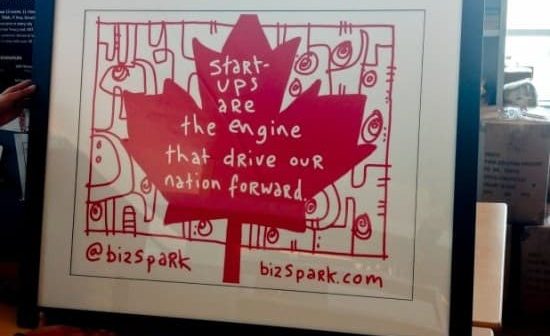
This was a nice little gig: A large print for Bizs­park Canada.

Three thoughts:

1. This is my first Mic­ro­soft gig for a while [Bizs­park is part of their mas­sive star­tup outreach pro­gram], so it felt good to be back in the ol’ saddle again.

2. This piece is a riff on a fami­liar theme of mine, that a nation is only as good as its star­tup cul­ture etc. As we see all the eco­no­mic crap hap­pe­ning in pla­ces like Spain and Greece (Unem­ploy­ment bet­ween 25%-60%, depen­ding on the age group!), it’s somethng we urgently need to teach our lea­ders, by any means neces­sary. And yes, gaping­void likes having clients who agree with us.

3. Though I love doing my more high­brow, intros­pec­tive fine art sch­tick, I also love the more extro­vert stuff for the office wall. Espe­cially offi­ces that belong to inte­res­ting folk doing inte­res­ting stuff, like the Bizs­park gang. This “tense dua­lity” bet­ween the inner and outer parts of exis­tence is where the action is. Too much of either one would be BEYOND tedious IMHO…

Thanks to Mark Gagne and the rest of the Bizs­park Canada team for making it hap­pen. Rock on.

July 26, 2011

Technology

Send to Kindle

[Buy the print!] [Subsc­ribe]

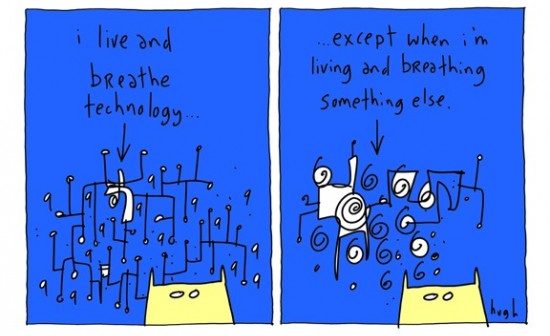
This car­toon was ori­gi­nally a per­so­nal busi­ness card I desig­ned for Microsoft’s Jeff Sand­quist.

He wan­ted a card that he could hand out to both techies and “civi­lians”, both at busi­ness and social events.

It’s a com­mon theme among most of my peers– we’re totally con­su­med by our careers, yet we still have the other parts of our lives to fit in somehow.

How do we do that? I have no idea. Does anybody?

April 3, 2011

cube grenade: jeff sandquist

Send to Kindle

Jeff Sand­quist, Robert Scoble’s old boss at Microsoft’s Chan­nel Nine, com­mis­sio­ned me to design this busi­ness card for him.

He wan­ted a design that wor­ked for both techies and non-techies alike. Something that made him appear both good at his job, but still a human being etc.

Fun! Thanks, Jeff!

[Com­mis­sion your own Cube Gre­nade here…]

March 24, 2011

does your schtick have a good creation myth? if not, maybe it needs one?
Send to Kindle

1. Sili­con Valley was born in 1939, when Mes­sieurs Hew­lett & Pac­kard star­ted their com­pany in a small garage in Paulo Alto.

2. In his book, “Deli­ve­ring Hap­pi­ness”, Zap­pos CEO Tony Hsieh speaks of  in great length about “The Loft”, a place where all his friends used to hang out and party, and how this sense of “mea­ning­ful gathe­ring” went on to inform the core values of his now-famous shoe company.

3. A very dated-looking pho­to­graph from 1978. Ele­ven young, goofy-looking techies. They turn out to be the foun­ding mem­bers of Mic­ro­soft, inc­lu­ding Bill Gates.

4. Michael Dell foun­ding his com­pu­ter empire in his dorm room at the Uni­ver­sity of Texas.

5. Ben & Jerry’s star­ted making ice cream in a con­ver­ted gas sta­tion in Vermont.

6. The busi­ness guru, Tom Peters often wri­tes about how his time as a young man ser­ving in the US Navy hel­ped evolve his now-famous worldview.

7. Rock star phy­si­cists, Brian Cox talks pas­sio­na­tely about the Big Bang Theory.

8. How a des­pon­dent, burned-out, second-rate adver­ti­sing copyw­ri­ter FINALLY got his groove when he star­ted dra­wing car­toons on the back of busi­ness cards.

9. The Beat­les pla­ying those early gigs at The Cavern Club in Liverpool.

10. The famous tech blog­ger, Robert Sco­ble tal­king about his job wor­king in a dis­count camera store, back when he was a kid.

11. How a bunch of young, angry social mis­fits start a small nightc­lub, the Caba­ret Vol­taire, in 1916 Zurich [at the height of World War One] and in the pro­cess invent Dada, one of the 20th Century’s most influen­tial art movements.

12. Abe Lin­coln was born in a log cabin.

So… What do these all have in common?

They’re all Crea­tion Myths. That’s right; just like The Gar­den of Eden.

We humans seem to need them, somehow. They manage to arti­cu­late who we really are, somehow. The help explain our core values, somehow.

And for wha­te­ver rea­son, REALLY suc­cess­ful peo­ple are even more likely to have them, even more likely to need them, somehow.

Does your sch­tick have a good crea­tion myth? If not, maybe it needs one?

Think about it.

September 25, 2010

things i wish my phone did dot com

Send to Kindle

Things I wish my phone did. Dot com. It’s a web­site we’re buil­ding for our client, Line2.

It should be up in a wee bit… we’re hoping to have a lot of fun with it– an “Idea Ampli­fier”, as it were.

Re. The car­toon above: No mat­ter how much you love your new state-of-the-art phone, it can’t love you back [For now, that is].

[Food for thought] From Seth Godin, May, 2007:

Now, of course, most blogs are one-person ope­ra­tions. Which means that suc­cess­ful blogs are often run by rest­less, outward-bound peo­ple in a hurry. And a lot of blog­gers either have day jobs or pas­sio­nate side­li­nes. I think that’s a good thing, even when they fail. It’s frus­tra­ting for me to hear, “stick to your blog­ging,” when peo­ple cri­ti­cize a pro­ject crea­ted by a blog­ger – because it’s part of the blog­ging, part of the lear­ning, part of what’s unfol­ding. I’d rather read a book that’s infor­med by the acti­vi­ties (not the repor­ting) of the wri­ter, and I’d rather read a blog that’s based on the suc­ces­ses (and fai­lu­res) of the blogger.

Which brings us to Hugh Mac­Leod and his work for Mic­ro­soft. Some cri­tics think he’s selling out. I don’t. I think he’s having a huge impact on an orga­ni­za­tion –from the outside– at the same time that he demons­tra­tes how just about any large orga­ni­za­tion can rethink its role in the world. And he’s doing it in front of all of us, without a net.

August 15, 2010

“the object-idea”: the future of what used to be called advertising
Send to Kindle

I’ve been wor­king on a pro­blem lately…

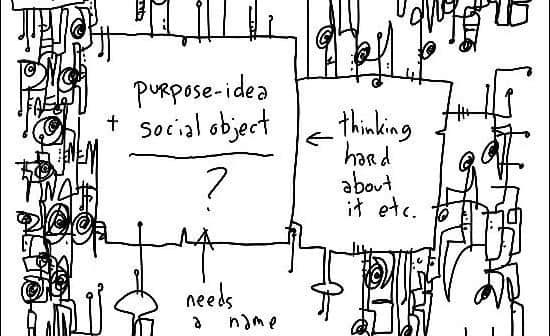
“Pur­pose Idea” plus “Social Object” equals…????

The Social Object, in a nutshell, is the rea­son two peo­ple are tal­king to each other, as oppo­sed to tal­king to some­body else. Human beings are social ani­mals. We like to socia­lize. But if think about it, there needs to be a rea­son for it to hap­pen in the first place. That rea­son, that “node” in the social net­work, is what we call the Social Object.

[Quo­ting Mark Earls:] Put really simply, the Purpose-Idea is the “What For?” of a busi­ness, or any kind of com­mu­nity. What exists to change (or pro­tect) in the world, why emplo­yees get out of bed in the mor­ning, what dif­fe­rence the busi­ness seeks to make on behalf of cus­to­mers and emplo­yees and ever­yone else? BTW this is not “mis­sion, vision, values” terri­tory – it’s about real dri­ves, pas­sions and beliefs. The stuff that men in suits tend to get emba­rras­sed about because it’s per­so­nal. But it’s the stuff that makes the dif­fe­rence bet­ween suc­cess and fai­lure, because this kind of stuff brings folk together in all aspects of human life.

In his bri­lliant book, “Wel­come to The Crea­tive Age,” Mark Earls, then one of the top adver­ti­sing plan­ners in Lon­don, coi­ned to term “Purpose-Idea”, as a more inte­res­ting, enga­ging and human term to replace the word, “Brand”. The lat­ter he vie­wed as an out­da­ted, ove­ru­sed and mostly mea­nin­gless concept.

Though I loved the book [“Purpose-Idea” is one of the most explo­sive “A-Ha!” moments I’ve had in my entire career], it soon became appa­rent to me that a Purpose-Idea doesn’t live in a vacuum. It needs to be arti­cu­la­ted via a Social Object, so the idea can spread. Ideas spread not on their own steam, but as social objects. “Hey Gang, what do y’all think of this idea” etc etc. The Mic­ro­soft Blue Mons­ter was a good example.

After the suc­cess of The Blue Mons­ter, I wan­ted to create more of these…

i.e. “Social Objects that Arti­cu­late a Purpose-Idea” etc.

So I star­ted dra­wing Cube Gre­na­des with EXACTLY THAT in mind.

But in order to explain what I was tal­king about, it nee­ded a name. Something more desc­rip­tive than say, “Blue Mons­ter” or “Cube Gre­nade”, terms which are both utterly mea­nin­gless without a lot of backs­tory and context.

So recently I’ve been using the term, “Object-Idea”. A bit of a mouth­ful, maybe, but it works for now.

So what does this have to do with anything?

Well basi­cally, I’ve been telling the ad agency world for while now, “Guys, you’re no lon­ger in the Mes­sage busi­ness, you’re in the Social Object business.”

Yes, TV com­mer­cials can be social objects [“Dude, did you see that crazy new Pro­gres­sive Insu­rance com­mer­cial? WTF??!!!”].

In fact, they must be, if the ad is to work. The “Whas­suup” cam­paign for Bud­wei­ser [which was actually writ­ten by my old adver­ti­sing buddy, Vinny Warren] didn’t work because the ad was THAT great artis­ti­cally or con­vin­ced you of the beer’s quality.

It wor­ked because sud­denly millions of young adults the world over star­ted saying ““Whasss­suuuup” to each other. The adver­ti­sing mes­sage, “Whas­suup” had become a social object. An utterly mas­sive one.

In the adver­ti­sing & mar­ke­ting world, suc­cess­ful social objects [Often called “virals”, espe­cially when tal­king online] are a good thing. Every brand man­ger and his uncle dreams of one day crea­ting the next Cadbury’s Gori­lla.

But a social object on ste­roids i.e. an Object-Idea, is far more powerful.

Because it’s actually tal­king about stuff that actually mat­ters to peo­ple. It’s not enough for peo­ple to like your pro­duct. For them to really LOVE it, somehow they’ve got to con­nect and empathize with the basic, pri­mal human dri­ves that com­pe­lled you create your pro­duct in the first place. The Pur­pose. The Idea. Other­wise you’re just one more piece of clut­ter to them.

The Object-Idea might catch on within the adver­ti­sing & mar­ke­ting world, it might not. It might need refi­ning on my part– maybe a lot, maybe a little– we’ll see. But I sin­ce­rely believe that the peo­ple who really get it will have a con­si­de­ra­ble advan­tage over their peers who don’t.

The Object-Idea. You heard it here first, Folks. Rock on.

[N.B. “Social Objects” is a term I did not coin myself, but was tur­ned onto by the anth­ro­pol­gist and Jaiku foun­der, Jyri Enges­trom.]

July 15, 2010

dying is no way to live

Send to Kindle

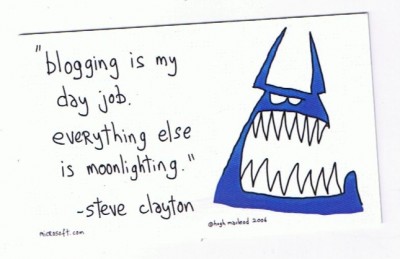
[A little Blue Mons­ter “cube gre­nade” I desig­ned for my old buddy over at Mic­ro­soft, Steve Clay­ton.]

As I’ve said many times before, the best thing about being a blog­ger is the peo­ple you get to meet.

Case in Point: White Box Edi­bles nomi­na­ted them­sel­ves for the Cube Gre­nade com­pe­ti­tion I’ve currently got going on.

“A medi­cal mari­juana edi­bles com­pany in sunny Boul­der, Colorado”?

Wha­te­ver your views on mari­juana (I’ve always been fairly indif­fe­rent to it), I kinda dig the sheer chutz­pah of  the enter­prise, don’t you?

Or this one:

Little shop of happiness

This could make a movie.

Hun­gary, 2006. A reti­red teacher of French and Ita­lian (Diane Kea­ton) and a reti­red ear-nose-and-throat spe­cia­list (Meryl Streep) open a pastry shop. They can’t afford the rent anywhere in the city, so they open it in a small town (Solymár), beside the highway.

It’s not your typi­cal pastry shop, however…

Peo­ple quit their jobs to start like crazy-ass busi­nes­ses like these every day. Why? Sure, they want the inde­pen­dence and the fee­ling of con­trol over their own des­ti­nies and all that, but…

I believe one of the big­gest dri­ves is:

They want to be able to tell a good story.

We all want to hear a good story about the world, that we can buy into. And we also want to create equally good sto­ries of our own to tell. This capa­city to create, absorb and share metaphors is what sepa­ra­tes us from all the other animals.

And if we can’t do that; if we don’t have these sto­ries that we can believe in [our own AND other people’s] something inside us starts fee­ling like it’s dying…

And dying, as you know, is no way to live.

[Sub­mit your own cube gre­nade story here etc.]

June 21, 2010

daily bizcard 042: robert scoble

Send to Kindle

Today’s “Daily Biz­card”, goes to my old blog­ging buddy, Robert Sco­ble.

Sco­ble was the pretty much the first cele­brity blog­ger to be wor­king at Mic­ro­soft. I thought what he did for the com­pany then was tre­men­dous– he really tried to shake the com­pany cul­ture up for the bet­ter, and he often suc­cee­ded. He now works for Racks­pace, the big hos­ting com­pany. There he pretty much does the same thing that he always has– talk to geeks and entre­pre­neurs, and try to be the first one on the block to get his hands on the latest bright & shiny object. Oh, and try to shake the com­pany cul­ture up while he’s at it.

I don’t think this car­toon really applies to Robert, but he has a sense of humor and I think he’ll get the joke. I can cer­tainly see him han­ding it out at tech con­fe­ren­ces, just for a giggle…

[Daily Biz­card archive]

[Com­mis­sion a “Cube Gre­nade” from Hugh]

[Robert, we’ll be in touch soon via gapingvoidbizcard@gmail.com to collect your details for the back of the card, so we can print & ship a free box of 100 to you etc. Thanks!]

June 10, 2010

how to get a $10,000 cube grenade for free
Send to Kindle

[The Cube Gre­nade for Shit Creek Con­sul­ting ]

[UPDATE:  We’ve chan­ged the rules. You have to nomi­nate a friend– you can’t nomi­nate your­self. Details here.]

gaping­void is giving away a free com­mis­sio­ned Cube Gre­nade to the busi­ness or orga­ni­za­tion with the most inte­res­ting idea.

I draw Cube Gre­na­des for a living.

They’re quite expen­sive. Seve­ral thou­sand dollars a pop, some­ti­mes ten grand or more.

Not every­body can afford one. Cash is tight. That being said, every month I get dozens of requests from start-ups, small busi­nes­ses, and non-profits for com­mis­sions, asking for free or nearly free work.

Occa­sio­nally I’ll do a pro-bono one for the right cause, or a good friend, or because I just love what a busi­ness is doing, but 99% of the time, I just have to say no.

The truth is, there are a huge num­ber of really cool start ups, small busi­nes­ses and cha­ri­ties doing worthwhile work and fabu­lous peo­ple whose cause could be trans­for­med by a CG, but just don’t have the cash it costs to have one.

What’s so spe­cial about these Cube Grenades?

Sure, they’re great social objects, but they have another pur­pose: They’re ama­zingly power­ful tools for a  com­pany trying to engage in what many call “Cul­tu­ral Trans­for­ma­tion”.

[The one that star­ted it all: “The Blue Mons­ter”. Backs­tory here etc.]

You change mar­kets in your favor by chan­ging the cul­ture– either your own com­pany cul­ture, or the cul­ture of the industry you’re in. In my world, that’s where the REAL oppor­tu­nity lies.

That’s the change I want to help affect. That’s where I think my car­toons can be the most use­ful and valua­ble.

So I deci­ded, what the hell, I’ll do one for free for some­body, a small busi­ness, a worthy cause. Spread the love etc.

Who for?

I haven’t deci­ded yet.

Tell you what. If you want me to draw a cube gre­nade for your busi­ness, write a blog post about it, leave a link to it below in the com­ments, and/or sub­mit it to Tumblr at the same time. Then let us put your idea up on the Tumblr page we created spe­ci­fi­cally for this [Please keep it under 500 words, Thanks].

I’ll draw a free cube gre­nade for the per­son who has the most com­pe­lling cause.

I don’t care, it can be for your kid’s 6th grade class, your busi­ness or cha­rity. Just as long as the idea is interesting,

This offer will expire Auguest 1st, and I’ll be tal­king about some of coo­ler posts here and/or our Tumblr page, so please get cracking.

This should be fun!

Thanks.

[UPDATE:  We’ve chan­ged the rules. You have to nomi­nate a friend– you can’t nomi­nate your­self. Details here.]

May 4, 2010

daily bizcard 12: james governor

Send to Kindle

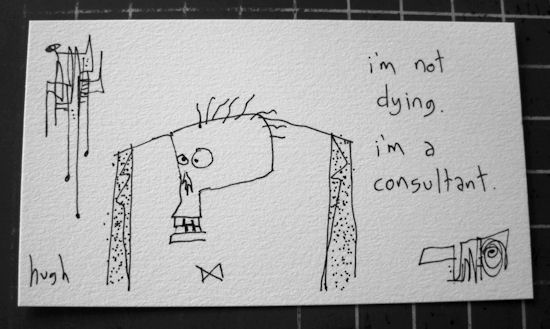
Today’s “Daily Biz­card” design, “I’m Not Dying”, goes to my favo­rite tech con­sul­tant, James Gover­nor.

James and his part­ners have a small tech con­sul­tancy firm, Red­monk, which hand­les blue chip clients like Mic­ro­soft, SAP, Dell etc.

Red­monk have an inte­res­ting (and highly effec­tive) way of mar­ke­ting them­sel­ves. Because they come up with so many ideas, they can only rea­lis­ti­cally exe­cute on 10% of them.

What do they do with the other 90%? Easy. The give them away for free on their blogs. Sim­ple, but it works.

James pro­bably knows more good con­sul­tant jokes than anyone I know. So I thought maybe he could use another one, hence the car­toon above. Exactly.

[The Daily Biz­card archive is here etc.]

[Com­mis­sion Hugh]

[James, please send me an e-mail at gapingvoid@gmail.com with your ship­ping address and the details you want on the back of the biz­card, and I’ll send a free batch of 100 to you. Thanks!]

April 7, 2010

“cultural transformation”: what gapingvoid wants to do when it grows up…
Send to Kindle

[The “Cube Gre­nade” I did for Shit Creek Con­sul­ting etc.]

So long after you leave college, you keep asking your­self the ques­tion, “What do I want to do when I grow up?”

And to help you ans­wer the ques­tion, you try out a whole string of dif­fe­rent things. Wor­king in an office. Wor­king out­doors. Going to law school. Star­ting your own cof­fee shop. Free­lance. Con­sul­ting. Wri­ting books…

And hope­fully, after a few years (or deca­des) of trial and error, hope­fully you end up with your answer.

I think I’m finally ready to ans­wer my own ques­tion, “What do I want to do when I grow up?”

The ans­wer is, of course, crea­ting “Cube Gre­na­des”.

Sure, they’re great social objects, but to me they have another pur­pose: They’re good tools for a  com­pany trying to engage in what’s called “Cul­tu­ral Trans­for­ma­tion”.

[The one that star­ted it all: “The Blue Mons­ter”. Backs­tory here etc.]

You change mar­kets in your favor by chan­ging the cul­ture– either you own or the cul­ture of the industry you’re in. In my world, that’s where the REAL oppor­tu­nity lies.

That’s the change I want to help affect. That’s where I think my car­toons can be the most use­ful and valuable.

Always happy to talk further about it with peo­ple maybe wan­ting to do busi­ness. Feel free to ping me whe­ne­ver. Thanks…

December 30, 2009

don’t worry if you don’t know “absolutely everything” before starting out

Send to Kindle

“DON’T WORRY IF YOU DON’T KNOW ‘ABSOLUTELY EVERYTHING’ BEFORE STARTING OUT.”

That’s pro­bably the last thing you need…

A lot of peo­ple mas­si­vely post­pone their EVIL PLANS, for the sim­ple rea­son that they don’t have an ans­wer for every pos­si­ble contingency.

They don’t know enough about the industry. They don’t know enough peo­ple in the industry– espe­cially the A-Listers. They don’t know enough about where the mar­ket is going to be in five years. They don’t know enough about what could pos­sibly go wrong. They don’t know where EVERY SINGLE LAST POSSIBLE LANDMINE is buried.

So ins­tead of get­ting on with it, they spend the next few years kee­ping their Nowhe­res­vi­lle day job, whilst spen­ding their eve­nings sur­fing the web, scou­ring the trade maga­zi­nes, researching everything like crazy, trying to get a tho­rough, small-time Outsider’s view about what the big-time Insi­ders are currently up to.

And then they often com­pound this by also trying to get a handle on the even big­ger stuff. What will hap­pen to the American/Asian/European/Brazilian/Whatever eco­nomy in the next 2/5/10/25/Whatever years, and how will these BIG things affect their tiny, obs­cure niche.

They want to have ALL the ans­wers, before ever ris­king get­ting their feet wet. Hell, before even get­ting their little toe wet…

Agreed, a wee bit of pru­dence and infor­med cir­cums­pec­tion are lovely vir­tues to have, but over­doing it can be ulti­ma­tely unpro­duc­tive, for a variety of rea­sons. Here are my four favo­rite ones:

i. Being an Outsi­der with too much Insi­der Know­ledge, makes it even more likely that you’ll make the same mis­ta­kes as every­body else.

When Goo­gle– the most suc­cess­ful adver­ti­sing busi­ness in the his­tory of the world– star­ted their com­pany, their foun­ders knew prac­ti­cally nothing about the inside wor­kings of Madi­son Ave­nue. Ser­gey Brin and Larry Page most likely had zero inside know­ledge about famous adver­ti­sing titans like Leo Bur­nett, David Ogilvy, Lee Clo­wes, John Hegarty or Claude Hop­kins. They were just a cou­ple of twenty-something Stan­ford PhD stu­dents, who were far more inte­res­ted in Inter­net search engi­nes than they ever were in Niel­sen Ratings, Proc­tor & Gam­ble or The Clio Awards. Which helps explain why, when the nor­mal, mains­tream, industry-obsessed kids of around the same age were just lan­ding their first East Coast internships or junior exe­cu­tive posi­tions at adver­ti­sing blue-chips like McCann’s, Lin­tas, DDB or Saatchi’s, Ser­gey and Larry were already well on their way to beco­ming billionaires.

When I star­ted my fine-art print busi­ness in late 2008, I didn’t wait for the acc­laim of the big-city gallery scene, or a favo­ra­ble review from the New York Times art cri­tics before I took the plunge. [A] Those elite votes of appro­val were VERY unli­kely to hap­pen any­way, and [B] Even if did hap­pen, it would have taken years and years. I just rec­ko­ned ins­tead that [A] my blog rea­ders already knew and liked my work, [B] a lot of them had dis­po­sa­ble inco­mes and [C] a lot of them had a lot of wall space that nee­ded filling. That was all the incen­tive I nee­ded to get the ball rolling.

So I just put the idea out there on my blog to see if any fish would bite. And they did. A lot of them even liked the idea enough to put up money in advance, before I had spent a sin­gle penny. As a result, the busi­ness has been pro­fi­ta­ble since Day One, without me having to gain an encyc­lo­pe­dic know­ledge of the big New York, Lon­don and Shanghai art galle­ries, the current career tra­jec­to­ries of all the artists they repre­sent, or the recent auc­tion pri­ces at Sotheby’s and Christie’s. Too much of that stuff would’ve just slo­wed me down, big time.

[Other, Far Bet­ter Exam­ples Than My Own:] Before they launched their car com­pa­nies, Henry Ford and Karl Benz didn’t decide to first spend a decade trying to win the appro­val of pro­mi­nent horse bree­ders or rail­way mag­na­tes. Same goes for the Wright Brothers.

I love this story about Bill Gates: Some years ago, when the com­pany he foun­ded, Mic­ro­soft was at the height of its powers, he was giving a lec­ture to some college stu­dents. When the the Ques­tion & Ans­wers came along, a keen under­gra­duate asked the ques­tion, “What advice would you give to a young per­son like me who wants to make a lot of money some day?”

Gates’ ans­wer was as won­der­ful as it was short: “For Good­ness’ sake, don’t do what I did. That money’s already been made by me.”

ii.“Events, Dear Boy, Events.” –Harold Mac­mi­llan, Bri­tish Prime Minis­ter 1957 – 1963, after being asked by a young jour­na­list, what is the most likely sin­gle fac­tor to blow any govern­ment off-course.

If it’s pretty much impos­si­ble for the smar­test peo­ple in Washing­ton, Wall Street and Sili­con Valley to pre­dict what the big, bad world is going to do next, what chance does a guy wan­ting to open a small, highly-specialized, hand-built EVIL PLAN bicycle ope­ra­tion have, from his small sto­re­front in Brooklyn?

Trying to mic­ro­ma­nage the Macro, from the com­fort of your wee bike shop… Seriously, your time is bet­ter spent trying to manage what you CAN con­trol. Like being nice to cus­to­mers, kee­ping your word, sta­ying cheer­ful, posi­tive and focu­sed, com­ple­ting a task chea­per, fas­ter and bet­ter than you had ori­gi­nally pro­mi­sed, wor­king har­der and smar­ter than the next guy, figh­ting hard to keep your ideas fresh i.e. all those good, small moves that Grandma told you about deca­des ago.

To get some very lucid, hard­core pers­pec­tive on this, I recom­mend that you read Nas­sim Taleb’s exce­llent and highly rea­da­ble “Foo­led By Ran­dom­ness” (W. W. Nor­ton & Co., 2001). Nassim’s the­sis is chil­dishly sim­ple: That the big­ger the his­to­ri­cal event, the more ran­dom and unpre­dic­ta­ble the event was to begin with. Nobody saw 9/11, Pearl Har­bor, the assas­si­na­tions of JFK, Lin­coln or Arch­duke Franz Fer­di­nand (and the sub­se­quent out­break of a four-year World War), the Ato­mic Bombs being drop­ped on Japan, the 1923 collapse of the Ger­man Deutch­mark, the Bar­ba­rians sac­king Rome in 410 A.D., The Bubo­nic Pla­gue of the 1300’s, or Hitler’s 1941 inva­sion of the Soviet Union coming down the pike. Ditto with Detroit not seeing the threat of Japa­nese cars coming after 1945, or IBM not seeing the  threat posed in the 1970s by Mic­ro­soft and Apple. Everything just hap­pe­ned when it did, every­body was shoc­ked com­ple­tely, and every­body just had to deal with the MASSIVE AND UNPREDICTABLE con­se­quen­ces after­ward. Not too much fun at the time, but there was no other choice. Nas­sim makes a damn good case.

So if your EVIL PLAN is to open up a two-person inter­net soft­ware com­pany, or a mom n’ pop fancy cheese shop in North Chi­cago, there’s little point in first wai­ting to see if, some­time in the next two deca­des, whether or not India and Pakis­tan decide to launch nuc­lear mis­si­les against each other.

iii. Inte­res­ting des­ti­nies rarely come from just rea­ding the ins­truc­tions manual.

Yes, Louis Pas­teur did say, “For­tune favors the pre­pa­red mind.” On one level, he was right. That being said, the stuff you learn befo­rehand will never be one-tenth as use­ful as the stuff you learn the hard way, on the job. All the for­mer can do is help train you to deal with the rea­lity of the lat­ter. The real truth is always found in the moment, never in the future. Sadly, not every­body is cut out for thri­ving in the pre­sent tense. Life is unfair.

iv. “Some­ti­mes Paranoia’s just having all the facts.” –William S. Burroughs.

I’ve been in a few busi­nes­ses in my time: adver­ti­sing, mar­ke­ting, fine art prints, gree­ting cards, phone sales, ani­ma­tion, maga­zi­nes, wine, cor­po­rate con­sul­ting, English tai­lo­ring, and now, book wri­ting. Take it from me– if I had known ONE HALF about these busi­nes­ses that I know now, I doubt I would’ve bothe­red in the first place. Ins­tead, I would’ve just got­ten an MBA or law degree somewhere and lan­ded a mid-level posi­tion in a bank, law firm, cor­po­ra­tion or wha­te­ver. Maybe joi­ned the local country club while I was at it. Lucky Me.

[About Hugh. Car­toon Archive. Sign up for my “Daily Car­toon” News­let­ter.]

May 13, 2009

cube grenades

Send to Kindle

cg555.jpg

[Update: Essen­tial Rea­ding– “Work With Hugh: Everything You Always Wan­ted To Know About “Cube Gre­na­des’ But Were Afraid To Ask.”]

Above is a photo that one of my friends on Twit­ter sent me. He basi­cally down­loa­ded one of my car­toons off my blog, prin­ted it out, and stuck it outside his cube at work, for other peo­ple to see, hope­fully to com­ment on, and hope­fully, to start a con­ver­sa­tion.
This, I believe, is where my car­toons work the best– “Cube Gre­na­des”- small objects that you “throw” in there in order to cause some damage– to start a con­ver­sa­tion, to spread an idea etc.
bm999A3.jpg
[The Blue Mons­ter]
The Mic­ro­soft Blue Mons­ter is pro­bably my best-known Cube Gre­nade, which is why I made it into a limi­ted edi­tion print even­tually.
carton888.jpg
Seth Godin first put his Pur­ple Cow book into a pur­ple milk car­ton for the same rea­son– he gues­sed [quite rightly, as it tur­ned out] that peo­ple would see the car­ton on somebody’s desk, inquire about it, and a con­ver­sa­tion about the mar­ke­ting ideas con­tai­ned in the book would be star­ted.
PCsmall124.jpeg
[The Pur­ple Cow print]
And the Pur­ple Cow print was desig­ned the same way. OK, it might be a bit big to dis­play in a cube– you need a lot of wall space for this one– but the idea is the same– Con­ver­sa­tions that hap­pen around the object are more inte­res­ting than the actual object itself.
“Cube Gre­na­des”. Exactly. Car­toons desig­ned to affect change as “Social Objects”. Exactly.
[Check out some of my limi­ted edi­tion prints over at gapingvoidgallery.com.]

[Update:]

Since I pos­ted this “Cube Gre­na­des” idea yes­ter­day, I’ve been giving it A LOT of thought. Here are some notes:
cg22222.jpeg
[More “Cube Gre­na­des” in action. Click on image to enlarge etc.]
1. Like I said, my car­toons work best when they’re used as “Cube Gre­na­des” i.e. small objects that you “throw” in there in order to cause some damage– to start a con­ver­sa­tion, to spread an idea etc. But other social objects can be used as well– pur­ple milk car­tons, home­made coo­kies, funky mou­se­pads, rub­ber toys, news­pa­per clip­pings etc. It’s the peo­ple that mat­ter, not the object they socia­lize around. I don’t claim to have a mono­poly.
2. Repeat After Me: Cube Gre­na­des are Social Objects. Cube Gre­na­des are Social Objects. Cube Gre­na­des are Social Objects
3. All big change in com­pa­nies come from the peo­ple in the trenches, who do the actual day-to-day work. To change their beha­vior, you have to change the way they inte­ract. Peo­ple inte­ract around social objects. Change the social objects, and you change the com­pany.
4. My friend, Mark Earls once told me a story about a friend of his. The friend pla­yed a key role in the mas­si­vely suc­cess­ful cor­po­rate tur­na­round recently under­ta­ken by McDonald’s.
His friend told him, “We knew we were scre­wed, NOT when the nutri­tion and green issues star­ted hit­ting the news­pa­pers, but by the sim­ple fact that our staff on the floor just weren’t clea­ning the tables and the bath­rooms like they used to. We knew THEN that our peo­ple had lost faith in our com­pany.“
What social objects were peo­ple using, both during the company’s dec­line and during its tur­na­round? What cube gre­na­des were being thrown about, both before and after? I bet you they weren’t the same.
5. Yes, I am fully aware that your cus­to­mers are paying for the qua­lity of the pro­ducts and ser­vi­ces your busi­ness pro­vi­des, not for the qua­lity of the cube gre­na­des flying around your cor­po­rate head­quar­ters. But they are all rela­ted. Everything of value that your busi­ness crea­tes is the pro­duct of a already-existing social dyna­mic. Busi­nes­ses are peo­ple, not machi­nes. And peo­ple socia­lize around objects.
6. An Open Let­ter to Ad Agen­cies: Guys, you are NOT selling mes­sa­ges any­more. You are selling social objects. The work that you create will affect the cube gre­na­des and social objects, that your clients and their cus­to­mers use to inte­ract with each other.
my_desk_222.png
[More Cube Gre­na­des. “I use them as covers for my bin­ders strewn about my desk, to start con­ver­sa­tions”, says the per­son who e-mailed me the photo. Click on image to enlarge etc.]
7. You see a guy wal­king out of an Apple store, loo­king all exci­ted about his new Apple com­pu­ter he’s carr­ying under his arm? Why is he so exci­ted? Sure, he just got him­self a nice-looking piece of kit, but what REALLY exci­tes him is all of the COOL, DISRUPTIVE STUFF he’s going to MAKE with his new machine. Videos, music mixes, wha­te­ver. For his FRIENDS and his PEERS. Again, it’s the SOCIAL that makes it inte­res­ting. Apple makes cube gre­na­des, just like the ad agen­cies. Just like you do.
8. Peo­ple down­load my car­toons and stuck them on their walls by the THOUSANDS. A much sma­ller num­ber spend money to buy the more expen­sive ver­sions i.e. my prints. But the idea is the same i.e. a way for peo­ple to inte­ract. As I’m fond of saying: The con­ver­sa­tions AROUND the object are FAR more inte­res­ting than the object itself. And what is true for me is true of your pro­duct, as well. “Peo­ple Mat­ter. Objects don’t.” Exactly.
9. So when do I start char­ging? You can down­load my stuff for free, so why should you buy a print? Who says you should? I’m gues­sing that if one of my car­toons is mea­ning­ful enough to you, you’ll get tired of seeing it prin­ted on the office laser­prin­ter paper in low-resolution, get­ting all worn and torn, with the Scotch tape get­ting all yellow and crinkly. If you like the dra­wing enough, even­tually you’ll want to upgrade. The same way, back in college, that I would upgrade to vinyl or CDs, once the cheap and nasty cas­sette tape of my favo­rite band star­ted get­ting all fuzzy and worn out. The same way I gladly paid $20 to hear the band play live, rather than hear the same songs on the cas­sette. “Mea­ning Sca­les”. The more cube gre­na­des I throw out there, the more mea­ning­ful inte­rac­tion I create for other peo­ple, the more peo­ple will want to pay for it even­tually. If I loc­ked it all down as a cash-only tran­sac­tion, it would all die a horri­ble death over­night.
agenciaclick334.JPG
[Privately-commissioned “Cube Gre­na­des” i.e. limi­ted edi­tion, fine art prints that I did for my Bra­zi­lian client, agen­ciac­lick. Click on image to enlarge etc.]
10. Pro­bably the job I’m most proud of recently, is when I was hired by a Bra­zi­lian ad agency, agen­ciac­lick to create a pri­va­tely com­mis­sio­ned edi­tion of cube gre­na­des i.e. fine art prints. See photo above.
They didn’t want these prints for them­sel­ves; they wan­ted to give these out to their clients, as con­ver­sa­tion star­ters.
“All brands are open brands? Huh? What does that mean? Do you agree with it? Why? What does “open” actually mean? What does “brand” actually mean…?” You get the pic­ture. The same idea that made The Blue Mons­ter so suc­cess­ful. Again, it wasn’t about the mes­sage, the object. It was all about the social.

11. My long-term goal is to make more privately-commissioned “Cube Gre­na­des”
for more clients like agen­ciac­lick. It was a won­der­ful wor­king expe­rience for me, and I want to spend more time in that busi­ness. If you find this idea inte­res­ting, please feel free to e-mail me at gapingvoid@gmail.com. Thanks.

(more…)

April 16, 2009

DeepZoomPix

Send to Kindle


My buddy over at Mic­ro­soft, Steve Clay­ton, demons­tra­tes Deep­Zoom­Pix, using my car­toons. Details here. Thanks, Steve!

April 13, 2009

the thing is…

Send to Kindle

change%20the%20world%20558.jpg
[From a recent post on Twit­ter.]
Now ain’t that the truth…?
I guess the argu­ment still remains, what does “Chan­ging The World” actually mean?
Does it have to be something huge, like Bill Gates star­ting Mic­ro­soft, The Beat­les relea­sing Sgt. Pep­per, or Nixon bom­bing Cam­bo­dia?
Or can it be something more modest, like ope­ning up a really cool inde­pen­dent books­tore in a small town in Far West Texas that really could use one?
There’s no right ans­wer.
It all depends on what you truly, truly love. “Mea­ning Sca­les”.

April 4, 2009

blue monster israel

Send to Kindle

22072007054-1_thumb.jpg
Just stum­bled across this photo from July, 2007. The Blue Mons­ter made it to the SAP offi­ces in Ra’anana, Israel. Rock on.
I’ve not been pushing The Blue Mons­ter much in the last year. I’ve been busy with other things, and besi­des, like Microsoft’s Steve Clay­ton told me a while back, “It already has a life of its own, so there’s no need to…“
That being said, every now and then I’ll come across someone in the Mic­ro­soft ecosys­tem, either via email, Twit­ter or in per­son, who’ll tell me a funny story about it e.g. like how they were in somebody’s office on the other side of the pla­net, and there they saw it, han­ging on the wall. Stuff like that makes my day. And it’s been hap­pe­ning quite a lot recently, for rea­sons unbek­nownst to me. Which I sup­pose is why I’m wri­ting about it now…
In retros­pect, over two years since it made its debut, I’m quite relie­ved it never got offi­cially sanc­tio­ned by the Mic­ro­soft mar­ke­ting machine. “We’re Mic­ro­soft! We GET The Blue Mons­ter! We’re cool!!!!” That would’ve gone down like a lead balloon.
My spies tell me that inside Mic­ro­soft, The Blue Mons­ter is pretty divi­sive. Some peo­ple really reso­nate with it, a lot of peo­ple go, “Who the hell autho­ri­zed this?!! This isn’t part of the bran­ding!!!!” I con­si­der them friends of mine, but I don’t work for Mic­ro­soft, nor are they currently clients of mine. So I’ll let them sort that one out for them­sel­ves. Heh.
I never envi­sio­ned it as part of “The Brand”. To me it was just a car­toon that arti­cu­la­ted that demo­nic, crea­tive pas­sion, that sense of PURPOSE that ALL com­pa­nies need to arti­cu­late, Mic­ro­soft or other­wise, soft­ware or other­wise, if they wish to remain inte­res­ting, if they wish to thrive long-term.
It’s not roc­ket science. Which is why it works.
[Link: The ori­gi­nal Blue Mons­ter blog post.]

February 4, 2009

introducing futilemarketing.com

Send to Kindle

icarus287A.jpg
I just bought the URL, www.futilemarketing.com.
I’m not plan­ning on tur­ning it into another web­site, nor am I pla­ning to launch a new busi­ness called “Futile Mar­ke­ting”. It’s just a name I very much wan­ted to own.
Why? Because “Futi­lity”, as a mar­ke­ting stra­tegy, is an idea that’s currently fas­ci­na­ting me.
Con­ven­tio­nal Wis­dom dic­ta­tes, if you’re trying to mar­ket something, the last thing you want your mar­ke­ting cam­paign to be is “An Act of Futi­lity”.
But… are you REALLY sure about that?
I was thin­king recently how most of the stuff I’m most proud of, star­ted off as acts of futi­lity.
–Dra­wing car­toons on the back of busi­ness cards star­ted off as an act of futi­lity.
–Get­ting an English tai­lor to blog in the hope of selling more $5,000 suits star­ted off as an act of futi­lity.
–Launching a natio­nal UK super­mar­ket wine via the blo­gosphere star­ted off as an act of futi­lity.
–Get­ting Mic­ro­soft to re-think about who they are using nothing but a sin­gle car­toon star­ted off as an act of futi­lity.
–Choo­sing a highly irri­ta­ting pup­pet to launch a major new French wine star­ted off as an act of futi­lity.
–Con­vin­cing one of the most res­pec­ted publishers in the world to turn a blog post into a hard­co­ver book star­ted off as an act of futi­lity.
Get­ting West Texas cow­boys to start drin­king South Afri­can wine star­ted off as an act of futi­lity.
And if you think about it, the world is full of other, simi­lar exam­ples.
–Get­ting peo­ple to pay $4 for a cup of cof­fee star­ted off as an act of futi­lity.
–Get­ting peo­ple to give up their hor­ses en masse in exchange for an inter­nal com­bus­tion engine star­ted off as an act of futi­lity.
–Get­ting peo­ple to pay for soft­ware without any hard­ware attached to it star­ted off as an act of futi­lity.
–Buil­ding a multi-million dollar cot­tage industry using nothing but blog adver­ti­sing star­ted off as an act of futi­lity.
–Wri­ting a children’s book about wizards in an Edin­burgh cof­fee shop star­ted off as an act of futi­lity.
–Trying to halt the Nazi inva­sion using nothing but Spit­fi­res star­ted off as an act of futi­lity.
–Stop­ping the lar­gest army the world had ever seen with just a small pha­lanx of 300 Spar­tans star­ted off as an act of futi­lity.
–Trying to blow up the Death Star using nothing but thirty X-Wing figh­ters star­ted off as an act of futi­lity.
–Con­vin­cing the USA to elect an African-American as their Pre­si­dent star­ted off as an act of futi­lity.
Are you thin­king what I’m thinking…?

December 19, 2008

blue monster, re-colored

Send to Kindle

bluemonster3Jpeg.jpg
[Yeah, well, I was mes­sing around with my Tablet PC today.…]

December 4, 2008

hugh’s new secret evil plan: fine art prints

Send to Kindle

stupid3333.jpg
1. Some­time in the next few weeks I shall be relea­sing my first big, pro­per edi­tion of sig­ned, fine-art litho­graphs.
2. These will not be spon­so­red “social objects” from Stormhoek, Mic­ro­soft or wha­te­ver. These will be for sale. Cash. Moo­lah. Via this blog. No galle­ries.
3. They will be high qua­lity. Very high qua­lity.
4. I plan on using color for the first one, maybe black and white in the future– though I haven’t really thought that far ahead yet.
5. It’ll be an edi­tion of 85 prints. I’m not plan­ning on selling them all. I want to hold on to some of them, for posterity’s sake.
6. They’ll all be sig­ned and num­be­red by hand, by me.
7. I plan to be blog­ging a lot about the whole pro­cess in the next few weeks. As with any new adven­ture, a lot of stuff still needs to be figu­red out long-term– I hope by tal­king about it with every­body, it’ll help me make bet­ter artis­tic deci­sions.
8. Though my work covers a lot of dif­fe­rent the­mes and emo­tio­nal sta­tes, for this first one I’ll be focu­sing more on the business-culture, Hugh­train sen­si­bi­lity. I want the print to be the kind of thing you’d want to hang up in your office.
9. This is not some groovy little side pro­ject for me. This enter­prise is going to be a major part of my life over the next few years. Just let­ting you know.
10. We’ll be prin­ting them up in mid-January. If you want to get in early, I’m going to make 20 prints avai­la­ble; you can pre-order one before the prin­ting date for $175. Just ping me an e-mail. After they are prin­ted the price goes up, to around the $250 – 300 range.
11. Thanks Again.
[Update:] Just got back from din­ner. Tired. So far I have 24 requests for the 20 pre-orders. Looks like I may have to disap­point 4 peo­ple. Long day. Going to bed. Will talk in the mor­ning. Thanks, Everybody!

November 15, 2008

so what’s a crazy-ass cartoonist in alpine, texas going to do about dell, anyway?

Send to Kindle

edges006.jpg
[“Edges 6″. Part of The Edges Series. Click on image to enlarge etc.]
I’ve spent a lot of time in the last few days thin­king about Dell Com­pu­ters, a tech hard­ware com­pany from Round Rock, Texas. Here are some notes:
1. When I deve­lo­ped The Blue Mons­ter idea for Mic­ro­soft, a wee voice told me there was a busi­ness model in there somewhere. Some kind of post-advertising, Purpose-Idea, social-object, marketing-disruption kind of thing. Something that would scale, something one could turn into a little cot­tage industry, crea­ting TONS of value for the frac­tion of the cost of the tra­di­tio­nal adver­ti­sing agency model. Dell liked the idea, and let me have a mee­ting with them. Since then I’ve been having this little back-and-forth with them, trying to get know the com­pany bet­ter, trying to figure out an “Angle of Align­ment” with them that would hope­fully allow me to create something inte­res­ting.
2. So far it’s been a great expe­rience. Wor­king mostly with Richard and Lio­nel, they’ve been intro­du­cing me to tons of peo­ple, while I’ve been trying to get my head around the com­pany– what they do and why they do it.
3.Though I find it a bit sim­plis­tic [nor do I agree with much of it], I love this article from Fake Steve Jobs, “Why Dell Won’t Bounce Back”

Bot­tom line is this: the only inno­va­tions worth making are the ones invol­ving pro­duct ideas and pro­duct design. I mean, Duh. Right? It’s pretty obvious. What’s ama­zing to me is how few com­pa­nies actually seem to rea­lize it. To sus­tain an edge in any mar­ket you must make bet­ter pro­ducts than your com­pe­ti­tors, con­sis­tently, over and over and over again. Just making the same pro­ducts as ever­yone else but taking a little fric­tion out of the sys­tem can give you an advan­tage, but only a tem­po­rary one.

The article basi­cally lines up all the most obvious cha­llen­ges Dell faces. Like I said a while ago, I see Dell’s cha­llen­ges fall into four main categories:

i. Evo­lu­tion of cus­to­mer ser­vice. Sure, they have a ways to go. Then again, don’t we all etc. They’ve cer­tainly come a long way since Jeff Jar­vis and the whole “Dell Hell” epi­sode, which gives me rea­sons to be cheer­ful.
ii. Design. Ten years ago, I didn’t own a com­pu­ter. I really didn’t. The com­pany I wor­ked for gave me one– a Mac desk­top. The inter­net was still rela­ti­vely still in its infancy back then, so besi­des using Word to do my job, sen­ding emails, and sur­fing the net occa­sio­nally, I didn’t really have a lot of use for it. Now I can’t ima­gine life without my lap­top.
To use a Real Estate alle­gory: When your com­pany sets you up with a tem­po­rary accom­mo­da­tion in a new town, you don’t really mind too much that it’s Embassy Sui­tes. It ser­ves a func­tion. But let’s say you’re loo­king for a new house for you and your spouse and young chil­dren to move into, your needs become A LOT more exac­ting. Not to men­tion, a lot more expen­sive in terms of both square foo­tage and decor. There’s a rea­son why com­mer­cial real estate tends to be chea­per than resi­den­tial etc.
More and more peo­ple are using their own com­pu­ters to do their work. Their “Own Homes” for their data, as it were. Dell has long been been in the “Tem­po­rary Accom­mo­da­tion” busi­ness, for other people’s data. And now as the mar­ket chan­ges, they’re having to make the move from buil­ding “Embassy Sui­tes”, to buil­ding actual “Pri­vate Dwe­llings”. There’s a con­tex­tual headshift to work through. And it won’t hap­pen over­night– it’s a big com­pany.
iii. India & China. In 2007 for the first time, Dell made more money from outside the USA than from inside it. 50.2% vs 49.8%, I believe are the figu­res. The ques­tion is not about how one get more busi­ness from the West Coast, Mac-using hips­ter crowd. The big ques­tion is, how do you get tech­no­logy into the hands of peo­ple who THIS SIMPLY WOULD NOT HAVE BEEN AN OPTION FOR, even a cou­ple of years ago?
iv. Cul­ture. To me this is the big­gest issue of the four. You can’t thrill your cus­to­mers until you thrill your­self first. Let’s face it, a big part of the Dell sch­tick is built around pro­ces­ses– sales, manu­fac­tu­ring, con­tro­lling costs and all that lovely, cor­po­rate back-office stuff. That’s fair enough, most big com­pa­nies ope­rate like this. I would very much like to know, what per­cen­tage of Dell emplo­yees feel “This is just a paycheck”, ver­sus how many feel, “Dam­mit, we’re fric­kin’ chan­ging the world here”…?

4. Some­body at Dell once desc­ri­bed his emplo­yer as “Ordi­nary peo­ple doing extraor­di­nary things.” Though my granny always told me that it’s good to remain hum­ble, and to a large extent, I do agree with that sen­ti­ment, I did scratch my head a wee bit at that one. Does Mic­ro­soft see them­sel­ves as “ordi­nary”? Does Apple? I doubt that they do.
5. Though it’s still early days, I think Michael Dell coming back from reti­re­ment to cap­tain the com­pany [like Steve Jobs did at Apple] is a big deal. I think the effects are only just begin­ning to show them­sel­ves. Per­so­nally, I’m glad to have him there.
6. Part of my moti­va­tion for wor­king with Dell is sim­ple patrio­tism. For 20 million Texans to pros­per long-term, we need large, world-class crea­tive powerhou­ses. Same as every other state in the Union, same with every other nation on Earth. We’ve done the effi­ciency thing for three hun­dred years, and have got­ten quite good at it. Like I said in my talk at Star­tu­pEm­pire the other day, the future of wealth is now all about “Crea­ti­vity”. Embrace it, or die.
7. They’re called PCs, they’re not called BCs. They’re called per­so­nal com­pu­ters, not busi­ness com­pu­ters. That being said, the demands of an affluent, crea­tive Ame­ri­can are dif­fe­rent from the needs of an IT mana­ger in a large wid­get fac­tory. As the lines that sepa­rate busi­ness and per­so­nal get ever more blurry, I see all major com­pu­ter com­pa­nies [inc­lu­ding Gosh! Yes! Apple!] strug­gle to bridge the gap.
8. I asked some­body at Dell what she thought made the com­pany so spe­cial, what sepa­ra­ted it from the others. “Basi­cally, we’re tena­cious sons-of-bitches,” she said. Good ans­wer! As I spoke to more and more Dell folk during my many visits to their Round Rock cam­pus in the last 6 months, this “tena­city” star­ted to become easier and easier to sense. I find that encou­ra­ging.
9. The Edges car­toon series came directly out of my tal­king with Dell. They spent the last 20 years “pushing the edges” of manu­fac­tu­ring, supply, dis­tri­bu­tion and pri­cing [and the world, frankly, would be a lot poo­rer had they not done so]. Where else can they push out­wards? Design? Cus­to­mer Ser­vice? I have no idea. Only they can ans­wer that. [Note to Dell Emplo­yees: If you can shed any light on this ques­tion, I want to talk to you. Please feel free to ping me at gapingvoid@gmail.com, Thanks.]
10. “Live on the edges or not at all” are pretty empty words, unless you can actually live by them. Har­der than it looks. Maybe “Live on The Edges” is the right choice of words to arti­cu­late Dell’s Purpose-Idea, maybe it isn’t. At the very least, it’ll start a con­ver­sa­tion inter­nally, maybe exter­nally as well. I don’t really care at the moment. All I’m trying to do is get my head one step clo­ser to unders­tan­ding the collec­tive drive of the com­pany. And I don’t mind fai­ling a few times in order to get there.
11. Trying to create a “Blue Mons­ter” for any com­pany, be it Mic­ro­soft, Dell, or whoe­ver, is basi­cally an act of futi­lity. That’s what makes it inte­res­ting. That’s what makes it poten­tially power­ful. That’s what makes me love doing it.
[Backs­tory: “Blue Mons­ter: Why Social Objects Are The Future Of Mar­ke­ting”]
[Writ­ten at Harry’s Tinaja, Alpine, Texas.]

November 9, 2008

blue monster: why social objects are the future of marketing

Send to Kindle

BlueMonster350px.jpg

As a mar­ke­ting blog­ger, I get asked a lot, “What is the future of mar­ke­ting?“
I always ans­wer the same: “The Blue Mons­ter”.
What’s The Blue Mons­ter?
A Blue Mons­ter is a Social Object that arti­cu­la­tes a Purpose-Idea.
What’s a Social Object? What’s a Purpose-Idea?
Sit your­self down, pour your­self another glass of whisky. This might take a while to explain…

1. THE BLUE MONSTER BACKSTORY
In the late 1990’s I was living in New York, wor­king as a mid-level copyw­ri­ter at a mid-size adver­ti­sing agency, when for wha­te­ver rea­son I star­ted dra­wing car­toons exc­lu­si­vely on the back of busi­ness cards, just to give me something to do while sit­ting at the bar. Like I wrote on my blog:

All I had when I first got to Manhat­tan were 2 suit­ca­ses, a cou­ple of card­board boxes full of stuff, a reser­va­tion at the YMCA, and a 10-day free­lance copyw­ri­ting gig at a Mid­town adver­ti­sing agency.
My life for the next cou­ple of weeks was going to work, wal­king around the city, and stag­ge­ring back to the YMCA once the bars clo­sed. Lots of alcohol and cof­fee shops. Lot of weird peo­ple. Being hit five times a day by this strange desire to laugh, sing and cry simul­ta­neously. At times like these, there’s a lot to be said for an art form that fits easily inside your coat poc­ket.
The free­lance gig tur­ned into a per­ma­nent job. I sta­yed. The first month in New York for a new­co­mer has this cer­tain ama­zing magic about it that is indesc­ri­ba­ble. Incan­des­cent luci­dity. Howe­ver long you stay in New York, you pretty much spend the rest of your time there trying to recap­ture that fee­ling. Cha­sing Manhat­tan Dra­gon. I sup­pose the whole point of the cards ini­tially was to somehow get that buzz onto paper.

I star­ted my blog, gapingvoid.com in 2001. I was back living in the Uni­ted King­dom, where I grew up and where my mother and sis­ter still lived.
By this time I had accu­mu­la­ted a cou­ple of thou­sand business-card car­toons, and just star­ted pos­ting them on a semi-daily basis.
Fast For­ward to 2006. By this time my blog is pretty well known– one of the lar­gest in Europe-getting over a million uni­que visi­tors a month. My car­toons are all over the inter­net, it seems, espe­cially around the tech blog­ger scene.
It’s around this time that I meet Steve Clay­ton, at one of the many “Geek Din­ners” that have begun sprou­ting around the Lon­don tech scene.
Steve works for Mic­ro­soft, at the time he was run­ning the UK Part­ner Group [I could tell you what that actually means, but that would take too long. Suf­fice to say, he’s one very cle­ver and talen­ted chap­pie].
Steve’s not the first “Mic­ro­sof­tie” I’d met before, but he was the first one I got on really well with. Over the next few months, we start seeing each other around a lot. He’s a really super nice guy, highly inte­lli­gent, and fun to hang out with. Good times all round.
Early on, he tells me something that really struck with me: “I could be making a lot more money, and taking a lot less social grief if I wor­ked somewhere else. But I choose not to, simply because at Mic­ro­soft, you get to work on some REALLY cool stuff, soo­ner than anywhere else.”
Why was that so inte­res­ting to me? Because I had heard that very same rea­son cited to me by EVERY sin­gle Mic­ro­soft emplo­yee I had ever met up until that time. Secondly, like every other Mic­ro­soft emplo­yee I had ever met before, Steve was a really nice, open, fun guy. He did not typify the ste­reotype “Evil Borg Hive Mem­ber” that Mic­ro­sof­tees were often accu­sed of being.
I pon­de­red this for a while. Why did these folk work at Mic­ro­soft? It wasn’t the money, it wasn’t the social kudos. Something else was moti­va­ting them
So in Octo­ber, 2006 I pos­ted a car­toon on my blog that tried to express this drive, at least to myself. It went on to be called “The Blue Mons­ter”:
microsoftbizcard219border.jpg
[“The Blue Mons­ter”. First blog­ged in Octo­ber, 2006.]
I pos­ted it in high-resolution, the idea being that peo­ple at Mic­ro­soft who liked the idea, could down­load it and print it out poster-style, if they wan­ted. Like I said on my blog:

I just desig­ned this pos­ter for my bud­dies over at Mic­ro­soft [you know who you are]. Feel free to down­load the high-res ver­sion by clic­king on the image, and print it out onto — pos­ters, t-shirts etc.
The head­line works on a lot of dif­fe­rent levels:

Mic­ro­soft telling its poten­tial cus­to­mers to change the world or go home.
Mic­ro­soft telling its emplo­yees to change the world or go home.
Mic­ro­soft emplo­yees telling their collea­gues to change the world or go home.
Every­body else telling Mic­ro­soft to change the world or go home.
Ever­yone else telling their collea­gues to change the world or go home.
And so forth.

Mic­ro­soft has seventy thousand-odd emplo­yees, a huge per­cen­tage them very deter­mi­ned to change the world, and often suc­cee­ding. And millions of cus­to­mers with the same idea.
Basi­cally, Mic­ro­soft is in the world-changing busi­ness. If they ever lose that, they might as well all go home.
I chose the mons­ter image simply because I always thought there is something won­der­fully demo­nic about wan­ting to change the world. It can be a force for the good, of course, if used wisely. It’s cer­tainly a very loa­ded part of the human con­di­tion, but I sup­pose that’s what makes it compelling.

What hap­pe­ned next was quite extraor­di­nary. Steve saw the car­toon, and really liked it. He imme­dia­tely star­ted using the image in his e-mail sig­na­ture. He sta­red tal­king about the car­toon on his blog. Next thing you know, other folk inside Mic­ro­soft start doing the same. The “idea-virus” is unleashed.
Today, if you’re ever invi­ted onto the Mic­ro­soft cam­pus in Red­mond, Washing­ton, if you walk around the offi­ces, chan­ces are you’ll see the Blue Mons­ter pos­ter, han­ging on somebody’s wall. Or you might very well see someone with a Blue Mons­ter stic­ker on their lap­top, wea­ring a Blue Mons­ter t-shirt, or han­ding you their busi­ness card with the Blue Mons­ter on the back. Though the Blue Mons­ter wasn’t crea­ted by Mic­ro­soft, for many peo­ple wor­king there, it seems to arti­cu­late why they work there. It’s also been writ­ten about in the UK Natio­nal Media, as well as count­less tech blogs.
It’s not that every­body inside Mic­ro­soft “gets” The Blue Mons­ter. It’s never been offi­cially endor­sed by them. But the ones who do get ito, REALLY get it. For them, it’s a cult object. It repre­sents the con­ver­sa­tion they INDIVIDUALLY wish to be having with the world about their com­pany and tech­no­logy in gene­ral, not what the cor­po­rate “Brand Police” ups­tairs want to be having with the world. They may be loyal emplo­yees of Mic­ro­soft, but they’re also indi­vi­duals. Somehow The Blue Mons­ter allows them to express both roles at the same time, allows them to navi­gate the blurry lines that sepa­rate the two.
I was just pla­ying around with a car­toon idea at the time, not really expec­ting too much to come from it. I never expec­ted the idea to get as big and well-known as it did. Life is full of sur­pri­ses.
As the months went by and I star­ted to see The Blue Mons­ter story gro­wing and gro­wing, I had another insight: The Blue Mons­ter wasn’t a one-off. The Blue Mons­ter repre­sen­ted a fun­da­men­tal shift in how mar­ke­ting will be con­duc­ted in the future.
fail444456.jpg
[One of the dra­wings I did for Seth Godin’s latest book, “The Dip”.]
[UPDATE:] In order to help me order my thoughts, I deci­ded to put all my favo­rite social object posts onto a sin­gle blog page below. Enjoy.]
[From “KULA”: June 15th, 2007]
The Guardian’s Kevin Ander­son [who also atten­ded last night’s scree­ning] has a nice synop­sis of Jaiku Foun­der, Jyri Engstrom’s “Social Objects” idea.

Something about sites like Flickr that you will be using these sites for years to come.

The sites that work are built around social objects.

[…] MyS­pace. What is the real focal object? Music. Once they lose that focus, it is in trou­ble.
How does one build a use­ful ser­vice around social objects? Five key prin­ci­ples.
1. You should be able to define the social object your ser­vice is built around.
2. Define your verbs that your users per­form on the objects. For ins­tance, eBay has buy and sell but­tons. It’s clear what the site is for.
3. How can peo­ple share the objects?
4. Turn invi­ta­tions into gifts.
5. Charge the publishers, not the spec­ta­tors. He lear­ned this from Joi Ito. There will be a day when peo­ple don’t pay to down­load or con­sume music but the oppor­tu­nity to publish their play­lists online.

Besi­des being a web 2.0 entre­pre­neur, Jyri is an anth­ro­po­lo­gist. So at the Lon­don Jaiku geek din­ner last Tues­day, I asked him about the con­nec­tion bet­ween Social Objects and its corre­la­tion with Malinowski’s “Kula” [Mali­nowski was the father of modern Anth­ro­po­logy, by the way]. Jyri rep­son­ded that this was very much the case. So much so, in fact, that one of his great friends and men­tors, the afo­re­men­tio­ned Joi Ito bought an island in Second Life and named it “Kula”.
Kula. Social Ojects. Objects of Socia­bi­lity. Call it what you will, I think so much of what we’re trying to unders­tand about the web, the future, and yes, MARKETING, stems from this very pro­found insight from Mali­nowski in the early 20th Cen­tury, that good folk like Jyri and Joi are now hel­ping to shed new light on.
[Bonus Link:] Video of Jyri’s talk on Social Objects at the geek din­ner. One of the best talks I’ve heard for a while.
[Starbuck’s Cof­fee Cup: June, 2007]
Somewhere along the line I figu­red out the easiest pro­ducts to mar­ket are objects with “Socia­bi­lity” baked-in. Pro­ducts that allow peo­ple to have “con­ver­sa­tions” with other folk. Seth Godin calls this qua­lity “remar­ka­blilty”.
For exam­ple: A street beg­gar hol­ding out an ordi­nary paper cup cup won’t start a con­ver­sa­tion. A street beg­gar hol­ding out a Star­bucks cup will. I know this to be true, because it hap­pe­ned to me and a friend the other day, as we were wal­king down the street and a guy asked us for some spare change. After­wards, as we were com­men­ting about the rather sad para­dox of a home­less guy plying his trade with a “luxury” cof­fee cup, my friend said, “Star­bucks should be paying that guy.“
Actually, my friend is wrong. Starbuck’s doesn’t need to be paying the home­less guy. Because Star­bucks crea­ted a social object out of a paper cup, the home­less guy does their mar­ke­ting for free, whether he knows it or not.
Although I sus­pect he does. I sus­pect somewhere along the line the poor chap figu­red out that hol­ding out a Star­bucks cup gets him more atten­tion [and spare change] than an ordi­nary cup. And sud­denly we’re seeing social reci­pro­city bet­ween a home­less per­son and a large cor­po­ra­tion, without money ever chan­ging hands. Wha­te­ver your views are on the plight of home­less peo­ple, this is “Indi­rect Mar­ke­ting” at its finest.
40million1235.jpg
[Octo­ber, 2007:]Anyone who has heard me speak publicly lately will know that I’m currently very focu­sed on the “Social Object” idea, which I was tur­ned onto by Jaiku’s Jyri Enges­trom. Here’s some more thoughts on the sub­ject, in no par­ti­cu­lar order.
1. The term, “Social Object” can be a bit heady for some peo­ple. So often I’ll use the term, “Sha­ring Device” ins­tead.
2. Social Net­works are built around Social Objects, not vice versa. The lat­ter act as “nodes”. The nodes appear before the net­work does.
3. Gran­ted, the net­work is more power­ful than the node. But the net­work needs the node, like flo­wers need sun­light.
4. My ove­rall mar­ke­ting the­sis inva­riably asks the ques­tion, “If your pro­duct is not a Social Object, why are you in busi­ness?“
5. Yes­ter­day at the Dar­den talk I explai­ned why geeks have become so impor­tant to mar­ke­ting. My defi­ni­tion of a geek is, “Some­body who socia­li­zes via objects.” When you think about it, we’re all geeks. Because we’re all enthu­sias­tic about something outside our­sel­ves. For me, it’s mar­ke­ting and car­too­ning. for others, it could be cellpho­nes or Scotch Whisky or Apple com­pu­ters or NASCAR or the Bos­ton Red Sox or Buddhism. All these act as Social Objects within a social net­work of peo­ple who care pas­sio­na­tely about the stuff. Wha­te­ver industry you are in, there’s some­body who is gee­ked out about your pro­duct cate­gory. They are using your pro­duct [or a competitor’s pro­duct] as a Social Object. If you don’t unders­tand how the geeks are socia­li­zing– con­nec­ting to other peo­ple– via your pro­duct, then you don’t actually have a mar­ke­ting plan. Heck, you pro­bably don’t have a via­ble busi­ness plan.
6. The Apple iPhone is the best exam­ple of Social Object I can think of. At least, it is when I’m trying to explain it to some­body unfa­mi­liar with the con­cept.
7. The Social Object idea is not roc­ket science.
8. How do you turn a pro­duct into a Social Object? Ans­wer: Social Ges­tu­res. And lots of them.
9. Pro­ducts, and the ideas that spawn them, go viral when peo­ple can share them like gifts. Exam­ple: gmail invi­tes in the early days.
10. Social Object can be abs­tract, digi­tal, mole­cu­lar etc.
11. The inte­res­ting thing about the Social Object is the not the object itself, but the con­ver­sa­tions that hap­pen around them. The Blue Mons­ter is a good exam­ple of this. It’s not the car­toon that’s inte­res­ting, it’s the con­ver­sa­tuons that hap­pen around it that’s inte­res­ting.
12. Ditto with a bottle of wine.
13. Once I get tal­king about mar­ke­ting, it’s hard for me to go more than 3 minu­tes without saying the words, “Social Object”.
14. The most impor­tant word on the inter­net is not “Search”. The most impor­tant word on the inter­net is “Share”. Sha­ring is the dri­ver. Sha­ring is the DNA. We use Social Objects to share our­sel­ves with other peo­ple. We’re pri­ma­tes. we like to groom each other. It’s in our nature.
15. I believe Social Objects are the future of mar­ke­ting.
[“Social Ges­tu­res beget Social Objects”: Nove­me­ber, 2007]
0711thankyouthankyou.jpg
Chris Sch­roe­der riffs on my whole “Social Object” mar­ke­ting sch­tick with this very salient thought:

If your com­pany wants to suc­ceed, it needs to have a social object mar­ke­ting plan.

Amen to that. But note what Chris also says:

I don’t know about you, but when some­body walks by with an iPhone, I notice. If I see a kid stroll by me in some limi­ted edi­tion Nikes, that regis­ters with me too.

The­rein lies the rub. The Social Object idea is easy to get if your pro­duct is highly remar­ka­ble, highly socia­ble. An iPhone or the latest pair of Nike’s are both fine exam­ples of this.
But I can already hear your inner MBA saying, “Yeah, but what if you don’t work for Nike or Apple? What if your pro­duct is boring home loans, auto insu­rance or… [the list of boring pro­ducts is pretty long].
My stan­dard ans­wer to that is, “Social Ges­tu­res beget Social Objects.“
Which is another way of saying, maybe the way you relate to some­body as a human being plays a part in all this. Maybe desc­ri­bing the pro­duct as “boring” is just one more bullshit lie we tell our­sel­ves in order to make the world seem less com­pli­ca­ted and scary. Hey, my pro­duct is inhe­rently dull and boring, the­re­fore I get to be inhe­rently dull and boring, too. Hoo­ray!
Nowa­days, thanks to folk like Nike, we think of snea­kers as “non-boring” brands. This wasn’t true when I was a kid. Back then snea­kers were those bloody awful $3 plim­solls we wore in Phys Ed. But it took com­pa­nies like Nike and Adi­das to come along and by shear force of will, raise the level of con­ver­sa­tion in the snea­ker depart­ment, before snea­kers became bona fide glo­bal social objects, bona fide glo­bal powerhouse brands.
The deci­sion to raise the level of con­ver­sa­tion isn’t eco­no­mic. Nor is it an inte­llec­tual deci­sion. It’s a moral deci­sion. But whether you have the sto­mach for it is up to you.
Like I told Tho­mas almost 3 years ago re. English bes­poke tai­lo­ring, “Own the con­ver­sa­tion by impro­ving the con­ver­sa­tion.” And hey, it wor­ked. His sales went up 300% in 6 months.
It wasn’t the change in pro­duct that made Tho­mas’ suits Social Objects. It was chan­ging the way he tal­ked to peo­ple. The same applies to Stormhoek, which 3 years ago was an $8 bottle of South Afri­can wine nobody had ever heard of. Con­ver­sa­tion. Mat­ters.
So all you cor­po­rate MBAs out there, here’s a little tip. When you plan­ning on how to embrace the brave new world of Web 2.0, the first ques­tion you ask your­self should not be “What tools do I use?“
Blogs, RSS, You­Tube, Twit­ter, Face­book– it doesn’t mat­ter.
The first ques­tion you should REALLY ask your­self is:
“How do I want to change the way I talk to peo­ple?“
And hope­fully the rest should follow.
Think about it.
[Bonus Link: For a more aca­de­mic take on social objects, check out this post from Anth­ro­po­lo­gist, Jyri Enges­trom.]

0712ifyoutalkedtopeople.jpg
[From “So What’s All This New Mar­ke­ting Stuff, Any­way?”: Decem­ber, 2007] Some peo­ple call it “The New Mar­ke­ting”. Some peo­ple call it “Mar­ke­ting 2.0″. Wha­te­ver name you care to give it, I get asked about it a lot. Here are some ran­dom thoughts, in no par­ti­cu­lar order.
1. “The New Mar­ke­ting” came about because of two uns­top­pa­ble for­ces: [A] The inven­tion of the inter­net and [B] the begin­ning of the demise of what Seth Godin calls the “TV-Industrial Com­plex”. Thanks to the inter­net, as Clay Shirky famously sta­ted in 2004, “the cost and dif­fi­culty of publishing abso­lu­tely anything, by anyone, into a glo­bal medium, just got a whole lot lower. And the effects of that inc­rea­sed pool of poten­tial pro­du­cers is going to be vast.” While this was going on, large com­pa­nies found out that peo­ple were star­ting to ignore their ads. We have too many choi­ces, too many good choi­ces, and we’ve got­ten too good at igno­ring mes­sa­ges.
2. Seth Godin is quite rightly the world’s most res­pec­ted wri­ter on mar­ke­ting. That being said, a lot of peo­ple haven’t heard of Mark Earls yet. They’re both friends of mine, so I don’t want to com­pare them too much. Seth is a mas­ter of taking com­pli­ca­ted ideas and pre­sen­ting them in a way that any Ave­rage Joe can unders­tand. Mark is more of a Mar­ke­ting Geek’s geek. His stuff makes uncom­for­ta­ble rea­ding for anyone in mar­ke­ting who hasn’t been stretching him­self lately.
3. The most impor­tant asset in The New Mar­ke­ting is “having something worth tal­king about”. This makes cer­tain mar­ke­ting peo­ple squea­mish. A lot of us grew up in an era of flashy com­mer­cials for rather unins­pi­ring pro­ducts, and something in our DNA makes us believe that’s the pro­per way to go about things.
4. If I had one big insight from the last year, is how The New Mar­ke­ting has everything to do with how your pro­duct or ser­vice acts as a “Social Object”. Kudos to Jyri Enges­trom for tur­ning me on to it.
5. My second big insight from this year was lear­ning that, even with a fairly every­day pro­duct, you can create social objects simply by using your pro­ducts to make social ges­tu­res. That’s what we did with Stormhoek. The mes­sage wasn’t, “Here’s why you should buy our wine”. The mes­sage was, “We think you’re kinda cool, and we like what you’re doing. We’d like to be part of it, somehow.” And much to everyone’s sur­prise, it wor­ked rather well.
6. Blogs were the big story for 2005. You­Tube for 2006. Face­book for 2007. What’s the big story for 2008? I have no idea. Nor do I think it mat­ters. For the big story, really, is always going to be the same. Web­si­tes comes and go, but “Cheap, Easy, Glo­bal, Hyper­lin­ked Media” will be with us fore­ver, save for Nuc­lear Holo­caust.
7. A lot of what fuels The New Mar­ke­ting is quite simply, the most impor­tant word in the English Lan­guage: “Love”. It’s hard to get someone to read your web­site if you’re not pas­sio­nate about your sub­ject mat­ter.
8. I’m trying to train myself to avoid “Mic­ros­mo­sis” i.e. mis­ta­king of a mic­ro­cosm for the entire cos­mos. If you got all your news from blogs, you’d be for­gi­ven for thin­king that there are just two phone com­pa­nies– Apple and Nokia. But Sony, Moto­rola, LG and Sam­sung sell a lot of pho­nes, too. Just not to our friends.
9. My Defi­ni­tion of “Web 3.0″: Lear­ning how to use the web pro­perly without it taking over your life. I’m not hol­ding my breath.
10. Why is it so hard to explain The New Mar­ke­ting to large com­pa­nies? Because the peo­ple who work there are simply not pre­pa­red to relin­quish the idea of con­trol. Live by metrics, die by metrics etc.
11. I find all this more inte­res­ting when I don’t take it too seriously. Like all things inter­net, it’s far too easy to get carried away.
0712cartoonsas.jpg
zzzbambam04.jpg
[From
“Social Objects For Begin­ners”: Decem­ber, 2007] As y’all will know, I’m fond of tal­king about “Social Objects” and how they per­tain to “Mar­ke­ting 2.0″. Even so, some peo­ple still get con­fu­sed by what a Social Object actually is. So I wrote the follo­wing to cla­rify some more:
The Social Object, in a nutshell, is the rea­son two peo­ple are tal­king to each other, as oppo­sed to tal­king to some­body else. Human beings are social ani­mals. We like to socia­lize. But if think about it, there needs to be a rea­son for it to hap­pen in the first place. That rea­son, that “node” in the social net­work, is what we call the Social Object.
Exam­ple A. You and your friend, Joe like to go bow­ling every Tues­day. The bow­ling is the Social Object.
Exam­ple B. You and your friend, Lee are huge Star Wars fans. Even though you never plan to do so, you two tend to geek out about Darth Vader and X-Wing figh­ters every time you meet. Star Wars is the Social Object.
Exam­ple C. You’ve pop­ped into your local bar for a drink after work. At the bar there’s some ran­dom dude, sen­ding a text on this neat-looking cellphone you’ve never seen before. So you go up to him and ask him about the phone. The ran­dom dude just LOVES his new phone, so has no trou­ble with telling a stran­ger about his new phone for hours on end. Next thing you know, you two are hit­ting it off and you offer to buy him a beer. You spend the rest of the next hour gee­king out about the new phone, till it’s time for you to leave and go dine with your wife. The cellphone was the social object.
Exam­ple D. You’re a horny young guy at a party, in search of a mate. You see a hot young woman across the room. You go up and intro­duce your­self. You do not start the con­ver­sa­tion by saying, “Here’s a list of all the girls I’ve gone to bed with, and some recent bank sta­te­ments sho­wing you how much money I make. Would you like to go to bed with me?” No, something more subtle hap­pens. Basi­cally, like all sin­gle men with an agenda, you ram­ble on like a yutz for ten minu­tes, making small talk. Until she men­tions the name of her favo­rite author, Saul Bellow. Halle­luiah! As it turns out, Saul Bellow hap­pens to be YOUR FAVORITE AUTHOR as well [No, seriously. He really is. You’re not making it up just to look good.]. Next thing you know, you two are totally enve­lo­ped in this deep and mea­ning­ful con­ver­sa­tion about Saul Bellow. “Seize The Day”, “Her­zog”, “Him With His Foot In His Mouth” and “Humbolt’s Gift”, eat your heart out. And as you two share a late-night cab back to her place, you’re thin­king about how Saul Bellow is the Social Object here.
Exam­ple E. You’re an attrac­tive young woman, married to a very suc­cess­ful Hedge Fund Mana­ger in New York’s Upper East Side. Because your hus­band does so well, you don’t actually have to hold down a job for a living. But you still ear­ned a Cum Laude from Dart­mouth, so you need to keep your brain occu­pied. So you and your other Hedge Fund Wife friends get together and orga­nise this very swish Cha­rity Ball at the Ritz Car­le­ton. You’ve gues­sed it; the Cha­rity Ball is the Social Object.
Exam­ple F. After a year of per­so­nal trauma, you decide that yes, indeed, Jesus Christ is your Per­so­nal Saviour. You’ve already joi­ned a Bible rea­ding class and star­ted atten­ding church every Sun­day. Next thing you know, you’ve made a lot of new friends in your new con­gre­ga­tion. Sud­denly you are awash with a whole new pile of Social Objects. Jesus, Church, The Bible, the Church Pic­nics, the choir rehear­sals, the Christ­mas fund drive, the coo­kies and cof­fee after the 11 o’clock ser­vice, yes, all of them are Social Objects for you and new friends to share.
Exam­ple G. You’ve been married for less than a year, and already your first child is born. In the last year, you and your spouse have acqui­red three beau­ti­ful new Social Objects: The marriage, the first­born, and your own new family. It’s what life’s all about.
There. I’ve given you seven exam­ples. But I could give THOUSANDS more. But there’s no need to. The thing to remem­ber is, Human beings do not socia­lize in a com­ple­tely ran­dom way. There’s a tan­gi­ble rea­son for us being together, that ties us together. Again, that rea­son is called the Social Object. Social Net­works form around Social Objects, not the other way around.
Another thing to remem­ber is the world of Social Objects can have many layers. As with any com­plex crea­ture, there can be more than one rea­son for us to be together. So any­body currently dating a cute girl who’s into not just Saul Bellow, but also into bow­ling and cellpho­nes and Star Wars and swish Cha­rity Balls as well, will know what I mean.
The final thing to remem­ber is that, Social Objects by them­sel­ves don’t mat­ter in the grand scheme of things. Sure, it’s nice han­ging out with Lee tal­king about Star Wars. But if Star Wars had never exis­ted, you’d pro­bably still enjoy each other’s com­pany for other rea­sons, if they hap­pe­ned to pre­sent them­sel­ves. Human beings mat­ter. Being with other human beings mat­ter. And since the dawn of time until the end of time, we use wha­te­ver tools we have at hand to make it hap­pen.
[Afterthought:] As I’m fond of saying, nothing about Social Objects is roc­ket science. Then again, there’s nothing about “Love” that is roc­ket science, either. That doesn’t mean it can’t mess with your head. Rock on.
[Link:] Mark Earls has some nice thoughts on this, as well. “Things change because of peo­ple inte­rac­ting with other peo­ple, rather than tech­no­logy or design really doing things to peo­ple.“
[N.B. “Social Objects” is a term I did not coin myself, but was tur­ned onto by the anth­ro­pol­gist and Jaiku foun­der, Jyri Enges­trom.]
zzzzzz7654237.jpg
[From “Why The Social Object Is The Future Of Mar­ke­ting”: January, 2008]From my pre­vious post:

The Social Object, in a nutshell, is the rea­son two peo­ple are tal­king to each other, as oppo­sed to tal­king to some­body else. Human beings are social ani­mals. We like to socia­lize. But if think about it, there needs to be a rea­son for it to hap­pen in the first place. That rea­son, that “node” in the social net­work, is what we call the Social Object.


I’ve often gone on record with the sta­te­ment, “Social Objects are the future of mar­ke­ting”. This post will attempt to explain further why i believe that.
THE BAD OLD DAYS: MARKETING IN THE AGE OF HYPER-CLUTTER.
We have just come through a hundred-year long era, called the “Mass Era”.
Mass Media and Mass Pro­duc­tion came of age at the same time. We try to sepa­rate the two, and we can­not.
A few deca­des ago, the local car dea­lers in town gave you a choice of four or five models. Now your choice is in the many dozens. There are well over a dozen varie­ties of Coca Cola. And thou­sands of dif­fe­rent drink com­bos you can buy at any Star­bucks on any given day.
I can sing you jin­gles for Nestle cho­co­late bars, from com­mer­cials I haven’t seen in over twenty years. That’s how clut­te­red my mind is. And yours is pro­bably not that dif­fe­rent.
Why would any sane per­son think that swim­ming in a pollu­ted sea of com­mer­cial mes­sa­ges was fun for peo­ple? Mes­sa­ges are not infor­ma­tion.
In this hyper-cluttered lands­cape the mediocre mar­ke­ter will say, “I know! Let’s add another item of clut­ter to the cul­tu­ral land­fill! Lets inc­rease the noise-to-signal ratio!!!”
And then he won­ders why it doesn’t work.
It doesn’t work because we’re igno­ring you now. You had our atten­tion for a while, but as you know, it was more a cul­tu­ral acci­dent than anything you really had any true con­trol over.
The world has moved on, and there’s not a damn thing you can do about it. Your boss also sus­pects this may be the case, but thank­fully for your career, he hasn’t brought it up in a mee­ting. Yet.
THEN ALONG CAME THE INTERNET…
I can’t help won­de­ring if the inter­net coming along at the same time as the Hyper-Clutter Era reaching cri­ti­cal mass was a his­to­ri­cal acci­dent, or did the inter­net evolve as fast as it did in order to cir­cum­vent the Hyper-Clutter? I’m gues­sing the lat­ter. If the pur­ve­yors of one-way con­ver­sa­tions had offe­red something more sus­tai­na­ble and satisf­ying, maybe our need to “talk to real human beings” again would not have been so pro­noun­ced.
Now, when you buy something, you don’t phone up the com­pany and order a brochure. You go onto Goo­gle and check out what other peo­ple– peo­ple like your­self– are saying about the pro­duct. In terms of com­mu­ni­ca­tion, the com­pany no lon­ger has first-mover advan­tage. They don’t ask your com­pany for the brochure until your pro­duct has already jum­ped through a series of hoops that SIMPLY WERE NOT there twenty years ago.
YOU NO LONGER CONTROL THE CONVERSATION. THEN AGAIN, MAYBE YOU NEVER DID.
Human beings are much bet­ter at recog­ni­zing the linear, rather than recog­ni­zing the ran­dom and expo­nen­tial.
1 Oh No! There’s a sabre-tooth tiger hea­ding my way!
2. Run!
That is linear. Our cave­man ances­tors found it a most use­ful qua­lity.
We run an ad. Sales go up. So taking the Cave­man cue, we frame it in a linear fashion to explain to our­sel­ves the cause and effect.
“Peo­ple liked our ad so much, they drop­ped what they were doing, sped down to Wal-Mart and bought our pro­duct!”
If only.
What hap­pe­ned was pro­bably more ran­dom. You saw an ad for Brand X. A few days later you’re having cof­fee over at your friend, Pam’s house. She has Brand X on her kitchen coun­ter.
“I saw that ad for it the other day,” you say. “Is the stuff any good?”
“Yeah,” she says. “It’s not bad.”
So the next time you’re in the super­mar­ket, you see the pro­duct, and buy it. Ker-chiing.
The ad didn’t make the sale. Your friend made the sale, not the ad. The ad merely star­ted a con­ver­sa­tion.
This is what they call “Word-Of-Mouth”. When it works, it works very, very well. The main pro­blem is, it rarely does. The mar­ke­ter has little con­trol of the out­come.
But the marketer’s boss doesn’t want to hear it. The mar­ke­ter wants to tell his boss this, even less. So we cons­truct mytho­lo­gies to dis­guise the fear. Dis­guise the unk­nown. Dis­guise the ran­dom, in the world where UNCERTAINTY AND RANDOMNESS MUST NOT BE ALLOWED TO TAKE OVER THE MATRIX. EVER.
YOU AND PAM, HAVING COFFEE.
Pam just sold you a box of Brand X. Pam doesn’t work for Brand X, Pam gets no com­mis­sion from Brand X, so why did she make the sale, inad­ver­tently, or other­wise?
Go back to what I said in my last post about Social Objects:

The final thing to remem­ber is that, Social Objects by them­sel­ves don’t mat­ter in the grand scheme of things. Sure, it’s nice han­ging out with Lee tal­king about Star Wars. But if Star Wars had never exis­ted, you’d pro­bably still enjoy each other’s com­pany for other rea­sons, if they hap­pe­ned to pre­sent them­sel­ves. Human beings mat­ter. Being with other human beings mat­ter. And since the dawn of time until the end of time, we use wha­te­ver tools we have at hand to make it happen.

When you and Pam met for cof­fee, you inte­rac­ted with each other in the con­text of what anth­ro­po­lo­gists call “Object-Centerd Socia­lity”. In other words, you did not socia­lize in a vacuum, you socia­li­zed around objects, you socia­li­zed around things. You tal­ked about the Cubs game last week. You tal­ked about how Billy was doing in Third Grade. You tal­ked about this great movie you just saw. You tal­ked about great Pam’s cof­fee was. And yes, you tal­ked, howe­ver briefly, about Brand X. All these things you tal­ked about, an anth­ro­po­lo­gist would call “Social Objects”. And the thing is, you came over just to chew the fat with Pam. Tal­king about Billy or the movie or the Cubs game was not part of any pre-agenda. You could’ve tal­ked about other things– books, records, home fur­nishings, it doesn’t mat­ter– and you would’ve enjo­yed your cof­fee with Pam just as much.
Yes, a lot of socia­li­zing is ran­dom. Ergo, yes, a lot of mar­ke­ting is also ran­dom.
SO WHERE DOES SOCIAL OBJECTS FIT IN, FROM NOW ON?
From now on you won’t have the TV Com­mer­cials to rely on to start your con­ver­sa­tions. Peo­ple are igno­ring you. Mass media has simply got­ten too expen­sive. The only way your pro­duct is going to spread is by word of mouth. The only way it’s going to get word of mouth is if there is something in it for the per­son tal­king about it.
The per­son you want tal­king about is not doing it for the money. She’ll only talk about it if it ser­ves as a Social Object. A “hook” to move the con­ver­sa­tion along. A hook she can use it as a way to relate to her fellow human beings.
THE BAD NEWS IS, MOST PRODUCTS ARE BORING. THE GOOD NEWS IS, MOST WORD-OF-MOUTH IS BORING.
If you’re an ave­rage mar­ke­ter, chan­ces are that Alas! you don’t sell Mer­ce­des’ or Apple iPods for a living. You pro­bably sell some fairly pro­saic, uti­li­ta­rian pro­duct. Like Brand X.
Obviously, if your pro­duct is more conversation-worthy, like a Mer­ce­des or an iPod, your job will be easier. Nice work if you can get it.
But let’s face it, ave­rage peo­ple are never going to sit down and have a deep and mea­ning­ful con­ver­sa­tion about Brand X. But hey, maybe over cof­fee, a cou­ple of little soon-forgotten sen­ten­ces from some­body like Pam, is enough to make the sale.
I’m fond of saying, “If your pro­duct is not a Social Object, why are you in busi­ness?”
But of course, as Pam just pro­ved, your pro­duct, Brand X, IS INDEED a social object. Just maybe your team needs to hone its thin­king a little bit.
[Bonus Link from Jyri Enges­trom:] “Why some social net­work ser­vi­ces work and others don’t — Or: the case for object-centered socia­lity.“
aaa123457000.jpg
[From “The Social Mar­ker– The Social Object on Ste­roids etc.” January, 2008] You all will be fami­liar with my wri­tings on Social Objects by now.

The Social Object, in a nutshell, is the rea­son two peo­ple are tal­king to each other, as oppo­sed to tal­king to some­body else. Human beings are social ani­mals. We like to socia­lize. But if think about it, there needs to be a rea­son for it to hap­pen in the first place. That rea­son, that “node” in the social net­work, is what we call the Social Object.

Inc­rea­singly I’ve been using a term, “Social Mar­ker” to desc­ribe a cer­tain type of Social Object. I’ve found it espe­cially use­ful for explai­ning cer­tain ideas to mar­ke­ting folk.
When two peo­ple meet, the first thing they try to do is place each other in con­text. A social con­text. So they insert some hints into the conversation:

“I used to know your Uncle Bob.“
“I work at Saatchi & Saatchi’s.
“I’ve been rea­ding Mal­colm Glad­well for years.“
“I’m a mem­ber of Soho House.“
“I was rea­ding Doc Searls’ blog the other day.“
“I was college room­ma­tes with your ex-girlfriend.“
“I was sam­pling some fine Islay sin­gle malts the other eve­ning.“
“I bought some Ver­sace shirts from Barney’s last week.“
“You’re a Red Sox fan too?“
“I think Andy Warhol is ove­rra­ted.“
“I think Led Zep­pe­lin is unde­rra­ted.“
“I was having din­ner with some guys from Gold­man Sachs.“
“My wife thinks the Upper West Side is really good for schools.“
“San Tro­pez is too expen­sive in February.”

Let’s say, for sake of argu­ment, that you never heard of me before, but I knew all about you. And let’s say, for exam­ple, you were also the world’s grea­test Bos­ton Red Sox fan. And let’s say I saw you in a cof­fee shop. And let’s say I went over to your table, like a stal­ker [You don’t know me from Adam, remem­ber].
And let’s say the first thing out of mouth was a short list of five names:
“Carl Yastr­zemski. Carl­ton Fisk. Rico Petro­ce­lli. Fred Lynn. Dwight Evans.“
Yes, gran­ted, that would be pretty strange beha­vior. That being said, because you knew every sin­gle fac­toid about the 1975 World Series there was to know, you would know exactly who and what I was tal­king about. Right away, you would know that we sha­red a con­text, even though I had only given you five names and nothing else. Which would make you more likely to invite me to sit down at your table and start a con­ver­sa­tion.
Every ecosys­tem has its own, uni­que set of social mar­kers– nouns that serve as social shorthand, stuff you use to let other peo­ple know ASAP that you know what you’re tal­king about, that you are a fellow “citi­zen” in a cer­tain space.
When I visit San Fran­cisco I am always sur­pri­sed how often the name of my friend, Robert Sco­ble comes up in ran­dom con­ver­sa­tion, unpromp­ted by myself. Why is that? Why is he so well known? Is his blog REALLY that good? Is he REALLY that smart and inte­res­ting?
Well, I could give a whole stack of rea­sons to explain why I think Robert’s suc­cess is well-deserved. But one major rea­son that his blog’s traf­fic is so high, and his name so well-known, is that his per­so­nal brand has somehow mana­ged to become a Social Mar­ker inside the Sili­con Valley ecosys­tem. The same could also be said for Mike Arring­ton, Loic Le Meur or Mark Zuc­ker­berg. Drop­ping their names into ran­dom con­ver­sa­tions allows peo­ple to quickly and effi­ciently con­tex­tua­lize them­sel­ves.
Something simi­lar hap­pe­ned to me a cou­ple of years ago. A artist friend of mine was hit­ting on a girl, another artist, in a bar in New York’s Lower East Side. For wha­te­ver rea­son, the sub­ject of “Art and the Inter­net” came up. So my friend star­ted telling the girl about this other friend of his, this guy living over in England, who drew these weird little car­toons on the back of busi­ness cards…
“That is SO uno­ri­gi­nal,” the girl inte­rrupts, rolling her eye­balls. “Who does he think he is, Hugh Mac­Leod?“
Heh. Small world. Yes. She was using me as a Social Mar­ker.
Social Mar­kers are a prime form of social shorthand, that peo­ple use to STAKE OUT the ecosys­tem they’re occup­ying. So why do I find this such a use­ful term for mar­ke­ters? Because obviously, if your pro­duct is a Social Mar­ker in your industry ecosys­tem [the way the iPhone is in the mobile world, or Star­bucks is in the cof­fee world, or Ama­zon is the book world, or Goo­gle is in the search world, or Whole Foods is in the super­mar­ket world, or Vir­gin is in the air­line world, or English Cut in the bes­poke world etc etc] you will have an AMAZING com­pe­ti­tive advan­tage to call your own.
And if the pro­duct your com­pany makes is not a Social Mar­ker, I guess the first ques­tion would be, “Why the hell not?” Quit your job and start over.
[Update:] Neal makes a really good point in the com­ments: Really inte­res­ting thought, Hugh, but bad pro­ducts could also be a social mar­ker — “ah, yes, I was rip­ped off by that buil­ding com­pany too” or “oh — you’ll be disap­poin­ted by that mobile phone as well”. I’d sug­gest there’s also a varia­ble here about posi­tive v nega­tive that you should think about before quit­ting that job :)
[Bonus Link] US News & World Report: “Selling in a Post-Meatball Era– The quest for ‘social objects’ that create their own Web buzz.” Seth Godin in a great inter­view to plug his new book, Meat­ball Sun­dae. “Social Object” given a small men­tion etc.
zzzzsteak20A.jpg
[From “Free Car­toons As Social Objects”: May, 2008] When I first star­ted put­ting up car­toons onto gaping­void in 2001, they were in a small, 400-pixel-wide for­mat, just like the “Love Let­ter” car­toon you see above.
Then about 2 years ago, I star­ted pos­ting them in high-resolution, like the “Dino­saur” car­toon below [Click on the image and the high-res ver­sion will pop up].
dinosaur001A.jpg
This meant peo­ple could actually down­load the ima­ges and start using them for their own stuff. Like I said in my licen­sing terms,

Hey, if you want to put the work up on your web­site, blog, or stick it on paper, t-shirts, busi­ness cards, stic­kers, home­made gree­ting cards, Power­point sli­des, or wha­te­ver, as far as I’m con­cer­ned, as long as it’s just for your own per­so­nal use, as long as you’re not trying to make money off it directly, and you’re giving me due attri­bu­tion, I’m totally cool with the idea.

As a “Social Object”, a car­toon that one can actually print out and hang on their cube wall, or put on a t-shirt, a busi­ness card etc is far more power­ful and use­ful than say, YET ONE MORE IMAGE you can find on the inter­net and e-mail en masse to your friends.
i.e. The car­toon itself hasn’t chan­ged, but the inte­rac­tion bet­ween it and the “End User” is sud­denly far more mea­ning­ful.
So of course, the next layman’s ques­tion is, “Yes, but… how do you mone­tize it?“
And of course, the ans­wer is, “Indi­rectly”.
For exam­ple, in Octo­ber, 2006 I post the Mic­ro­soft Blue Mons­ter car­toon. Within a few months Mic­ro­soft is somehow paying me a lot of money to do other dra­wings for them. Without the for­mer, the lat­ter would never have hap­pe­ned. And without the lat­ter, Sun Mic­rosys­tems would never have approached me. Everything feeds into everything else. Exactly.
In other words, I don’t create the online car­toons as “pro­ducts” to be sold. I create the car­toons as “Social Objects”, i.e. “Sha­ring Devi­ces” that help me to build rela­tionships with.
As with all things, the REAL value comes from the human rela­tionships that are built AROUND the social object, not the object in itself.

I’ll quote my friend, Mark Earls one more time. This is from his second book, “Herd”:

“Cova is surely right to sug­gest that much of modern con­su­mer beha­viour is social in nature. We do it not just in a social con­text (tan­gi­ble and imme­dia­tely pre­sent or over dis­tan­ces) but for social rea­sons — that is the object or acti­vity is the means for a group or tribe to form or inte­ract. This also echoes a lot of what Dou­glas Atkin desc­ri­bes in his study of cult brands — brands which have deve­lo­ped a cult sta­tus (like Apple, and Ford’s bes­tse­lling pic­kup) seem to serve an underl­ying social need within each indi­vi­dual (just as reli­gious cults do): a need to belong. The real draw is pro­bably not the brand but… other people.”

And I’ll also ask my favo­rite ques­tion, one more time: If your pro­duct is not a “Social Object”, how on earth do you manage to stay in business?

zzzzzz7654122.jpg
(Car­toon taken from The Hugh­train etc.)
Like I said in my inter­view with Mark Earls, The Blue Mons­ter is a “Purpose-Idea”. As Mark, the man who first coi­ned the term explains it:

Put really simply, the Purpose-Idea is the “What For?” of a busi­ness, or any kind of com­mu­nity. What exists to change (or pro­tect) in the world, why emplo­yees get out of bed in the mor­ning, what dif­fe­rence the busi­ness seeks to make on behalf of cus­to­mers and emplo­yees and ever­yone else? BTW this is not “mis­sion, vision, values” terri­tory — it’s about real dri­ves, pas­sions and beliefs. The stuff that men in suits tend to get emba­rras­sed about because it’s per­so­nal. But it’s the stuff that makes the dif­fe­rence bet­ween suc­cess and fai­lure, because this kind of stuff brings folk together in all aspects of human life.

Real dri­ves, pas­sions and beliefs. Exactly.
The Blue Mons­ter line, “Change The World Or Go Home” is not roc­ket science or lite­rary bri­lliance. It just arti­cu­la­tes a sim­ple belief, a sim­ple pas­sion, a sim­ple drive THAT ALREADY EXISTED, long before The Blue Mons­ter ever came on to the scene. That’s all it was ever meant to do.
msbizcard999aaa.jpg
[The Mic­ro­soft Blue Mons­ter etc.]
Whether you agree or disa­gree with it doesn’t mat­ter, the impor­tant bit is that peo­ple within Mic­ro­soft believe it. Unlike a con­ven­tio­nal ad cam­paign, it’s not about you. It’s about them.
Why is something like this poten­tially valua­ble to a busi­ness? Simply put, if you believe something pas­sio­na­tely enough, for long enough, arti­cu­late it well enough, and your actions are alig­ned, cre­di­ble and con­sis­tent with your belief for long enough, it’s just a mat­ter of time before other peo­ple start belie­ving it, too. And next thing you know, you have an inte­res­ting con­ver­sa­tion going on, both inside and outside the com­pany. And as Doc Searls famously said, “Mar­kets are con­ver­sa­tions”. Ker-Chiing.
Again, none of this is roc­ket science. Tal­king to peo­ple never is.
When peo­ple ask me what exactly is a Blue Mons­ter, I tell them, it’s not neces­sa­rily a car­toon. It’s simply a social object that allows one to more easily arti­cu­late the Purpose-Idea. No more, no less.
I’ve been asking myself for years, what comes after con­ven­tio­nal, Madison-Avenue-style adver­ti­sing, now that we live in a post-TV, post-advertising, post-message world? “Crea­ting Blue Mons­ters” is the clo­sest I’ve ever come to fin­ding an actual ans­wer.
Besi­des dra­wing the car­toons, hel­ping other com­pa­nies create Blue Mons­ters is how I intend to spend the remain­der of my career.
Car­toons and Blue Mons­ters. I really do have the world’s grea­test job. Rock on.
[To Be Continued.…]

November 1, 2008

creating blue monsters: “social objects” that articulate the purpose-idea

Send to Kindle

zzzzzz7654122.jpg
(Car­toon taken from The Hugh­train etc.)
Like I said in my inter­view with Mark Earls, The Blue Mons­ter is a “Purpose-Idea”. As Mark, the man who first coi­ned the term explains it:

Put really simply, the Purpose-Idea is the “What For?” of a busi­ness, or any kind of com­mu­nity. What exists to change (or pro­tect) in the world, why emplo­yees get out of bed in the mor­ning, what dif­fe­rence the busi­ness seeks to make on behalf of cus­to­mers and emplo­yees and ever­yone else? BTW this is not “mis­sion, vision, values” terri­tory — it’s about real dri­ves, pas­sions and beliefs. The stuff that men in suits tend to get emba­rras­sed about because it’s per­so­nal. But it’s the stuff that makes the dif­fe­rence bet­ween suc­cess and fai­lure, because this kind of stuff brings folk together in all aspects of human life.

Real dri­ves, pas­sions and beliefs. Exactly.
The Blue Mons­ter line, “Change The World Or Go Home” is not roc­ket science or lite­rary bri­lliance. It just arti­cu­la­tes a sim­ple belief, a sim­ple pas­sion, a sim­ple drive THAT ALREADY EXISTED, long before The Blue Mons­ter ever came on to the scene. That’s all it was ever meant to do.
msbizcard999aaa.jpg
[The Mic­ro­soft Blue Mons­ter etc.]
Whether you agree or disa­gree with it doesn’t mat­ter, the impor­tant bit is that peo­ple within Mic­ro­soft believe it. Unlike a con­ven­tio­nal ad cam­paign, it’s not about you. It’s about them.
Why is something like this poten­tially valua­ble to a busi­ness? Simply put, if you believe something pas­sio­na­tely enough, for long enough, arti­cu­late it well enough, and your actions are alig­ned, cre­di­ble and con­sis­tent with your belief for long enough, it’s just a mat­ter of time before other peo­ple start belie­ving it, too. And next thing you know, you have an inte­res­ting con­ver­sa­tion going on, both inside and outside the com­pany. And as Doc Searls famously said, “Mar­kets are con­ver­sa­tions”. Ker-Chiing.
Again, none of this is roc­ket science. Tal­king to peo­ple never is.
When peo­ple ask me what exactly is a Blue Mons­ter, I tell them, it’s not neces­sa­rily a car­toon. It’s simply a social object that allows one to more easily arti­cu­late the Purpose-Idea. No more, no less.
I’ve been asking myself for years, what comes after con­ven­tio­nal, Madison-Avenue-style adver­ti­sing, now that we live in a post-TV, post-advertising, post-message world? “Crea­ting Blue Mons­ters” is the clo­sest I’ve ever come to fin­ding an actual ans­wer.
Besi­des dra­wing the car­toons, hel­ping other com­pa­nies create Blue Mons­ters is how I intend to spend the remain­der of my career.
Car­toons and Blue Mons­ters. I really do have the world’s grea­test job. Rock on.
[More Blue Mons­ter back­ground rea­ding here.]


October 30, 2008

the blue monster celebrates two years without being killed

Send to Kindle

bluemonsterazure_sm_thumb.jpg
[Blue Mons­ter PDC Edi­tion– it’s colo­red azure for a rea­son.]
It was two years ago today that I first pos­ted the Blue Mons­ter on this blog. Thanks mainly to Microsoft’s Steve Clay­ton run­ning with the idea [At great risk to his own career, I might add], it’s been quite an adven­ture for us both, to say the least.
Microsoft’s James Senior pos­ted this two days ago:

About a year ago, my pal Steve Clay­ton (happy birth­day buddy) unleashed a genius viral mar­ke­ting ploy aimed at star­ting a con­ver­sa­tion about Mic­ro­soft. It was really a call to arms cha­llen­ging the com­pany to rein­vent itself. To inno­vate. To change the world.
Today we really did announce some stuff that will change the world, and it’s an ama­zingly exci­ting time to be at the com­pany. Here’s the stuff that we announ­ced today at PDC 2008.
* Win­dows 7 fea­tu­res
* Office Web Appli­ca­tions
* Office 14 fea­tu­res
* Live Fra­me­work
* Live Mesh Beta
* Live Mesh Dev Plat­form
* Live Mesh on the Mac
* Live Mesh on Win Mobile
* Visual Stu­dio 2010 WPF
* Visual Stu­dio Edi­tor exten­si­bi­lity
* Win­dows Live ID and Open ID
* And more…
I think we’ve finally ans­we­red the call of the Blue Mons­ter. We’re not going home, we’re going to change the world! Rock and Roll.

Here are some ran­dom notes on our little blue friend, in no par­ti­cu­lar order of impor­tance:
1. I always liked what Dave Armano had to say about it:

Because ever­yone at Mix 08 who wor­ked for Mic­ro­soft and han­ded me either a “Blue Mons­ter” busi­ness card or had the stic­ker, see­med dif­fe­rent. It was hard to put a fin­ger on, but although they were belie­vers in Mic­ro­soft, they also see­med to believe in an exter­nal vision that cha­llen­ged Mic­ro­soft to make a mea­ning­ful impact in the world. It’s a non cor­po­rate honest opi­nion, and some at Mic­ro­soft embrace it publicly.
What’s to be lear­ned? Blue Mons­ter shows us that no mat­ter how big or small the com­pany that the world is a big­ger place. And exter­nal influen­ces can become inter­nal influen­ces. And it teaches us that if we are inte­res­ted in the evo­lu­tion of cor­po­rate cul­ture, that sym­bols are impor­tant. If we don’t find our own — someone will find them for us.

2. There was a time, maybe a year ago, when I could have fea­sibly tur­ned the Blue Mons­ter sch­piel into a full-time gig. A com­bi­na­tion of ran­dom events and my equally ran­dom self somehow deci­ded against it in the end. Pro­bably just as well. It’s more inte­res­ting without it being tied to a pri­vate, com­mer­cial agenda.
3. So Mic­ro­soft wants to change the world. But as JP once remin­ded me, with the Blue Mons­ter the con­verse is also true: the world wants Mic­ro­soft to change as well. Which is exactly how it should be.
4. When the Blue Mons­ter first star­ted get­ting trac­tion, Sarah Blow and others war­ned me that there was a lot of talk amongst the geeks, about how alig­ning with Mic­ro­soft might damage my own per­so­nal brand… “Hugh embra­ces The Dark Side” etc. I was per­fectly aware of the risk; and frankly I didn’t care. I liked the peo­ple from Mic­ro­soft I had met up until that point, I also had a point to prove about large com­pa­nies and their inter­nal cul­tu­res, about how the inter­net made it pos­si­ble for large com­pa­nies to talk to the world in new ways. The “Porous Mem­brane” etc. To hell with “Per­so­nal Brand” crap. Wha­te­ver.
5. There are a lot of gaping­void rea­ders who don’t much care for Mic­ro­soft, and don’t mind telling me so. Do I worry about it? Not really, hell, some of it I actually agree with. They’re entit­led to their opi­nion. They may not care for the car, that’s fine by me, that doesn’t mean I’m not allo­wed to amuse myself, chec­king under the hood.
6. I am not a techie, I am not a coder. I’m use­less at that stuff. What inte­rests me about Mic­ro­soft is the “Cul­ture” bit i.e. kee­ping 70,000 peo­ple happy and pro­duc­tive, while making a pro­fit by selling nothing more than ones and zeroes. The “Purpose-Idea” of the place etc. When you have a com­pany that large, that inte­res­ting, that pas­sio­nate and that power­ful, it’s a gold­mine of new mate­rial to write about.
7. I’ve not done much work with Mic­ro­soft this year, mainly because I moved to West Texas. In Decem­ber that might be chan­ging. Watch this space.
8. Props to Steve Clay­ton for everything. He’s a rare breed.
[UPDATE:] Steve Clay­ton talks about the two-year anniversary:

What a ride that has been. An inte­res­ting ride and at times a dan­ge­rous one for me per­so­nally. As James Senior said in a post ear­lier this week the PDC has been a Blue Mons­ter week – for the second birth­day we couldn’t have pic­ked a bet­ter week. PDC has been full of world chan­ging announ­ce­ments. Maybe they’re just world chan­ging from where I sit so please don’t think I’m sug­ges­ting we just cured can­cer or something….but I con­ti­nue to believe this com­pany does world chan­ging stuff. Stuff we should be proud of and that’s the kind of stuff we announ­ced this week. For me, the coin­ci­dence of timing is amazing.

[Digg This Story Here.]

September 2, 2008

desert rats

Send to Kindle

edges004.jpg
[“Edges 4″. Part of “The Edges” Series. Click on image to enlarge etc. Yes, I was thin­king about Mic­ro­soft when I drew that etc etc.]
Out here in West Texas, we have a cer­tain type of indi­vi­dual, who are affec­tio­na­tely refe­rred to as “Desert Rats”.
Desert Rats are basi­cally peo­ple who choose to live a spar­tan, alter­na­tive, self-sufficient exis­tence out in the desert. Pro­bably the most famous clus­ter of them around these parts can be found down in Ter­lin­gua Ghost Town, in the Chi­qua­qua Desert, about 100 miles South of where I live, close to Big Bend Natio­nal Park and the Mexi­can bor­der. Some­body just made docu­men­tary about them.
Ter­lin­gua Ghost Town used to be a small mer­cury mining town of about 2,000 peo­ple. Then in the 1940s the ore ran out, and the work dried up over­night. So peo­ple left. It became a ghost town, just like hun­dreds of other for­mer mining towns here in the South­west. A few deca­des later peo­ple loo­king to escape the rat-race in the most extreme way pos­si­ble star­ted moving down there. The utter harsh­ness of the lands­cape somehow ins­pi­red them.
When tal­king about Ter­lin­gua, you never go very long without someone men­tio­ning “The Porch”. They’d be tal­king about the porch of the Ter­lin­gua Gene­ral Store, the place where peo­ple gather daily at sun­set to drink beer, play gui­tar and tell sto­ries. I’ve hung out there a few times. Got chat­ting to Doc­tor Doug, one of the local cha­rac­ters. Nice guy. He’s been living in a rusty, yellow, dila­pi­da­ted school bus for 20 years or so [He gets a men­tion in the docu­men­tary, so click on the link above to see more].
But not all Desert Rats live just in Ter­lin­gua– they’re pretty much everywhere round these parts. I’ve met lots of them here in Alpine, for ins­tance.
What you notice is that, their uncon­ven­tio­nal lifestyle not­withs­tan­ding, they’re quite dif­fe­rent to the usual alter­na­tive Woodstock-college-student-hippie-drippie ste­reotype. They own guns and hun­ting kni­ves, and will use them if they have to. Try tres­pas­sing on their land with bad intent one day, if you don’t believe me.
The other thing you notice is JUST HOW LITTLE MONEY some of them live on. Heck, I thought I was cut­ting back when I moved out here, but some of these peo­ple are off the scale. It’s not uncom­mon to see them living on $5 – 10 thou­sand per year. Lord knows how they do it; except that bar­ter is a huge part of the equa­tion.
Sure, by mains­tream Ame­ri­can stan­dards you could argue the Desert Rats are an eccen­tric, “out there” bunch. But there’s something com­pe­lling about them, too. That great Ame­ri­can ideal, “Rug­ged Indi­vi­dua­lism” is clear to see in their faces. Their lives somehow seem a lot clo­ser to the 19th-Century Wes­tern pio­neers, than to say, the present-day, Blackberry-addicted com­mu­ters of New York and San Fran­cisco.
And you always ask your­self, Why? What makes them take this par­ti­cu­lar path?
Short Ans­wer: Because they can. They wan­ted to do it, some­ti­mes for good rea­sons, some­ti­mes for bad. And so they did, for bet­ter or for worse. And yes, though parts of their lives seem inc­re­dibly rewar­ding– espe­cially from a dis­tance– they’ve also paid an equally inc­re­dibly high price for the pri­vi­lege, which isn’t always so obvious at first glance . This inc­re­dibly high price is no dif­fe­rent than anywhere else, whether we’re tal­king here in West Texas, or we’re tal­king a big tech com­pany in Sili­con Valley, a star­tup in Chi­cago, a Wall Street bank. “Living on The Edges” is inva­riably a damn expen­sive business.

August 21, 2008

gapingvoid commissions

Send to Kindle

tc003smallJPEG.jpg
[The litho­graph I did for last month’s Techc­runch party in Menlo Park, spon­so­red by Stormhoek. Click on image to enlarge etc.]
I’m going to be han­ging out my shin­gle more in the car­too­ning depart­ment. I think it’s time.
I’m loo­king at lots of ideas, but here are the four that currently inte­rest me the most:
1. Litho­graph Com­mis­sions. Like the litho­graph I did for Techc­runch above, or the Blue Mons­ter one I did for Mic­ro­soft, I’ll be taking on cor­po­rate com­mis­sions. If you have a com­pany that you think could use a high-end “social object”, please feel free to send me an e-mail, thanks.
now%20what.jpg
[This is a car­toon I desig­ned for Jerry Colonna’s busi­ness card, about 2 years ago, which he still uses.]
2. Busi­ness Card Com­mis­sions. Sure, get­ting one of my car­toons onto your busi­ness card is easy enough via my Street­cards site, but if you fancy something a bit more per­so­nal, a it more uni­que, again, feel free to email me.

murdock002.jpeg
3. Car­toon Com­mis­sions. Peo­ple want car­toons for all sorts of rea­sons. One of my favo­rite gigs this year was a series of car­toons I did for Sun Mic­rosys­tems. I’m open to dis­cus­sing all sorts of ideas here. Let me know.
4. Events. Every now and then peo­ple will spon­sor me to come to their events, draw car­toons live and hand them out to atten­dees. Here’s a link to one I did a few months ago. I’m in the mar­ket to do more of these. Again, feel free to send me an e-mail.
My one caveat is: I’m not as inex­pen­sive as I used to be. Basi­cally, I charge cor­po­rate rates. Just let­ting you know…
Loo­king for­ward to seeing where this goes. I’ll keep you pos­ted. Rock on.

August 15, 2008

the three c’s: changers, contributors and coasters

Send to Kindle

business128765.jpg
I’ve wor­ked with a lot of com­pa­nies over the years, big and small.
I have found that even small com­pa­nies are remar­kably com­plex orga­nisms. But of course, anywhere that ambi­tion is allo­wed to focus usually is. Human beings are messy crea­tu­res.
It seems to me that in any com­pany, large or small, you can divide the peo­ple into three broad categories.

1. The “Chan­gers”. These are the peo­ple who use their work as a plat­form to “Change The World”. They go into a mar­ket and try to change it, in order to create something bet­ter, both for them­sel­ves and for the mar­ket at large. They can be the CEO or work in the mail room. Theirs is not a social posi­tion, it’s a psycho­lo­gi­cal con­di­tion.
2. The “Con­tri­bu­tors”. These are peo­ple who want to do their jobs, do it well, and get hand­so­mely rewar­ded for it. They don’t neces­sa­rily see the need for “change” per se, they just want to see what works, and get it done. They want to find out who’s on the win­ning team, and get them­sel­ves a place on it.
3. The “Coas­ters”. They just want to turn up and get paid. Their lives and iden­ti­ties are outside their work– fami­lies, friends, hob­bies etc– their job is just a means to an end; a way to pay for their “real lives” elsewhere.

None of the three is neces­sa­rily bet­ter or worse than the others– we all have dif­fe­rent needs, dif­fe­rent agen­das, dif­fe­rent tem­pe­ra­ments. We’ve all made dif­fe­rent deci­sions about what kind of life we want to lead, what kind of com­pro­mi­ses we’re willing to make, what kind of adven­tu­res we want to have. All roads exact their own uni­que toll. All choi­ces come with a price.
I sup­pose I’ve always ended up in the “Chan­ger” camp, somehow. It was never deli­be­rate. It was just about how I relate to the world. Some­ti­mes it was a defi­nite advan­tage. Other times it was career sui­cide.
So in the last cou­ple of weeks I’ve been having a lot of con­ver­sa­tions with peo­ple at Dell. The sub­ject of the need to “Change Dell” has come up a bit. Actually, no. It has come up A LOT. A WHOLE LOT.
As a “Chan­ger”, the word “Change” really doesn’t frigh­ten me. To talk about “Change”, doesn’t neces­sa­rily imply that there’s anything abnor­mal or wrong going on. As I’m fond of saying, all busi­ness models are wrong. Wha­te­ver sys­tem you’ve got in place, it’s yesterday’s model. Wha­te­ver pro­cess you’ve got ins­ta­lled, the world has since moved on– all you can do is try to play catch-up, to grea­ter or les­ser degrees of suc­cess. Hence the car­toon pos­ted above.
So in a mee­ting in Round Rock, I ask this one Dell per­son, “So why are you guys inte­res­ted in tal­king to me? I’m no Peter Druc­ker, I’m just a car­too­nist.” The per­son ans­wers, “Because we like your very aty­pi­cal point of view. We think it could perhaps be use­ful to us.” Fair enough. If I had been that per­son, I’d pro­bably have said much the same.
So these last few weeks, I’ve been mulling over the word, “Change”, and how it applies to Dell. Or to put it more simply, what ACTUALLY needs to change? Sure, they’ve had their fair share of trials and tri­bu­la­tions over the last few years. But there’s a lot that they’ve got­ten right, as well. Sure, you might pre­fer Apple over Dell for your per­so­nal choice of com­pu­ter, but guess what? The con­su­mer sec­tor repre­sents only 15% of their total busi­ness. In the other 85% of the busi­ness, B2B, they’ve not been doing too shabby. The com­pany still makes a pro­fit. Their big­gest cus­to­mers still return their phone calls. Sure, they have their issues, but hey, who doesn’t? As I’m fond of saying, this stuff is HARD. Get over your­sel­ves.
i.e. “Change”. What does it REALLY mean for Dell? I’m just asking… Yes. I really, really want to know.
I’ve also been mulling over how this expe­rience dif­fers from the work I’ve done with Mic­ro­soft.
One thing I have noti­ced so far inside the com­pany, is how often the word “Dell” is used interchan­geably with “Michael”. Some­ti­mes we’re tal­king about the man, some­ti­mes the com­pany. The lines seem very blurry. I don’t recall “Mic­ro­soft” and “Bill” being so interchan­gea­ble, I really don’t.
Michael Dell seems to cast a huge pre­sence over the com­pany, even more so than Bill Gates casts a pre­sence over Mic­ro­soft. This is no bad thing. It just is what it is.
Actually, I find this quite an endea­ring aspect to the com­pany. Michael is cer­tainly no absen­tee land­lord CEO, from what I can make out. Every day, I’m told he sends a lot of emails to peo­ple to lots of dif­fe­rent levels in the com­pany. He’s very hands-on, he doesn’t just hold court with the peo­ple repor­ting directly to him. Dell might be a For­tune 50 com­pany, but there’s something about it that is STILL just this crazy college kid from Aus­tin, buil­ding made-to-order com­pu­ters in his dorm room for his friends. These hum­ble roots still hold strong. Walk around the offi­ces, and you can still smell them around you.
So one eve­ning last week, after a long but inte­res­ting day over at the Round Rock offi­ces, I’m having din­ner with an old friend in South Aus­tin. A nice little Mexi­can joint I’ve become very fond of. Avo­cado mar­ga­ri­tas. Smo­ked pork tacos that melt in your mouth. It’s all good.
My friend asks me how I’m get­ting on with this new Dell pro­ject. I tell her, “Well, I’m fin­ding it pretty darn inte­res­ting so far. But at the end of the day, if Michael Dell doesn’t grok it, there’s not much I can do. From what my gut tells me, it seems like it’s very much ‘his’ com­pany, even more so than Bill Gates and Mic­ro­soft. I could be wrong, but there it is… Of course, if he does end up grok­king it, then it’ll get pretty intense, pretty quickly. But in a good way.“
My friend and I are sit­ting there, enjo­ying the eve­ning, tal­king about the good old days, back when we both atten­ded uni­ver­sity in Aus­tin. Sud­denly in the back of mind, I’m thin­king about the “Chan­gers” inside Dell. These, I decide, are the peo­ple I need to speak to. All roads ANYWHERE worthwhile begin with these good folk. The rest can look after them­sel­ves. The rest won’t quite unders­tand me, and there’s simply no point pre­ten­ding that they will.
It is true. I don’t know EXACTLY what I’m loo­king from them quite yet. It’s still early days. Then again, a jazz musi­cian never knows EXACTLY what notes he’s going to play, before the gig actually starts…
We live in inte­res­ting times…

August 5, 2008

cloud bottlenecks & humanification

Send to Kindle

utterly789.jpg
[Car­toon ori­gi­nally appea­red in “The Hugh­train”.]

1. Sarah Blow left a nice note in the com­ments of yesterday’s “Cloud” post:

A cloud com­pu­ting sys­tem is only as relia­ble as the hard­ware and soft­ware that it is built upon. I have a fee­ling peo­ple are going to get their fin­gers burnt a few times before the cloud beco­mes a per­ma­nent place of work.
It defi­ni­tely has its uses though… Loving Ever­note and a cou­ple of other cloud sys­tems. Howe­ver most of them suck some what ;) par­tially com­ple­ted, little or no mobile inte­rac­tion and no focus. They’ll learn one day.
[.…]
An inte­res­ting ques­tion for your rea­ders… Where do they see the bott­le­neck in cloud computing…

Ummmm.… Bott­le­necks. Any­body? Please leave a com­ment below, Thanks.
2. And a quasi-related story. This mor­ning I recei­ved a kind let­ter from a PR guy who follows me on Twitter:

Hugh,
Saw your tweets about cloud com­pu­ting. Thought you might be inte­res­ted in the infras­truc­ture side of the story. For there to be a domi­nant player(s), there has to be net­work infras­truc­ture to sup­port them. AT&T’s announ­ce­ment this mor­ning dis­cus­ses that. Here is a link to a story today on Bloom­berg about the announ­ce­ment.

And, here is a link to the media kit on AT&T’s site.

And so forth.
An hour later I notice on Tech­meme that the same story has already hit the mains­tream press. It’s always inte­res­ting watching the PR machine in action in action.
Like I told my old PR buddy, Dave Par­met, I don’t mind PR flacks sen­ding me sto­ries, at least from the ones who aren’t clue­less.
PR peo­ple are like adver­ti­sing peo­ple: Every­body hates them, until they have a busi­ness that actually needs one [Note To Self: “Peo­ple hate AT&T, until they need an iPhone.” Or something like that…].
3. I’m enjo­ying my new adven­ture with Dell. Like my sch­tick with Mic­ro­soft, I’m doing it for a rea­son, which I hin­ted at in a blog post I wrote last year:

4. You’ve already done “effi­cient”. We’re living in a post-efficiency world now. We already know how to make things bet­ter, chea­per and fas­ter than the pre­vious gene­ra­tion. We already know how to squeeze our sup­pliers till the pips squeak. We already know how to build sys­tems that maxi­mize pro­fits at every stage of the pro­duc­tion and selling pro­cess. We’re already outsour­cing our stuff to China, and so is ever­yone else. Been there. Done that. So where does the growth need to come from? What needs to hap­pen, in order to save your job?
THESIS:
5. The growth will come, I believe, not by yet more inc­rea­sed effi­cien­cies, but by huma­ni­fi­ca­tion.
For exam­ple, take two well-known air­li­nes. They both per­form a use­ful ser­vice. They both deli­ver value. They both cost about the same to fly to New York or Hong Kong. Both have nice Boeings and Air­bu­ses. Both serve pea­nuts and drinks. Both serve “air­line food”. Both use the same air­ports. But one air­line has friendly peo­ple wor­king for them, the other air­line has surly peo­ple wor­king for them. One air­line has a sense of fun and adven­ture about it, one has a tired, jaded business-commuter vibe about it. Guess which one takes the human dimen­sion of their busi­ness more seriously than the other? Guess which one still will be around in twenty years? Guess which one will lose billions of dollars worth of sha­rehol­der value over the next twenty years? What para­llels do you see in your own industry? In your own company?

It’s all about the “Huma­ni­fi­ca­tion”, Folks.

How does a big com­pany [like Dell, like Mic­ro­soft etc etc] “huma­nify” them­sel­ves? How do they “de-commodify” them­sel­ves? It’s a sub­ject that never fails to fas­ci­nate me. That’s why I do what I do. Rock on.
[UPDATE:} The uber-intelligent Lee Byant from Headshift left a great com­ment below:

Hi Hugh,
I agree that the twin cha­llen­ges of de-commoditisation and huma­ni­sa­tion are part of the key to com­pa­nies like this deve­lo­ping the kind of new rela­tionships we all want to see.
You have tried the blue mons­ter thing, which is a kind of inter­nal adver­ti­sing cam­paign, to gal­va­nise peo­ple inside large com­pa­nies. I think we need to com­ple­ment this with a num­ber of other tech­ni­ques to huma­nise the orga­ni­sa­tion and take inter­nal brand enga­ge­ment to a new level if we are to move for­ward.
I wrote a lon­gish post about this recently based on a talk I gave at Reboot: http://www.headshift.com/blog/2008/07/free-the-battery-humans.php

August 4, 2008

more thoughts on “the cloud”

Send to Kindle

cloud0471.jpg
About a year ago, I was at a geek break­fast in Lon­don with Steve Clay­ton and some other folk, inc­lu­ding a few peo­ple from Mic­ro­soft.
Steve and some other geeks were tal­king about “The Cloud”. At the time Steve was making the tran­si­tion from wor­king in the UK Part­ner Divi­sion, to wor­king in the “Soft­ware & Ser­vi­ces” divi­sion of Mic­ro­soft, which is how the con­ver­sa­tion came up.
Right then and there I drew the car­toon above. Steve saw it, and right away asked me if he could use the pic­ture for his busi­ness card, which he now does.
That was the first time I really star­ted paying atten­tion to the term, “The Cloud”.
I would by no means call myself an expert or an autho­rity on the sub­ject, but in the last cou­ple of months I’ve been get­ting inc­rea­singly aware of “Cloud Thin­king”. It’s seriously inte­res­ting to me.
As far as I can tell, all three of the big tech com­pa­nies I know best, Mic­ro­soft, Sun and Dell, seem to be bet­ting a lot of their future on The Cloud. It was even just announ­ced recently that Dell was appl­ying to tra­de­mark the term, “Cloud Com­pu­ting”. Heck, even my friends over at Techc­runch are loo­king to get a piece of the action.
Even today, I lear­ned that Mic­ro­soft is now seriously plan­ning for the post-Windows era, and you gues­sed it, The Cloud fea­tu­res hea­vily. And Busi­ness­week just ran a big article on it:

A Sea Change in Com­pu­ting
Some analysts say cloud com­pu­ting repre­sents a sea change in the way com­pu­ting is done in cor­po­ra­tions. Merrill Lynch (MER) esti­ma­tes that within the next five years, the annual glo­bal mar­ket for cloud com­pu­ting will surge to $95 billion. In a May 2008 report, Merrill Lynch esti­ma­ted that 12% of the world­wide soft­ware mar­ket would go to the cloud in that period.
Those ven­dors that can adjust their pro­duct lines to meet the needs of large cloud com­pu­ting pro­vi­ders stand to pro­fit. Com­pa­nies like IBM, Dell (DELL), and Hewlett-Packard (HPQ), for ins­tance, are moving aggres­si­vely in this direc­tion. On Aug. 1, IBM said it would spend $360 million to build a cloud com­pu­ting data cen­ter in Research Trian­gle Park, N.C., brin­ging to nine its total of cloud com­pu­ting cen­ters world­wide. Dell is also tar­ge­ting this mar­ket. The com­pu­ter mar­ker sup­plies pro­ducts to some of the lar­gest cloud com­pu­ting pro­vi­ders and Web 2.0 com­pa­nies, inc­lu­ding Face­book, Mic­ro­soft, Ama­zon, and Yahoo (YHOO). “We crea­ted a whole new busi­ness just to build cus­tom pro­ducts for those cus­to­mers,” Dell CEO Michael Dell says.

I was also recently really sur­pri­sed and deligh­ted about all the dis­cus­sion my last post, “The Cloud’s Best-Kept Sec­ret”, see­med to gene­rate. Not just the amount of dis­cus­sion, but the qua­lity of it, from some of the smar­test peo­ple I know on the pla­net. Peo­ple like Tim O’Reilly, JP Ran­gas­wami, Den­nis How­lett, James Gover­nor, all piping in. Rock on.
And of course, there’s the “Cloud Por­traits” I’ve been dra­wing recently. Clouds, clouds, clouds… Clouds everywhere. Like West Texas in the rainy sea­son etc.
What does this all mean? Frankly, I have no idea. I have no inten­tion of beco­ming a “Cloud Blog­ger” or wha­te­ver, I’m just start to feel a con­nec­tion here. Con­nec­tions are my life­blood. One of my favo­rite car­toons ever exists simply because I saw a con­nec­tion bet­ween ego, emo­tion and typo­graphy. In 2005 I was the first per­son to see a con­nec­tion bet­ween $5K English suits and the blo­gosphere [which back then, I can tell you, A LOT of peo­ple thought that was a bit of a stretch]. In 2006 I saw a simi­lar con­nec­tion bet­ween a small South Afri­can wine brand and the geek com­mu­nity of Sili­con Valley.
This year I’m fee­ling the same sort of con­nec­tion bet­ween all of the work I’ve been doing in the last year. It’s hard to explain– it’s vis­ce­ral; it’s like you can just smell it, even if it remains so far invi­si­ble. It’s just there. A fee­ling, not quite yet a fact. And a wee voice keeps telling me that The Cloud is at the cen­ter of it somehow. Wait and see.

August 1, 2008

the cloud’s best-kept secret

Send to Kindle

grey purpose small.jpg
[“Pos­si­ble Cloud Por­trait”. Click here to enlarge/download/print etc.]
You hear a lot of talk about “The Cloud” nowa­days.
The pre­mise is sim­ple. In the future, we won’t have or even need all our data or soft­ware pro­grams on our own com­pu­ters, they’ll be floa­ting around somewhere on some­body else’s ser­vers, acces­si­ble via the inter­net. A vast, inter­con­nec­ted “nebula” of other people’s data and ser­vers, hence the word, “Cloud”.
Big pla­yers in this game so far inc­lude some fami­liar names like Sun, Mic­ro­soft, Ama­zon, Goo­gle, etc etc.
The way I’m seeing the future com­monly tal­ked about, is all this data and pro­grams spread all over the net­works of all these com­pa­nies, rela­ti­vely pro­por­tio­nal to their current mar­ket caps. Some folk have their stuff with Sun, some with Ama­zon, etc.
But nobody seems to be tal­king about Power Laws. Nobody’s saying that one day a sin­gle com­pany may pos­sibly emerge to domi­nate The Cloud, the way Goo­gle came to domi­nate Search, the way Mic­ro­soft came to domi­nate Soft­ware.
Mono­poly issues aside, could you ima­gine such a com­pany? We wouldn’t be tal­king about a multi-billion dollar busi­ness like today’s Mic­ro­soft or Goo­gle. We’re tal­king about something that could fea­sibly dwarf them. We’re poten­tially tal­king about a multi-trillion dollar com­pany. Pos­sibly the lar­gest com­pany to have ever exis­ted.
I ima­gine many of my friends who work for the afo­re­men­tio­ned com­pa­nies know all about this, and know how VAST the sta­kes are.
Win­dows vs Apple? Who cares? Kid’s stuff. There’s a much big­ger game going on… And for some rea­son, its utter enor­mity seems to be a very well-kept sec­ret, at least to non-combatants like myself.
[UPDATE:] My friend James Gover­nor, who con­sults in this world, left the follo­wing com­ment below:

Totally agree Hugh. As I said on on my blog recently: “Cus­to­mers always vote with their feet, and they tend vote for something somewhat pro­prie­tary — see Sales­force APEX and iPhone apps for exam­ple. Expe­rience always comes before open. Even sup­po­sed open stan­dards dorks these days are rushing head­long into the walled gar­den of gor­geous­ness we like to call Apple Com­pu­ters.“
The pla­yers you men­tion will con­ti­nue with The Great Game, but there is room for a new entrant (The Hun In The Sun).

[Bonus Link:] James also has a nice post on the sub­ject, “Whose Cloud Is It, Any­way?”.
[UPDATE:] JP Ran­gas­wami com­ments over on his blog, advo­ca­ting Open Source as the anti­dote to Cloud Monopolies:

I have always had this sense that there is no lon­ger any room for arti­fi­cial mono­po­lies, that the mar­ket will pro­vide a self-correcting mecha­nism. But I have always been wrong on this. We can argue about why this is so, but not about the fact. Mic­ro­soft, Goo­gle and Apple are facts.
Open stan­dards, open plat­forms and open source are ways to pre­vent this hap­pe­ning. Ways to gua­ran­tee that his­tory won’t repeat itself. But this needs cohe­rent com­mu­nal action, something that is hard to achieve in emer­gent environments.

[PS: That “Power Laws” link is highly, highly, highly recom­men­ded rea­ding. Just so you know.]

July 30, 2008

the blue monster tattoo

Send to Kindle

BMtattoo2.jpg
Dan Wood­man, a Mic­ro­soft emplo­yee for the last two years, liked the Blue Mons­ter so much, he went and got him­self a REAL tat­too of it. He explains why here:

While I can never for­get how much I love this com­pany and all of the great things we do, I wan­ted a daily remin­der of the fact that I, as a Mic­ro­sof­tie, need to change the world every sin­gle day. That is why, as part of MGX this year, I deci­ded to fully embrace the Blue Mons­ter and all it stands for. That is my very own Blue Mons­ter tat­too (and yes, he is real!). He’s there to make sure I don’t for­get why I am here and what it is that I am doing — chan­ging the world.

Wow. Thanks, Dan. As a car­too­nist, it doesn’t get any bet­ter than this. Like Pam Slim just told me, “Yikes, Hugh, that brings ‘Put­ting Skin into The Bran­ding Game’ to a whole new level!“
[Hint to Mar­ke­ters:] The fact that one of your collea­gues is willing to get a com­pany tat­too, AGAIN, demons­tra­tes a strong sense of what Mark Earls calls “The Purpose-Idea”. Think about it. Seriously.

July 29, 2008

note to dell: don’t compare yourself to apple; you guys aren’t in the same business etc.

Send to Kindle

painful8742.jpg
In my last post about Dell, Len left the follo­wing comment:

Hugh, I’m curious what exactly they want you to do? Their direc­tion or lack there of baf­fles me.
Although a rein­ven­tion can be many things or have many mea­nings, set­ting the course of a com­pany the size of Dell is a tall order. A tall order that a CEO and a board of direc­tors are paid to envi­sion and carry out.
Com­pa­nies hire con­sul­tants all the time, that’s not a big deal, howe­ver it stri­kes me that if they don’t have an idea of what direc­tion they need to go in, the mana­ge­ment needs to change before anything mea­ning­ful can occur.
It would be a dif­fe­rent story if they had an idea and nee­ded exper­tise in get­ting there, but it’s com­ple­tely another when they ask someone to tell them where they need to be. The old quote from Wayne Gretzky applies here. The rea­son for his suc­cess was that he didn’t chase the puck, he ska­ted to where he thought the puck was going to be.
Clearly their pre­sent lea­dership is una­ble to do this, so unless you plan on taking up per­ma­nent resi­dency at Dell, they’ll still have trou­ble long-term. That is unless they have a clear vision and just don’t know how to get there (enter Hugh), which takes me back to my ope­ning line/question.

There’s lots of stuff to chew on here; so let’s make a list:
1. So far, the haven’t told me what they want me to do. I’ve not even been offi­cially hired by them yet, though we are tal­king. We’ll see. I’m just kinda making it up as I go along. Mic­ro­soft never hired me to create The Blue Mons­ter, either.
2. I think the “re-invention” will come from four angles:

i. Evo­lu­tion of cus­to­mer ser­vice. Sure, they have a ways to go. Then again, don’t we all etc. They’ve cer­tainly come a long way since Jeff Jar­vis and the whole “Dell Hell” epi­sode, which gives me rea­sons to be cheer­ful.
ii. Design. Ten years ago, I didn’t own a com­pu­ter. I really didn’t. The com­pany I wor­ked for gave me one– a Mac desk­top. The inter­net was still rela­ti­vely still in its infancy back then, so besi­des using Word to do my job, sen­ding emails, and sur­fing the net occa­sio­nally, I didn’t really have a lot of use for it. Now I can’t ima­gine life without my lap­top.
To use a Real Estate alle­gory: When your com­pany sets you up with a tem­po­rary accom­mo­da­tion in a new town, you don’t really mind too much that it’s Embassy Sui­tes. It ser­ves a func­tion. But let’s say you’re loo­king for a new house for you and your spouse and young chil­dren to move into, your needs become A LOT more exac­ting. Not to men­tion, a lot more expen­sive in terms of both square foo­tage and decor. There’s a rea­son why com­mer­cial real estate tends to be chea­per than resi­den­tial etc.
More and more peo­ple are using their own com­pu­ters to do their work. Their “Own Homes” for their data, as it were. Dell has long been been in the “Tem­po­rary Accom­mo­da­tion” busi­ness, for other people’s data. And now as the mar­ket chan­ges, they’re having to make the move from buil­ding “Embassy Sui­tes”, to buil­ding actual “Pri­vate Dwe­llings”. There’s a con­tex­tual headshift to work through. And it won’t hap­pen over­night– it’s a big com­pany.
iii. India & China. In 2007 for the first time, Dell made more money from outside the USA than from inside it. 50.2% vs 49.8%, I believe are the figu­res. The ques­tion is not about how one get more busi­ness from the West Coast, Mac-using hips­ter crowd. The big ques­tion is, how do you get tech­no­logy into the hands of peo­ple who THIS SIMPLY WOULD NOT HAVE BEEN AN OPTION FOR, even a cou­ple of years ago?
iv. Cul­ture. To me this is the big­gest issue of the four. You can’t thrill your cus­to­mers until you thrill your­self first. Let’s face it, a big part of the Dell sch­tick is built around pro­ces­ses– sales, manu­fac­tu­ring, con­tro­lling costs and all that lovely, cor­po­rate back-office stuff. That’s fair enough, most big com­pa­nies ope­rate like this. I would very much like to know, what per­cen­tage of Dell emplo­yees feel “This is just a paycheck”, ver­sus how many feel, “Dam­mit, we’re fric­kin’ chan­ging the world here”…?
The fact is, one can never unde­res­ti­mate the impor­tance what the mili­tary call, “Esprit De Corps”. One can never unde­res­ti­mate the impor­tance of what my friend, Mark Earls calls, “The Purpose-Idea”. If you work for Dell [or for any other com­pany, really], I’d seriously recom­mend you go check out his “Bana­nas” book to find out more.
It’s not about “The Brand”, Peo­ple. It’s about something far more important.

3. Though re-invention may be a favo­rite word of mine, I think it might be a bit strong in Dell’s case. Though Dell has plenty to keep itself busy over the next cou­ple of years, it’s not exactly a dying com­pany. It’s not exactly a com­pany in cri­sis. But, as I’m fond of saying, it is ente­ring a new, glo­ba­li­zed, internet-enabled era. Things change. Con­texts change. Adapt or die. Sim­ple to unders­tand, far har­der to exe­cute.
4. I think it’ll be temp­ting for a lot of peo­ple to say, “Dell sucks. F*ck off, Hugh”. Wha­te­ver. Any sch­moe can have a opi­nion. What’s far more inte­res­ting [and far har­der] is figu­ring out EXACTLY WHAT you’re going to do to solve a pro­blem. The good news is; I don’t claim to have the ans­wers; I’m just a fly on the wall. But I am genui­nely curious what the ans­wers might be. Hence this blog post. We live in ama­zing times, and this all seems to me like another good oppor­tu­nity to prove it. Exactly.
[Bonus Link:] Dell’s Richard Binham­mer points to some recent Michael Dell inter­views in the mains­tream media, which I found to be very inte­res­ting rea­ding. Rock on.
[Bonus Link:] Boing­Boing desc­ri­bes Dell’s latest pro­duct offe­ring as “Small, gor­geous & cheap.” Cool.
[UPDATE:] Microsoft’s Ray Ozzie made a recent key­note: Here are his salient thoughts:

1. Cons­traints are empo­we­ring
2. Accept threats as resig­na­tions
3. Never follow; either leap­frog or stop
4. Diver­sity means sur­vi­val
5. Don’t tole­rate into­le­rance
6. Stra­tegy and archi­tec­ture are inse­pa­ra­ble
7. Short and direct earns res­pect
8. Dela­ying the ine­vi­ta­ble ine­vi­tably back­fi­res
9. A re-org will never cure what ails you
10. You needn’t be an #%@hole to get things done

[From an exce­llent post on “Belief”, by James O’Neill.]


July 16, 2008

my conversation with dell

Send to Kindle

permanent332.jpg
Four years ago in “The Hugh­train” I published the car­toon above, with the follo­wing thought beneath it:

: There’s only one thing har­der than star­ting a new busi­ness: Re-inventing an old one.
Start-ups are fine and dandy, most peo­ple rea­ding this will know all about them.
But what about Start-Agains? Are they an exer­cise in futi­lity or a tre­men­dous oppor­tu­nity?
THOUGHT: The future of adver­ti­sing is clients inc­rea­singly asking their agen­cies to help re-invent not just their brands, but their actual com­pa­nies. The future is agen­cies being inc­rea­singly una­ble to deli­ver on this.
Out of this wrec­kage a new industry will emerge…
So how do com­pa­nies, busi­nes­ses, brands etc re-invent them­sel­ves?
Big, big ques­tion. Worth a for­tune to know the ans­wer.
Actually, the answer’s pretty sim­ple: The same way humans re-invent them­sel­ves.
I know. It shouldn’t be that sim­ple, but it is.

1. I’ve been thin­king about this a lot lately. I like the entry, though four years later, I’m not sure how com­for­ta­ble I still am with the sta­te­ment, “Actually, the answer’s pretty sim­ple: The same way humans re-invent them­sel­ves. I know. It shouldn’t be that sim­ple, but it is.“
Cor­po­rate re-invention may be in sim­ple in retros­pect, but when it’s hap­pe­ning in real time it’s a tough, nasty, bru­tal busi­ness [Ask IBM if you don’t believe me]. Not for the faint of heart. But that’s what makes it so damn inte­res­ting. And poten­tially luc­ra­tive.
2. In the early 2000’s I had got­ten quite disi­llu­sio­ned with tra­di­tio­nal, Madi­son Ave­nue adver­ti­sing, the industry I had ente­red when I left college [Though let’s be honest, it had never thought that highly of me, either, but that’s a story for another day].
Thank­fully, with the advent of The Clue­train, blogs and what later went on to be called “Web 2.0″, it see­med a new world order was emer­ging. The Inter­net was chan­ging things; just none of us knew exactly how. But it was damn exci­ting new rea­lity to con­tem­plate.
In 2004, I first star­ted arti­cu­la­ting a belief that I still hold true today– that good, well-executed com­mu­ni­ca­tion via blog­ging can make a huge dif­fe­rence in the for­tu­nes of a com­pany, large or small [I went on to explain it as “The Porous Mem­brane”]. And this time, the empha­sis would not be a one-way mes­sage, but in a two-way “Con­ver­sa­tion”.
Of course, “Con­ver­sa­tion” is just a metaphor. When was the last time you wan­ted to phone up Hershey’s and have a long, deep, sti­mu­la­ting con­ver­sa­tion with one their emplo­yees about 75-cent candy bars? No, some­ti­mes you just want to put your money on the coun­ter of the con­ve­nience store and buy your kids a little treat. And. That. Is. Enough. Human beings don’t scale. Our capa­city for deep-and-meaningful is limi­ted. “Con­ver­sa­tion” is just con­ve­nient shorthand to bet­ter explain how mar­kets– sup­pliers and buyers– relate to each other as human beings, not just as num­bers on the spreadsheet. But that’s all it is. That’s all it needs to be.
Since I’ve become aware of this new world of Web 2.0, I’ve always been inte­res­ted in tes­ting its limi­ta­tions, espe­cially when it comes to mar­ke­ting. So I’ve always been on the loo­kout for new oppor­tu­ni­ties in this area of busi­ness.
3. Ear­lier this year I star­ted a con­ver­sa­tion with Dell. So far the con­ver­sa­tion is still going on. Some folks inside the com­pany had seen The Mic­ro­soft Blue Mons­ter and won­de­red if there was anything in this kind of thin­king that could help their com­pany. I’m gues­sing the ans­wer might be “No”. The Blue Mons­ter came out of pretty uni­que, ran­dom cir­cums­tan­ces. Which of course, is the whole point. Ergo, I’m not really inte­res­ted in a car­too­ning gig with Dell per se. I am, howe­ver, inte­res­ted in the com­pany.
4. It seems to me that, like a lot of large tech com­pa­nies of a cer­tain age, Act One in the Dell drama has reached its end. The war to get com­pu­ters onto the desk­tops of the deve­lo­ped world, cheaply and easily, has been lar­gely fought and won by com­pa­nies like Dell, Mic­ro­soft, HP and Apple.
Mis­sion Accom­plished.
But what hap­pens in Act Two? How do large tech com­pa­nies like Dell have to re-invent them­sel­ves in order to make the grade? To keep their ever-growing army of cus­to­mers and sha­rehol­ders rela­ti­vely con­tent? Seriously. I want to know.
5. What needs to hap­pen in order for Dell to become a bet­ter com­pany? What needs to change? What needs to remain the same? These are huge ques­tions. Like I said, it’s worth a for­tune to any­body who can come up with good ans­wers.
6. What is “The Con­ver­sa­tion” that needs to hap­pen? You tell me.
Over the last few years, I’ve had a few ideas about mar­ke­ting and the inter­net. English Cut, Stormhoek and The Blue Mons­ter were oppor­tu­ni­ties for me to prove them. And for the most part, I suc­cee­ded. Dell might be another oppor­tu­nity. I’m not sure yet.

June 25, 2008

creating “blue monsters”

Send to Kindle

bluemonster2255.jpg
[BACKSTORY: A year and a half ago, I crea­ted the Blue Mons­ter car­toon, which with the help of Microsoft’s Steve Clay­ton, took on a life of its own inside the Mic­ro­soft Corp. It was fun, inte­res­ting, Steve and I were well plea­sed etc.]
A few weeks ago, I tal­ked about “Blue Mons­ter 2.0″. I allu­ded to a new direc­tion I was taking; I thought I’d ela­bo­rate further:
Crea­ting Blue Mons­ters, I believe, is a fine way for a mar­ke­ting guy to spend his time. Espe­cially as I’m fond of saying that Blue Mons­ters are “The Future of Mar­ke­ting”.
[NB. In its sim­plest form, a Blue Mons­ter is my pet name for a “Social Object” desig­ned to bring about cul­tu­ral change within an orga­ni­za­tion. It cer­tainly wor­ked well enough at Mic­ro­soft etc.]
Can another Blue Mons­ter be crea­ted? Can ligh­ting strike twice? Can ligh­ting strike outside of Mic­ro­soft? I believe it can. Only, there has to be some ground rules. The client in ques­tion has to be ready for it, has to want it see it hap­pen.
Ideas within com­pa­nies are like peo­ple within com­pa­nies. It doesn’t mat­ter how good thy are, there has to be a cul­tu­ral fit or else it’s a com­plete waste of time; you’re just figh­ting a losing battle.
I have an evil plan. Weighing options…

May 18, 2008

free cartoons as “social objects”

Send to Kindle

zzzzsteak20A.jpg
When I first star­ted put­ting up car­toons onto gaping­void in 2001, they were in a small, 400-pixel-wide for­mat, just like the “Love Let­ter” car­toon you see above.
Then about 2 years ago, I star­ted pos­ting them in high-resolution, like the “Dino­saur” car­toon below [Click on the image and the high-res ver­sion will pop up].
dinosaur001A.jpg
This meant peo­ple could actually down­load the ima­ges and start using them for their own stuff. Like I said in my licen­sing terms,

Hey, if you want to put the work up on your web­site, blog, or stick it on paper, t-shirts, busi­ness cards, stic­kers, home­made gree­ting cards, Power­point sli­des, or wha­te­ver, as far as I’m con­cer­ned, as long as it’s just for your own per­so­nal use, as long as you’re not trying to make money off it directly, and you’re giving me due attri­bu­tion, I’m totally cool with the idea.

As a “Social Object”, a car­toon that one can actually print out and hang on their cube wall, or put on a t-shirt, a busi­ness card etc is far more power­ful and use­ful than say, YET ONE MORE IMAGE you can find on the inter­net and e-mail en masse to your friends.
i.e. The car­toon itself hasn’t chan­ged, but the inte­rac­tion bet­ween it and the “End User” is sud­denly far more mea­ning­ful.
So of course, the next layman’s ques­tion is, “Yes, but… how do you mone­tize it?“
And of course, the ans­wer is, “Indi­rectly”.
For exam­ple, in Octo­ber, 2006 I post the Mic­ro­soft Blue Mons­ter car­toon. Within a few months Mic­ro­soft is somehow paying me a lot of money to do other dra­wings for them. Without the for­mer, the lat­ter would never have hap­pe­ned. And without the lat­ter, Sun Mic­rosys­tems would never have approached me. Everything feeds into everything else. Exactly.
In other words, I don’t create the online car­toons as “pro­ducts” to be sold. I create the car­toons as “Social Objects”, i.e. “Sha­ring Devi­ces” that help me to build rela­tionships with.
As with all things, the REAL value comes from the human rela­tionships that are built AROUND the social object, not the object in itself.

I’ll quote my friend, Mark Earls one more time. This is from his second book, “Herd”:

“Cova is surely right to sug­gest that much of modern con­su­mer beha­viour is social in nature. We do it not just in a social con­text (tan­gi­ble and imme­dia­tely pre­sent or over dis­tan­ces) but for social rea­sons — that is the object or acti­vity is the means for a group or tribe to form or inte­ract. This also echoes a lot of what Dou­glas Atkin desc­ri­bes in his study of cult brands — brands which have deve­lo­ped a cult sta­tus (like Apple, and Ford’s bes­tse­lling pic­kup) seem to serve an underl­ying social need within each indi­vi­dual (just as reli­gious cults do): a need to belong. The real draw is pro­bably not the brand but… other people.”

And I’ll also ask my favo­rite ques­tion, one more time: If your pro­duct is not a “Social Object”, how on earth do you manage to stay in business?

May 17, 2008

the numbness

Send to Kindle

numbness48.jpg
[UPDATE:] Thanks to Microsoft’s Steve Clay­ton for put­ting this little gaping­void car­toon sli­deshow together. It was done using Popfly, and can be embed­ded on any web­page. Rock on.


blue monster 2.0

Send to Kindle

bluemonster2.jpg
[Click on image to enlarge/download/print etc.]
For those of you who don’t work at Mic­ro­soft, I pla­yed around with this new “Blue Mons­ter 2.0″ logo. Feel free to print it out or wha­te­ver. Rock on.
bluemonster3.jpg
[P.S. Click on image to get the white back­ground ver­sion etc.]

May 12, 2008

mark earls and the “purpose-idea”

Send to Kindle

headup337.jpg
When I’m tal­king with clients about mar­ke­ting, it’s very hard for me to go more than a few minu­tes without men­tio­ning the term, “Purpose-Idea”.
The “P.I.” is not a term I coi­ned myself. That cre­dit goes to my friend, mar­ke­ting hero and fre­quent pod­cast part­ner, Mark Earls. He wrote about the P.I. in his semi­nal mar­ke­ting book, “Wel­come To The Crea­tive Age”.
Marks begins his the­sis by saying that actually, when you think about it, tal­king about “The Brand” is pretty mea­nin­gless. Ima­gine lots of mee­tings cram­med full of suits yak­king on about “Core Brand Values”, “Living The Brand” and all that mar­ke­ting waf­fle, and you kinda get the idea. I’ve been in those mee­tings and they suck.
What’s far more inte­res­ting, Mark says, is the rea­son we all get out of bed in the mor­ning. The thing that dri­ves us as indi­vi­duals, as a com­pany. Ask your­self, what is our com­pany for? Is all our pro­fes­sio­nal life about just selling alu­mi­num wid­gets for 16.7% mar­gin, or is there some sort of higher mea­ning invol­ved? What are we trying to change? To improve upon? To dis­rupt?
Why are we here?
Mark then goes on to say how much more fun, inte­res­ting and pro­fi­ta­ble it is for a com­pany when what it does has a sense of sha­red pur­pose, an idea it can believe in. This is the “P.I.“
The Blue Mons­ter i.e. “Change The World Or Go Home” is a P.I., the Mic­ro­soft tagline, “Your Poten­tial, Our Pas­sion” is not.
Why not? Because that’s not how peo­ple talk in real life. Sure, the word, “pas­sion” may be in the line, but it burns with about as much pas­sion as a wet Klee­nex. Which is why it comes off being con­tri­ved and phony at worse, boring and unins­pi­red at best.
I’m not trying to go after Mic­ro­soft, here. They’re still bud­dies of mine, I con­ti­nue to like, admire and res­pect them. But there’s so much real, genuine pas­sion under the hood of that car, I just WISH they could do a bet­ter job of let­ting the rest of us see it more often. I find their tagline a sorely mis­sed oppor­tu­nity.
I would guess that the chea­pest and easiest way to bet­ter arti­cu­late this pas­sion, My Friends in Red­mond, is to spend more time thin­king about what your Purpose-Idea ACTUALLY IS, as oppo­sed to what you think peo­ple outside the com­pany might want to hear. I’d recom­mend any Mic­ro­soft emplo­yee who knows me, to go read Mark’s book. Rock on.
[Disc­lo­sure: I con­si­der myself a friend of Mic­ro­soft. They’ve been clients of mine in the past, they’ll hope­fully be clients of mine in the future, they are not not clients of mine at the moment. It’s all good.]


May 8, 2008

“the blue monster is the future of marketing”

Send to Kindle

BlueMonster350px.jpg
I haven’t tal­ked about The Blue Mons­ter for a while.
The Blue Mons­ter, as you will remem­ber, is a cartoon-based “Social Object” that me and my Mic­ro­soft buddy, Steve Clay­ton, unleashed on the good but unsus­pec­ting folk at Mic­ro­soft. For those unfa­mi­liar with it, you can find the backs­tory here on Goo­gle.
One of the rea­sons I haven’t tal­ked about it much lately, is simply because there is no lon­ger the need. To paraph­rase Steve, “It’s already out there, it’s already wor­king its magic. It has a life of its own and it no lon­ger needs us.“
Exactly. And as my friend, Tara Hunt so rightly poin­ted out, to push it too hard, espe­cially with Mic­ro­soft mana­ge­ment giving it a big thumbs-up, would somehow defeat the pur­pose. If ove­ru­sed, “Sub­ver­sion as a mar­ke­ting tool” can be coun­ter­pro­duc­tive, espe­cially if it comes from above.
In 2007, the con­ver­sa­tion was all about “THE” Blue Mons­ter. But in 2008, a new con­ver­sa­tion seems to be emer­ging: “A” Blue Mons­ter.
Let me explain:
I’ve been tal­king to some com­pa­nies recently, tal­king about doing some new busi­ness with them. Without any doubt, the ques­tion I get asked the most is, “Can you make a Blue Mons­ter for us?“
Obviously, when they’re tal­king about “A” Blue Mons­ter, they’re not tal­king about a wee blue car­toon cha­rac­ter with pointy horns, that hails from Red­mond, Washing­ton.
What they’re tal­king about, of course, is a “Social Object”, not neces­sa­rily a car­toon, desig­ned to create what I loo­sely desc­ribe as “Mar­ke­ting Dis­rup­tion”.
It’s not unlike when you’re tal­king about Seth Godin. When you say, “THE” Pur­ple Cow, you’re tal­king about his won­der­ful and semi­nal mar­ke­ting book from a few years ago. But when you talk about “A” Pur­ple Cow, you’re just tal­king a about a pro­duct, any pro­duct, which from a mar­ke­ting stand­point has been desig­ned so well, it does not need any tra­di­tio­nal mar­ke­ting per se. It’s so “remar­ka­ble” for what it is, peo­ple can’t help but talk about it. And so the word spreads, almost by magic. Seth actually gives a really good exam­ple of exactly that here.
So what’s the dif­fe­rence bet­ween a Pur­ple Cow and a Blue Mons­ter? Well, we could split hairs on that one fore­ver, but for me, the main dif­fe­rence is Pur­ple Cows have their “remar­ka­bi­lity” baked into the pro­duct. Blue Mons­ters are more about the “Social”, the inte­res­ting bit is the inte­rac­tions that hap­pen AROUND the pro­duct. That’s what gave our little wine com­pany the edge when mar­ke­ting Stormhoek. The VAST majo­rity of our con­ver­sa­tion was not about the wine in the bottle. The con­ver­sa­tion WAS ALL ABOUT the peo­ple drin­king it. As we were fond of saying, “Wine is the ulti­mate social object. It’s only inte­res­ting AFTER the cork is pulled.“
So in conc­lu­sion, yes, something has recently evol­ved in my thin­king. Though my rela­tionship with Mic­ro­soft remains as strong as ever, “Blue Mons­ter” now means something far big­ger to me than just car­toons, gaping­void, Mic­ro­soft, Red­mond etc. The Blue Mons­ter is all about the Social Object.
I have often said, I believe Social Objects are the future of mar­ke­ting.
Let me modify that slightly: I believe the Blue Mons­ter is the future of mar­ke­ting.
[UPDATE:] Steve Clay­ton sent me the follo­wing mes­sage on Twit­ter:
steveclatwit125.jpg
I replied back:
stevecla126.jpg
[Afterthought:] Unders­tan­ding the Blue Mons­ter means unders­tan­ding the need to be “big­ger than your­self”. Exactly.

April 16, 2008

business is:

Send to Kindle

atlassian006
[This car­toon was com­mis­sio­ned by my client, Microsoft.]

home vs office

Send to Kindle

atlassian005
[This car­toon was com­mis­sio­ned by my client, Microsoft.]

purpose

Send to Kindle

atlassian004
[This car­toon was com­mis­sio­ned by my client, Microsoft.]

without collaboration

Send to Kindle

atlassian003
[This car­toon was com­mis­sio­ned by my client, Microsoft.]

flow

Send to Kindle

atlassian002
[This car­toon was com­mis­sio­ned by my client, Microsoft.]

creativity etc.

Send to Kindle

atlassian001
[This car­toon was com­mis­sio­ned by my client, Microsoft.]

April 8, 2008

how does a software company make money, if all software is free?

Send to Kindle

91321_lie.jpg
On Page 122 of this month’s Wired Maga­zine, I’m given a brief men­tion in the first para­graph of an article, “Open Source Soft­ware Made Deve­lo­pers Cool; Now It Can Make Them Rich”, all to do with mone­ti­za­tion of Open Source soft­ware. Here’s the online version.

Last spring, mar­ke­ter and blog­ger Hugh Mac­Leod pos­ted a ques­tion on his site: If open source is such a phe­no­me­non, where are all the open source billio­nai­res? His audience wasn’t amu­sed. Open source soft­ware relies on a com­mu­nity of volun­teer deve­lo­pers who tin­ker on, write for, or amend a pro­gram, then give it away free. MacLeod’s site filled up with com­plaints that even to look for billio­nai­res vio­la­ted the spi­rit of the open source move­ment. “There have to be rewards,” one com­men­ter wrote, “but they don’t have to be finan­cial.” Another simply recom­men­ded that Mac­Leod “shut the fuck up,” adding: “You don’t know what you’re tal­king about.”

I would agree with this char­ming “shut the fuck up” fellow that I know very little about soft­ware. I have never clai­med to be that inte­res­ted in it. What gets me wor­king for Mic­ro­soft is that I’ve always been very inte­res­ted in something else, namely, how peo­ple make a living. This is true for large com­pa­nies, small com­pa­nies, billio­nai­res and “hum­ble tra­des­men” alike. This is why I can work with a large soft­ware com­pany like Mic­ro­soft, or a small tai­lo­ring firm like English Cut, and find them both utterly fas­ci­na­ting. Every­body needs to get paid; that is the great cons­tant in busi­ness.
Last sum­mer, at a din­ner party in Lon­don, I had the great plea­sure of mee­ting Simon Phipps, the Head of Open Source at Sun Mic­rosys­tems. What a great guy. Insa­nely smart. Enjo­yed his com­pany immen­sely. A lot of the con­ver­sa­tion was off the record, but one of my main take-outs was that Simon pas­sio­na­tely belie­ves that “The Future Is Open Source”.
Simon may be right, he may be wrong, he may be a little bit of both. The future always has a way of sur­pri­sing us all. But for sake of argu­ment, assu­ming that “The Future of Soft­ware is Open Source” is pro­ved correct in time, perhaps this would be a good time for my client, Mic­ro­soft to ask the ques­tion: How does a soft­ware com­pany make money, if all soft­ware is free?
The ans­wer, of course, was hin­ted at in the afo­re­men­tio­ned Wired article. With Open Source, peo­ple don’t pay for the soft­ware per se; but they DO pay for the peripherals.

How can you build a busi­ness by giving away the store? The money comes from selling add-ons, ser­vice con­tracts, and hard­ware to go with the software.

It took me a while to figure this out, but what applies to Open Source, also applies to Mic­ro­soft.
When you buy a Mic­ro­soft pro­duct, you’re not just get­ting ones and zeros. There’s also a form of “social con­tract” impli­cit in the com­mer­cial tran­sac­tion. You gave them money, this entit­les you to cer­tain expec­ta­tions.
A few weeks ago, I met a young deve­lo­per who wor­ked in an IT depart­ment of a large insu­rance com­pany. I asked him what kind of soft­ware did he use. Ans­wer: About 75% Mic­ro­soft, 25% Open Source. I asked him why did he not use more Open Source? I thought IT peo­ple loved Open Source?
“If something goes wrong with Mic­ro­soft, I can phone Mic­ro­soft up and have it fixed. With Open Source, I have to rely on the com­mu­nity.“
And the com­mu­nity, as much as we may love it, is unpre­dic­ta­ble. It might care about your pro­blem and want to fix it, then again, it may not. Anyone who has ever wit­nes­sed something online go “viral”, good or bad, will know what I’m tal­king about.
The rea­son Mic­ro­soft is able to charge the money it does IS NOT JUST BECAUSE OF THE SOFTWARE. Like Open Source, the social con­tract can often mat­ter far more than the ones and zeros.
[UPDATE:] After rea­ding the com­ments below, a friend of mine sent me the follo­wing e-mail:

OMG open source peo­ple are funny. Is it always that easy to make them dance? :)
What stri­kes me as par­ti­cu­larly enter­tai­ning is that, if their
product/service offe­rings ARE com­pa­ra­ble or bet­ter than Big Busi­ness
offe­rings, perhaps if they tur­ned their pas­sion out­wards ins­tead of just
ran­ting and gushing to each other and at you, more of the world might know
about it and they might get more mar­ket trac­tion and be grea­ter catalysts
for com­pe­ti­tion and change within their indus­tries.
Dear Open Source Com­mu­nity: It would appear that you suck at mar­ke­ting.
Which makes it posi­ti­vely comedy gold that you are bitching at Hugh Mac­Leod
about the cha­llen­ges and mis­con­cep­tions you face… due to suc­king at mar­ke­ting. :)
Love,
XXXXX

My friend’s snarky atti­tude not­withs­tan­ding, I’m won­de­ring what mar­ke­ting pro­blems Open Source DOES have. I know techies like to con­si­der them­sel­ves rela­ti­vely immune to “All that mar­ke­ting crap”, however…

February 25, 2008

“doodling for profits”

Send to Kindle

bluemonsterbadge998.jpg
There’s a great little article on the Busi­ness­week web­site about the power of dood­ling in the cor­po­rate world. Steve Clay­ton, The Blue Mons­ter and myself all get a wee mention.

In the fall of 2006, a group of senior Euro­pean exe­cu­ti­ves at Mic­ro­soft ente­red a mee­ting expec­ting to see a Power­Point pre­sen­ta­tion. Ins­tead, Steve Clay­ton — then the chief tech­no­logy offi­cer for Microsoft’s U.K. Part­ner Group — sho­wed them a hand-drawn image of an impish blue crea­ture bea­ring gnar­led fangs and spor­ting the pro­vo­ca­tive cap­tion “Mic­ro­soft: Change the world or go home.” After a few ini­tial gasps, recalls Clay­ton, the atten­dees enga­ged in a lively dis­cus­sion around the current direc­tion of the com­pany and the brand. “Peo­ple liked the way it chan­ged the angle of con­ver­sa­tion,” Clay­ton says.

Rock on.

February 6, 2008

cartoonist for hire

Send to Kindle

MSFTSanJose004.jpg
[Me dra­wing car­toons at the ODC event. Peo­ple hand me their busi­ness cards, I draw on them on an EMO overhead pro­jec­tor, so peo­ple see them being drawn live on a big pro­jec­tor screen, a few feet away. Very cool.]
1. I’m wri­ting this from San Fran­cisco. Mic­ro­soft has spon­so­red me to come over and draw some car­toons for them at the Office Developer’s Con­fe­rence. I’ve had a blast so far.
I got the gig through Kris Fuehr, who hired me last year to come to Red­mond, back when she was still wor­king for Mic­ro­soft. She’s since left the com­pany, and star­ted up a new enter­prise. Based in Seattle, she’s basi­cally my Mic­ro­soft hand­ler. So anyone from Mic­ro­soft who wants to hire me to draw car­toons should talk to her. Thanks.
I’m really open to the idea of doing more car­toon stuff with Mic­ro­soft, if they’ll let me. The more I get to know the com­pany, the more inte­res­ting I find it. Maybe not so much from a tech­no­lo­gi­cal pers­pec­tive [I’m not really much of a techie, truth be told], but more from a cul­tu­ral pers­pec­tive. The cul­ture is so vast and com­plex, as are their cha­llen­ges, posi­tive and nega­tive, I find it all extre­mely sti­mu­la­ting. Besi­des that, I gene­rally like the peo­ple meet there. Smart, nice and dri­ven is a good combo, if you ask me. So if any Mic­ro­sof­tees are rea­ding this, please feel free to spread the word.
2. I’m also avai­la­ble for car­toon com­mis­sions for other com­pa­nies, as well. Again, talk to Kris.
3. I’m also avai­la­ble as a public spea­ker. Again, talk to Kris.
4. I’m also tal­king to other com­pa­nies re. other con­sul­ting gigs, all to do with “Mar­ke­ting 2.0″ and how “Social Object Theory” applies to their busi­nes­ses. Again, talk to Kris.
5. “Have Lap­top, Will Tra­vel.“
6. Thanks Again.

leo burnett and microsoft

Send to Kindle

zzzzzz7654144ego.jpg
My old adver­ti­sing buddy, Dave Everitt-Carlson, who star­ted wor­king at Leo Bur­nett in Chi­cago the very same day as me, count­less years ago, just wrote a book about his expat adven­tu­res in Asia. One pas­sage really got my attention:

During my time in Korea it was rela­yed to me that Bur­nett Chi­cago had a shot at the Mic­ro­soft adver­ti­sing account. Having crea­ted icons for some of the most pro­mi­nent brands in his­tory, Marl­bo­rough, Kellogg’s, McDonald’s and the Kee­bler Brands to name a few, it see­med only natu­ral that Bur­nett would desire the Mic­ro­soft name in their sta­bles, not to men­tion the billings.
As the story goes, Bill Gates visi­ted the agency and was trea­ted to a pitch owing to the spi­rit of P.T. Bar­num. Crea­tive teams sho­wed story­boards, sang songs and put on a show extraor­di­naire, in kee­ping with the finest Bur­nett tra­di­tions. After the pitch Mr. Gates was repor­tedly trea­ted to the cus­to­mary agency tour, replete with aisle upon aisle of pris­tine offi­ces loo­king more like those of a Japa­nese bank than an Ame­ri­can crea­tive powerhouse.
At the end of his tour I was told he exc­lai­med, “Exce­llent pre­sen­ta­tion gent­le­men, but as I see it, you don’t use com­pu­ters and that would make it impos­si­ble for you to unders­tand my business.”

I wasn’t at that pre­sen­ta­tion, nor can I tes­tify to the vera­city of what Mr. Gates said, but it would’ve been would’ve been early 1990s [My office still boas­ted a wor­king IBM typew­ri­ter back then]. One world ending, a new world just begin­ning, and the peo­ple caught in the middle not liking either side of the deal, much.
And now many I’ve spo­ken to are won­de­ring if Mic­ro­soft is having the same pro­blem I saw Leo Bur­nett having all those years ago. As fond as I am of the groovy cats in Red­mond, hey, I was also fond of Leo Bur­nett once, and still am. Appa­rently Bur­nett has done very well these last few years by finally unders­tan­ding that their busi­ness, like their clients, was now glo­bal, not Ame­ri­can Mid­wes­tern. Rock on.
It’s easy to say in a mee­ting, “The world is chan­ging, and we need to change with it”. And just as easy to get every­body in the mee­ting to agree with it. What’s har­der is what hap­pens after ever­yone has left the room. When ever­yone has to worry about kee­ping their jobs.
Per­so­nally I am hoping Mic­ro­soft carries on hap­pily for the next thirty years. Two things have to hap­pen, as far as I can see:
1. Like the Blue Mons­ter says, Mic­ro­soft has to get bet­ter at telling their story. In the grand scheme of things, that’s actually not dif­fi­cult, once you’ve REALLY deci­ded to do that.
2. Microsoft’s current sch­tick is, “Unless we can get 75% plus of the world’s com­pu­ter users buying our pro­duct, we’re not inte­res­ted.” I think if they could change their sch­tick to, “Unless we can get 75% of the world’s com­pu­ter users LOVING our pro­duct, we’re not inte­res­ted,” I think they will do just fine.
I know, I know, if the lat­ter were easy…
This is why I’m watching the recent Mic­ro­soft offer to buy Yahoo with great inte­rest. To me, this is not just about “Search” and “Taking on Goo­gle”. Like I told Dave Winer after rea­ding his won­der­ful post on the sub­ject, “The thing that might save MSFT long-term is a mas­sive infu­sion of Sili­con Valley DNA. That’s why I think they’re offe­ring Yahoo the $40billion.“
All com­pa­nies, no mat­ter what the size, have a their own, uni­que cock­tail of four dif­fe­rent forms of capi­tal– Finan­cial, Inte­llec­tual, Tech­ni­cal and Cul­tu­ral. Mic­ro­soft is rela­ti­vely fine with the first three. But in the next few years, it’s with Num­ber Four that the really BIG pro­blems AND BIG oppor­tu­ni­ties will show them­sel­ves.
[Update:] Another Bur­net­ter I knew back then just e-mailed me: “I wasn’t at the mee­ting either, but the story you refe­rence is the story I heard.”]

[Disc­lo­sure: I con­sult occa­sio­nally for Mic­ro­soft, like I am for this upco­ming Office Developer’s Con­fe­rence next week.]


February 5, 2008

off to california on saturday for the office developer’s conference

Send to Kindle

zzzzzz765416888.jpg
This Satur­day I’m put­ting on my traveler’s hat and hea­ding for San Jose, Cali­for­nia, for the Mic­ro­soft Office Developer’s Con­fe­rence, 2008.
Here’s a page on the rea­sons peo­ple attend:

–Take a deep dive into the real world pro­duct and deploy­ment expe­rience and gui­dance about the Mic­ro­soft Office Sys­tem pro­ducts and tech­no­lo­gies since Office 2007 came to mar­ket.
–Expand your thin­king by lear­ning about Office Busi­ness Appli­ca­tions and how Office as an appli­ca­tion deve­lop­ment plat­form is revo­lu­tio­ni­zing the soft­ware deve­lop­ment lands­cape.
–Learn key soft­ware archi­tec­ture pat­terns for desig­ning and buil­ding Office Busi­ness Applications.

I’ve been com­mis­sio­ned by Mic­ro­soft to basi­cally walk around the place, talk to peo­ple, and draw car­toons. The dood­ling equi­va­lent to Gonzo Jour­na­lism, I guess you could say.
From a per­so­nal stand­point, I like han­ging with the Mic­ro­soft peo­ple. Because [A] they’ve got so much going on all the time and [B] they’re very, very smart peo­ple, there’s a lot for me to learn. I’ve already done the “Art” thing in spa­des. I like the totally con­tras­ting, somewhat naive foray into tech.
There are rumors I might get to meet Bill Gates. That would be inte­res­ting.
Then I’m off to Texas for a week or two to visit my father, who I’ve not seen for a while. Then I’m in Las Vegas for Mix ’08 in early March.
I’m really loo­king for­ward to being back on the road again, after a month or two off in Cum­bria.
I seem to have two sides of my per­so­na­lity. One is the hyper-social side, where I get on a plane and meet and talk with lots of peo­ple, again and again.… then I burn out and head back to Cum­bria, and play rec­luse for a while, and recharge my bat­te­ries.
James Joyce once said that a wri­ter needs three things– Silence, Exile, and Cun­ning. I sup­pose my Cumbrian-Globetrotting mix is my way of achie­ving exactly that. Rock on.

January 31, 2008

the blue monster game [update]

Send to Kindle

0711bluemonstergame.jpg
[Click on image to enlarge]
Like I hin­ted in Novem­ber, The Blue Mons­ter has tur­ned up in a video game. Ryan Ander­son from Fuel Indus­tries in Canada sent me the follo­wing update:

Just wan­ted to let you know that Mic­ro­soft Tech­net pro­mo­tio­nal game with the Blue Mons­ter cameo appea­rance is now live at http://www.server-quest.com. He’s part of the second mini-game called “Pac­ket Inva­ders.” You have to stop a secu­rity breach by blo­wing up the bad port requests and kee­ping the good ones. When the Blue Mons­ter appears in the bot­tom right, you can click on him and he’ll chomp across the screen and des­troy any of the dan­ge­rous ports.
We’ve crea­ted a video sho­wing him in action.
There’s also a trai­ler for the game itself on MSN Video.
I hope you get a chance to play the rest of the game as well — there are a lot of hid­den jokes and refe­ren­ces throughout the levels. We had a lot of fun crea­ting this, and I’m very happy that we were able to inte­grate the Blue Mons­ter into it somehow. Hope­fully next time, he’ll get a big­ger role.

Rock on.