Posts Tagged ‘Jason Calacanis’
January 31, 2013
3 Comments

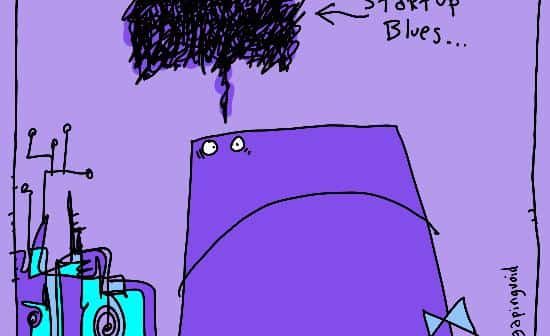
I drew this cartoon because a recent story in the news made me sad:
A lively and popular figure of the start-up scene, Jody Sherman commited suicide.
I didn’t know the guy, but we had mutual friends, like Jason Calacanis and Tony Hsieh.
Jason summed it up well: “And it seems like folks are not ready to talk about that issue just yet. Which I can understand.”
This is the second startup suicide in a month, after poor ol’ Aaron Swartz. We are genetically programmed to have our our tiny brains fried by the suicide of somebody we care about; writing about it well is impossibe at the best of times. But here are some of my own meagre, insufficient thoughts:
1. My deepest condolences to Jody’s family, esecialy his wife and children. The sorrow must be horrible, simply horrible. I am so sorry, truly.
2. Once we’ve made our millions, retired and gotten old and decrepit, hey, then DEATH is not so scary an idea, but when one is still in one’s prime… Most of us doing the start-up thing are still in our prime, so natually DEATH is amazingly strange and alien to us.
3. The start-up life, for all the time we spend glorifying it, is a very tough road. Again, Jason says it well:
Perhaps we owe it to these three amazing humans to examine if the pressures of being a founder, the pressure of our community’s relentless pursuit of greatness, in some way contributed to their deaths?
I’ve always believed that being a founder is an unhealthy pursuit at times, and few have disagreed — certainly not those who have done it. Read any biography of a successful founder and you’ll find collateral damage around — and certainly in — those individuals.
Startups are a full-contact sport. This is a good time for all of us to pause and think about why we’re doing this. And the impact it’s having on us and the people around us.
4. Me and my friends in the sart-up scene aren’t spring chickens anymore, for the most part. We’re the old guard now. And as Karma catches up with us and the hard choices we made, our deaths are going to start getting a lot more common.
5. As I’m fond of saying, anything worth doing will cost you your life, eventually. Best make sure it’s worth it, make sure it’s something your deepest self actually wants.
6. Yes, your deepest self, not just your glib, sexy, bullshit self.
7. This is it. Fight like hell. Godbless.
April 24, 2010
4 Comments

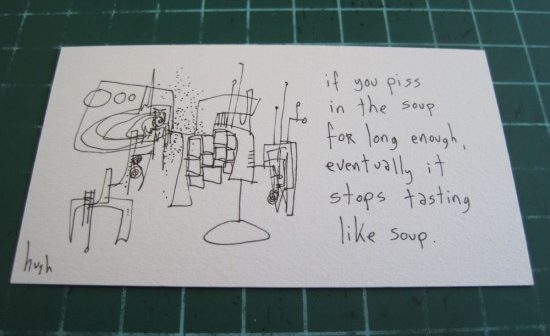
Today’s Daily Bizcard, “Soup” goes to Jason Calacanis.
Web 2.0 serial entrepreneur Jason is one of the smartest people I know. Some people find his manner abrasive, but eh, that’s just his high-energy, take-no-prisoners, no-bullshit way. He’s a real gentleman and a sweetheart if you ever actually spend time around him.
The cartoon is all about cutting corners. It’s a really tempting and easy thing to do, especially when business is slow. The downside is that inevitably people do notice eventually. Of course they do.
[The Daily Bizcard archive is here etc.]
[Jason, please send me an e-mail at gapingvoid@gmail.com with the details you want to see on the back of the card, and I’ll send a free batch of 100 to you. Thanks!]
February 28, 2010
88 Comments

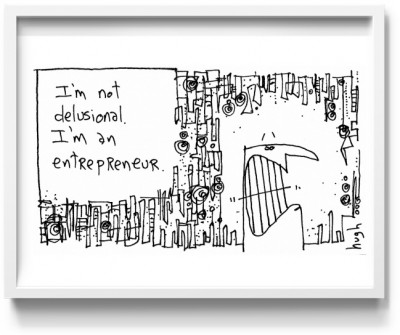
[The “I’m Not Delusional” print, for sale on the gallery…]
Random thoughts on being an entrepreneur. [Originally posted January, 2007]
I wouldn’t say I was an authority on entrepreneurship, certainly not in the same league as people like Fred Wilson or Jason Calacanis. That being said, the last couple of years haven’t been too shabby, either. With that in mind, here are a few thoughts I have on the subject, in no particular order. The list, by the way, is far from complete– I’ll probably be adding to it sooner than later etc.
1. Everything takes three times longer than it should. Especially the money part.
2. The best way to get approval is not to need it.
3. People want what they can’t have. In fact, that’s pretty much all they do want.
4. Once you become an entrepreneur, you find the company of non-entrepreneurs a lot harder to be around. You’ve seen things they haven’t; the wavelengths alter, it’s that simple.
5. In a world of over-supply and commodification, you are no longer paid to supply. You’re being paid to deliver something else. What that is exactly, is not always obvious.
6. Word of mouth is the best advertising medium of all. The best word of mouth comes from disrupting markets.
7. People buy your product because it helps fill in the narrative gaps in their lives.
8. You can either be cheapest or the best. I know which one I prefer.
9. Some people think that once they secure venture funding, their problems will be over. Wrong. That’s when your problems REALLY begin.
10. It’s better to be underfunded than overfunded.
11. If an average guy in a bar can understand what you do for a living, chances are you’re halfway to becoming a commodity.
12. It’s easier to turn an ally into a customer than vice versa.
13. If you’re happy in your career before the age of thirty, you’re probably doing something wrong. Heck, if you’re happy in your career before the age of seventy, you’re probably doing something wrong.
14. Smart, young, artistic people are always asking me which is a better career path, “Creativity” or “Money”. I always answer that it doesn’t matter. What matters is “Effective” and/or “Ineffective”.
15. Write the following on a piece of paper, have it framed, and stick it on your office wall: “Have you hugged your customer today?”
16. People will always, always be in the market for a story that resonates with them. Your product will either have this quality or it won’t. If your product fails this test, quit your job and go find something else. Just making the product incrementally cheaper or better won’t help you.
17. Products are idea amplifiers. The molecules and/or bytes are secondary.
18. People remember the quality long after they’ve forgotten the price. Unless you try to rip them off.
19. Markets serve entrepreneurs better if the latter can keep the former undersupplied. Oversupply is the kiss of death.
20. I personally know a former CEO who, once he attained control of the company, ran an EXTREMELY profitable business into the ground in less than two years. From a market cap of $100 million to ZERO, just like that. Why? Short answer: He loved being “The” CEO, but he didn’t much care for being “a” CEO.
21. In terms of becoming an entrepreneur, probably the most useful thing I learned in the last twenty years was how to enjoy my own company for long stretches of time.
22. One successful entrepreneur I know well has a wonderful quality, namely that he never, ever compares himself to other people. He just does his own thing, which actually serves him rather well. Just because his competitor has bought himself a bigger motor boat, doesn’t mean he feels the need have a bigger motor boat. This quality helps him to build his business the way he sees fit, not the way the motor boat people see fit.
23. Running a startup is full of extreme ups and downs. Which is why so many successful and happy entrepreneurs I know lead such normal, stable, unglamorous, “boring”, family-centered lives. Somehow they need the latter in order to balance out the former. Extra-curricular drama looks great in the tabloids, but that’s all it’s ultimately good for.
24. MBAs are conditioned to use their brains in much the same way as sex workers are conditioned to use their genitals. Nice work if you can get it.
25. Bill Gates may have a million times more money than me, but he isn’t going to live a million times longer than me, watch a million times more sunsets than me, make love to a million times more women than me, drink a million times more fine wines than me, listen to a million times more Beethoven String Quartets than me, nor sire a million times more children than me. Human beings don’t scale.
26. F. Scott Fitzgerald once wrote, “There are no second acts in American lives.” F. Scott was a drunkard and a fool.
February 17, 2009
42 Comments

[UPDATE: Please sign up for the “Crazy, Deranged Fools” Newsletter. Thanks!]
Dear Crazy, Deranged Fools,
For a while, I’ve been thinking about what to call y’all collectively, i.e. the people who follow my work with regularity.
My friend, Jason Calacanis calls his regular readers “Jason Nation”. I thought that was very clever; I liked it a lot. Hey, it rhymes! In a similar exercise in wordplay, I thought about “Voidettes”, “Gapingvoiders”, “Hughtrainers” or whatever, but nothing really stuck. I guess that’s because these kind of names were “All About Hugh”. And, well, let’s face it, it isn’t all about me– you guys have your own stuff going on, as well. That’s what makes it interesting.
So what unites us? The answer came to me in flash this morning, in a blog post:
A. Most people work for the money. Most people wouldn’t do their jobs for free.
B. Most people hate their jobs.
But I’m not thinking about “Most People” right now. I’m thinking about the small percentage of the population who want to love their work; who want to find meaning in their work… and are willing to work like hell to find out how.
Those crazy, deranged fools…
How do they manage to exist? How dare they exist!
Are you one of them? Just curious…
A CrazyDerangedFool [CDF for short] is, like me, somebody who has the temerity to aspire to work in a way that produces both joy, meaning and contribution for both them and others, while also paying the bills. It’s about creativity, it’s about finding meaning, but it’s also about living in the real world. That’s the reality I want to live in, and from the vast quantities of e-mails and comments I get from y’all, that seems to be your game plan, as well.
I really liked what Ms Constantine said in the comments of the aforementioned post:
I’m working about 30 hours a week on top of my “day job” so that one day I’ll be able to do the work I love.
I’m currently doing the extra hours for free, so I’m kind of one of them.
Gotta pay the bills though.
Ms Constantine, that too has been my life for the last twenty years. I too am a CDF. This IS INDEED the crazy, deranged, foolish world of my own making that I chose to live in. And this IS INDEED the crazy, deranged, foolish world I will die in. I’ve already crossed the Rubicon. Alea iacta est. There is no going back. Ever.
With Love and Respect to You All,
Thank You. Seriously. Godspeed!
–Hugh MacLeod
July 13, 2008
32 Comments

[Cartoon originally published December, 2007. It was dedicated to my friend, the dauntless Robert Scoble.]
As anyone who has been reading Techcrunch will know, the “Is Blogging Dead?” meme has reared its ugly head again.
Well, before we all get dressed up in our best funeral gear, let me say it one more time: The big story is not about blogging. It’s not about Twitter, YouTube, Facebook, Friendfeed or whatever. And it certainly is not about Robert Scoble, Mike Arrington, Jason Calacanis, Nick Denton or whatever so-called “A-Lister” you care you mention.
Yes, again, it’s all about what Clay Shirky said four years ago, in a wonderful interview he did for Gothamist:
“So forget about blogs and bloggers and blogging and focus on this — the cost and difficulty of publishing absolutely anything, by anyone, into a global medium, just got a whole lot lower. And the effects of that increased pool of potential producers is going to be vast.”
I had coffee with Clay a couple of weeks ago. A totally great guy. We didn’t talk about blogs much. Nor did we talk much about Twitter or Facebook.
We talked about something conceptually far simpler: Cheap. Easy. Global. Media.
CheapEasyGlobal is the big story. And it’s here now. It has arrived. And it’s permanent. And there’s not a damn thing anyone can do about it, save for a nuclear holocaust.
Some people will do very well by it. Other people will prefer to stay on the sidelines instead, using the internet to yak yak yak endlessly on about what other people are up to, holding the “players” to far higher standards than they will ever attain themselves. These lovely armchair quarterbacks will be swiftly forgotten by history. Same as it ever was.
April 18, 2008
8 Comments

So it looks like my friend, Steve Gillmor is working with Mike Arrington now. Jason Calacanis breaks the story, with the above cartoon on the blog post. The Gillmor Gang’s new permanent home is here.]
Jason writes:
Here’s some exclusive news: after being offline for over a year in a legal dispute (can’t get into details) the Gillmor Gang is back and is part of TechCrunch! Steve Gillmor is one of the most insightful minds in the technology space, and his “gang” is a free-form thought-fest that unpacks, repacks, and distracts memes faster than any other conversation out there.