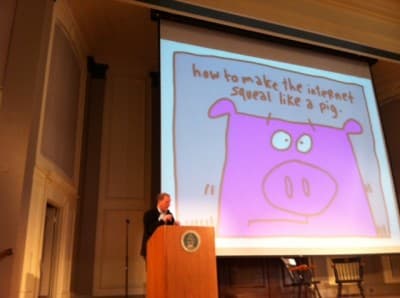
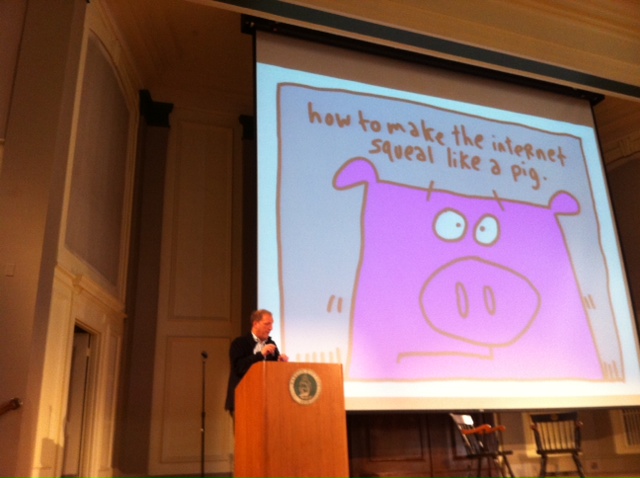
“How To Make The Internet Squeal Like A Pig”


[Bab­son Pre­si­dent Len Sch­le­sin­ger making the intro…]

Last Satur­day my busi­ness par­ter, Jason Kor­man and I gave a wee Q&A talk up at Bab­son College entit­led, “How To Make The Inter­net Squeal Like A Pig”, as part of their tenth annual Bab­son Enter­prise Forum. Below are the rough notes/transcription, with Jason asking the ques­tions and me doing the ans­we­ring. Thanks Again to Len for the great oppor­tu­nity, we had a blast!

[Further Rea­ding: “Why Social Objects are the Future of Marketing…”]

HOW TO MAKE THE INTERNET SQUEAL LIKE A PIG

Q. So, Make the Inter­net Squeal like a pig, what you mean by that?

If you’re going to be an entre­pre­neur these days, you’re going to have to figure out the Internet.

From the entrepreneur’s pers­pec­tive, what makes the Inter­net tick? From an entre­pre­neu­rial pers­pec­tive, what actually works?

We’ve built a tidy inter­net based busi­ness over the last ten years, b just obe­ying a few rules and they’re not easy to exe­cute, but they are easy to understand.

Q. If you were going to gene­ra­lize about these rules, what could you say?

The Inter­net is just like anywhere else– offline is just like online. Basi­cally, the ideas that spread, win. The ideas that go no where, lose.

Q. So what spreads, how do you create stuff that goes viral?

Viral is a fig­ment of people’s imagination.

The thing that spreads online, of course, is “great con­tent”. This great con­tent can either be your pro­duct itself (Huf­fing­ton Post), or con­tent about or somehow con­nec­ted to your pro­duct (37 Signals).

 Q. But what does that actually mean? What does great con­tent have, that mediocre con­tent lacks?

You can’t just say, “I’ll know it when I see it”. No, great con­tent has its great­ness baked in somehow. It follows rules. It has elements.

 Q. Let’s talk about the five buil­ding blocks of great con­tent–  Recent buzz­words have made it sound like it Is just about pas­sion and authen­ti­city – is that all one needs?

Pas­sion for passion’s sake is usually mis­di­rec­ted as it often mis­ses busi­ness pur­pose. Authen­ti­city has become a black hole.  As I twee­ted a few months ago, Authen­ti­city is the new Bullshit. Authen­ti­city is now being faked so well, that its hard to tell real real, vs real fake.

 Q. So, if its then not about pas­sion and authen­ti­city, then what is about.

As with any human endea­vor, WHY you do something is ALWAYS more inte­res­ting than WHAT you actually do.

Q. So is it about that Why? Where does that “Why” come from?

The ques­tion of “Why” in busi­ness was first rai­sed  by our friend, Mark Earls, in his 2001 book “Wel­come to the Crea­tive Age”. He called called the “Pur­pose Idea” – This has become a popu­lar sub­ject in con­tem­po­rary busi­ness, and it has to do with the ‘why’ of what you do.

The “Why” is not your mis­sion sta­te­ment, it is not about “Best Practices” – it is about the heart and soul of what you do – As Simon Sinak says, the” Peo­ple don’t buy what you do, they buy why you do it“.  “Why” is the thing that gets you and your collea­gues out of bed in the morning.

Call it the “Why”, call it the Pur­pose Idea, it is all the same: It defi­nes the true moti­va­tion of your busi­ness, as oppo­sed to the “what” you do of your business.

Q. How is it dif­fe­rent from the “What’ of your business.

What is the end result. It is the actual ser­vice or pro­duct. If I am in the busi­ness of pro­du­cing note­books, for exam­ple, that is the end pro­duct, but the why might be to help peo­ple be more crea­tive, as is the case with Moleskins.

Q. The “WHY” of con­tem­po­rary busi­ness really had its roots in the 1960’s and 1970’s – How has it deve­lo­ped since then?

We think that the ‘Why’ ques­tion first ori­gi­na­ted in cause-centered busi­nes­ses of the 60’s and 70’s – Anita Rod­dick, at the Body Shop (explain). The Whole Earth Cata­lo­gue, Rollings­tone and MAD maga­zi­nes in their own way.  The idea that busi­ness could work for social good or change was at the heart and soul of why they did what they did every day.

So, while this idea star­ted with the cause-driven enter­prise, It has deve­lo­ped much further, and vee­red away from just social cau­ses. Cer­tain com­pa­nies such as out­door retai­ler REI (actually foun­ded in 1938) is a good exam­ple, a COOP, it is now a billion and a half dollar busi­ness, these busi­nes­ses were on some level, even if they were for– pro­fit busi­nes­ses, had a social cause. Rollings­tone– Mad, etc)

It is really about the real belief that is at the core of your pro­duct or ser­vice. It is in part about func­tion, it is in part about the soul of your ser­vice or product.

If peo­ple con­nect with your values, your “why”, they’ll tell their friends, it’s that simple.

 Q. So, how does that trans­late to more mun­dane busi­nes­ses, com­pa­nies that are not out to change the world, but just to sell something and make a profit.

Okay, let’s talk about retai­ling shoes. Tony Hsieh of Zap­pos made seve­ral hun­dred million dollars selling shoes. Why? Because he unders­tood that shoes were his WHAT, but his WHY was DELIVERING HAPPINESS.

Racks­pace, a ten year old hos­ting busi­ness, com­ple­tely ama­zingly effec­ti­vely against the titans of the tech world because they know that their what might be hos­ting, but their why is FANATICAL SUPPORT.

 Q. We’ve grap­pled with the ques­tion of “Why” in our busi­ness, and its pro­bably taken 3 years to resolve, but I think it is a good illus­tra­tion of a Pur­pose Idea.

On the face of it, I’m a car­too­nist, and we are in the busi­ness of selling car­toons. We license them, we sell them as limi­ted edi­tion prints, we do cor­po­rate com­mis­sions and messaging.

That’s all very jolly, but the ques­tion is: Why? And, it may of star­ted off being, “Because I’m a car­too­nist”, But today, why do we do what we do?

The ans­wer is that our Pur­pose is not to make car­toons. Our true pur­pose is to create tools that peo­ple can use to com­mu­ni­cate bet­ter, lead busi­nes­ses more effec­ti­vely, help peo­ple give more com­pe­lling pre­sen­ta­tions, create stron­ger orga­ni­za­tions and gene­rally kick ass har­der and better.

That is our pur­pose and that is WHY we get out of bed every day. We help peo­ple kick ass through these ama­zingly effec­tive little cartoons.

Q. What hap­pens after you unders­tand the WHY?

Once you unders­tand your true pur­pose, and ans­wer the ques­tion: “Why” – you then have a lens through which you view everything you do, every piece of mar­ke­ting com­mu­ni­ca­tion, every pro­duct or ser­vice offering.

At the same time, it must be said that fin­ding the ans­wer to “Why” isn’t always easy and is isn’t as sim­ple as it looks – but the pro­cess of dis­co­ve­ring it is very powerful.

So, the first thing you must do to is dis­co­ver the “Why” of what you do.

It is easier to see now how it informs your entire online voice.

 Q. You star­ted blog­ging about “Smar­ter Con­ver­sa­tions” in 2004. It’s your 2nd of the five items here. It seems like a sim­ple idea. What makes it so powerful?

The great Doc Searls in the 1999 book he co-authored called “The Clue­train Mani­festo” famously wrote that “Mar­kets are Con­ver­sa­tions”. An obvious sta­te­ment today, but it was a much less obvious sta­te­ment a dozen years ago.

The point is whether you are buying fruit from a street ven­dor, or tra­ding deri­vi­ti­ves, mar­kets are made by infor­ma­tion and this infor­ma­tion is exchan­ged through con­ver­sa­tions ‘lite­rally or metaphorically’.

So, if you want to be vie­wed as a lea­der in your industry, then the thing that you must do is have the Smar­test Con­ver­sa­tion in your industry.

This is one rea­son why blogs and other social media tools are so power­ful. It costs nothing to have a voice, and if you are able to have a crazy smart con­ver­sa­tion about your industry, you will get noticed.

Pros­pec­tive cus­to­mers will return your calls, you will be able to hire the best and smar­test peo­ple in your industry, the media will turn to you when they need and expert. It will trans­form your business.

Q. So, what kind of com­pa­nies are having a Smar­ter Con­ver­sa­tion? It is usually the guys that also unders­tand “Why”?

Tar­get is one. They have a really smart con­ver­sa­tion about the fact that design doesn’t have to be expen­sive. Shake Shack, also has a smar­ter con­ver­sa­tion about bet­ter tas­ting fast food, as does Pret a Man­ger, a UK import sand­wich chain now owned by Mac­Do­nalds that was very early into the sus­tai­na­ble, qua­lity, nutri­tious fast food mar­ket. The Mor­gan Hotel Group trans­for­med the entire hotel industry with a few pro­per­ties in NY and Miami.

 Q. You’ve blog­ged a lot about the idea of busi­nes­ses having a Porous Mem­brane, what is it all about and how does that relate back to Smar­ter Conversations?

So the dia­gram above repre­sents your mar­ket, or “The Con­ver­sa­tion”. That is demar­ka­ted by the outer circle “y”.

2. There is a sma­ller, inner circle “x”.

3. So the entire mar­ket, the “con­ver­sa­tion” is sepe­ra­ted into two dis­tinct parts, the inner area “A” and the outer area “B”.

4. Area “A” repre­sents your com­pany, the peo­ple suppl­ying the mar­ket. We call that “The Inter­nal Conversation”.

5. Area “B” repre­sents the peo­ple in the mar­ket who are not making, but buying. Other­wise know as the cus­to­mers. We call that “The Exter­nal Conversation”.

6. So each mar­ket from a cor­po­rate point of view has an inter­nal and exter­nal con­ver­sa­tion. What sepa­ra­tes the two is a mem­brane, other­wise known as “x”.

7. Every company’s mem­brane is dif­fe­rent, and con­tro­lled by a host of dif­fe­rent tech­ni­cal and cul­tu­ral factors.

8. Ideally, you want A and B to be iden­ti­cal as pos­si­ble, or at least, in sync. The things that A is pas­sio­nate about, B should also be pas­sio­nate about. This we call “align­ment”. A good exam­ple would be Zap­pos. The peo­ple at Zap­pos know that they’re job is to make peo­ple happy, and and so do their cus­to­mers. They are aligned.

9. When A and B are no lon­ger alig­ned is when the com­pany starts get­ting into trou­ble. When A starts saying their gizmo is great and B is telling every­body it sucks, then you have serious misalignment.

10. So how do you keep misa­lign­ment from happening?

11. The ans­wer lies in “x”, the mem­brane that sepe­ra­tes A from B. The more porous the mem­brane, the easier it is for con­ver­sa­tions bet­ween A and B, the inter­nal and exter­nal, to hap­pen. The easier for the con­ver­sa­tions on both side of mem­brane “x” to adjust to the other, to become like the other.

12. And nothing, and I do mean nothing, pokes holes in the mem­brane bet­ter than blogs. You want porous? You got porous. Blogs punch holes in mem­bra­nes like it was Swiss cheese.

Q. So, it sounds like the more porous your mem­brane (“x”), the easier it is for the inter­nal con­ver­sa­tion to inform and align with the exter­nal con­ver­sa­tion, and vice versa.

14. Not to men­tion it makes misa­lign­ment, if it hap­pens, a lot easier to repair.

15. Of course this begs the ques­tion, why have a mem­brane “x” at all? Why bother with such a hie­rarchy? But that’s another story.

N.B. And yes, this works with inter­nal blogs as well, poking holes in the mem­bra­nes that sepe­rate peo­ple within a cor­po­rate cul­ture; alig­ning “the con­ver­sa­tion” inter­nally etc.The other advan­tage of inter­nal blog­ging is that it orga­ni­ses con­ver­sa­tion into a long-term mana­gea­ble form. Two peo­ple sha­ring ideas via blogs is a lot more per­ma­nent, viral and use­ful for the com­pany than two peo­ple sha­ring the same infor­ma­tion over by the watercooler.

Q.  So, poking holes in mem­bra­nes sub­verts hie­rarchies and flat­tens Organizations?

Yes, that’s the idea…

Q. It doesn’t seem like any of this requi­res much of a bud­get, is it more about money or world view?

The deci­sion is a moral deci­sion, not a busi­ness deci­sion. Since it costs nothing, it is simply about deci­ding. Once you do it, make it smart, put it through the lens of your busi­ness purpose.

If you tie this up with kno­wing your true busi­ness pur­pose, then you will have an ama­zingly power­ful free mar­ke­ting platform.

Q. Okay, We’ve cove­red Fin­ding “Why”, “Smar­ter Con­ver­sa­tions” and “Porous Mem­bra­nes”, What is the next tac­tic for making the inter­net squeal?

We call it “News­worthy Interventions”:

An Inter­ven­tion is when you change the rules, when you alter the per­cei­ved rea­lity, when you “poke the box”, as hac­kers like to say.

That’s what all great busi­nes­ses do. They enter a pre-existing lands­cape and alter it fore­ver, for the better.

Inter­ve­ning with rea­lity, in order to change it, for the better.

Q. This doesn’t sound like the sort of thing that a small boots­trap­ped start-up can do? How do you do this with limi­ted resources?

There are small com­pa­nies that do it all the time. The point here is that you have free media to craft (tell) any story you want. At the same time the media costs you nothing. Nada. So, you can, as we like to say, “roll snow­balls down hill and see if they turn into avalanches”.

A per­fect recent exam­ple is a little clothing com­pany based in Cali­for­nia called Beta­brand. Cool clothes, dis­rup­tive mes­sa­ging, Ste­ware Lind­land, the CEO says:

“We run our clothing com­pany as an Inter­net com­pany, so we play by Inter­net rules when doing so,” says Lind­land. “One of the big rules of the Inter­net is that you have to be new all the time; there’s a sense of cons­tant rein­ven­tion. We put out pro­ducts as quickly as we pos­sibly can, as fre­quently as we pos­sibly can, and we try to get peo­ple takng about them with each one we put out. It’s almost like an edi­to­rial calen­dar that dri­ves design.”

You see, this is a com­pany that runs its busi­ness to take advan­tage of all the tools that the inter­net has to offer.

It is very simi­lar to what you and I did with Stormhoek, where we vie­wed wine as an ampli­fier of ideas, to create fun con­tent, which was just as impor­tant as the pro­duct itself.

 Q. So, if you do a good enough job, then other peo­ple are going to want to talk about it –

And if enough peo­ple want to talk about it, then sud­denly the media wants to talk about it as well… and the idea starts to spread, by the fac­tor of ten. Or a hun­dred or a thousand.

But this doesn’t hap­pen by itself. First it needs the ope­ning salvo.

 Q. SO, would it be safe to think about news­worthy inter­ven­tions as PR 2.0?

You Bet. PR on Ste­roids, that embra­ces social and tra­di­tio­nal medium

Q. The sub­ject of Buil­ding Cons­ti­tuen­cies: Seth Godin called it Tri­bes, Mark Earls refers to it as Herd Beha­vior. Its the 4th item on the list. How does that make the inter­net work for entrepreneurs?

You have to remem­ber that we are now dea­ling in a world where you know  (or are dis­co­ve­ring) your “pur­pose”, you are having a Smar­ter Con­ver­sa­tion about your industry, and doing stuff that gets noticed.

Now, Mark and Seth have a dif­fe­rent take with the same result and its worth tal­king about the differences.

Mark says that we are all Hyper Con­nec­ted apes. We all have a need to not just con­nect with others, but to follow what others are doing. It is the glue of com­mu­ni­ties. It can be sum­ma­ri­zed in the old as where the fellow at the bar says “I’ll have what he’s having”. Mark would say that we all have a need to be part of a lar­ger group, be accep­ted and be loved.

Seth would say that there are peo­ple within society who lead others through their actions. They are often not the usual sorts of lea­ders, but they can attract a huge follo­wing of peo­ple through their beliefs and actions.

Mark says we are hard wired to join groups, Seth says that we are ins­pi­red into groups. For the pur­po­ses of this con­ver­sa­tion, they are one and the same.

As an entre­pre­neur, you need to find your tribe, your herd, etc.

Howe­ver, you are now equip­ped with all the tools you need for them to find you.

You have your pur­pose, you know how to com­mu­ni­cate it, you are fin­ding them, but more likely, they are fin­ding you.

 Q. So how do you manage this Tribe?

The ans­wer to that ques­tion is one that we don’t have time for today, it is more impor­tant that we all know that your goal is to attract like min­ded peo­ple through broad­cas­ting your pur­pose and then ins­pi­ring, mana­ging and most impor­tantly sca­ling that tribe effectively.

Another way of put­ting it is:

“A good cus­to­mer base is the best mar­ke­ting depart­ment there is.”

It sounds like once you have your tribe, they can be one of the main dri­vers of your business’s growth?

Q. So, lastly, HOW DO WE TIE THIS ALL TOGETHER?

Make Social Objects:

We like to say that “Social Objects are the future of marketing”.

Q. Can you please explain What is a social object?

A social object is a pro­duct, idea or piece of com­mu­ni­ca­tion that is inhe­rently inte­res­ting enough that peo­ple want to talk about it or share it. It could be the phone in your poc­ket, accor­ding to X Far­ley CMO of Ford, a car is a social object – or it could be a car­toon. Social Objects have mea­ning that do not require further expla­na­tion, but encou­rage con­ver­sa­tion and human inte­rac­tion around them.

A good exam­ple of social objects are:

Miyachis

gaping­void Cartoons

Once you are inte­res­ting, then you will have the atten­tion of your mar­ket, or the peo­ple who mat­ter in your mar­ket, and then you want your pro­duct or ser­vice to spread.

We like to say that “Social Objects are the future of marketing” .

What is a social object?

We are hyper-social pri­ma­tes that have a need to socia­lize. These objects

Mali­nofsky came up with the insight that peo­ple socia­lize around objects.

These days lots of very smart mar­ke­ters are very con­cer­ned with how to make them because it is unders­tood that they are very power­ful tools.

Fun­da­men­tal buil­ding blocks to crea­ting them.

The three ways to create mea­ning in your (hat tip: Guy Kawasaki):

-       Improve the qua­lity of life

-       Right a wrong

-       Pre­vent the end of something good (artisanal)

-       Create Play – it’s well recog­ni­zed how impor­tant Play for lear­ning, etc.


Are you ready to work with us?

Get More Info

Testimonials

His work acknowledges the absurdity of workaday life, while also encouraging employees to respond with passion, creativity, and non-conformity...   MacLeod’s work is undeniably an improvement over the office schlock of yore. At its best, it’s more honest, and more cognizant of the entrepreneurial psyche, while still retaining some idealism.

The New Republic
Lydia Depillis

Last year my State of the College address was 76 slides loaded with data. This year it was 14 cartoons that were substantially more memorable.

Len Schlesinger
Former President, Babson College

Hugh MacLeod is a genius.  Genius.

Seth Godin
Best Selling Author

In moments of indecision I glance at the wall for guidance.

Brian Clark
@copyblogger
 
  • The New Republic
  • Len Schlesinger
  • Seth Godin
  • Brian Clark
prevnext