I was having a long conversation with a friend last night about “Business Porn”:
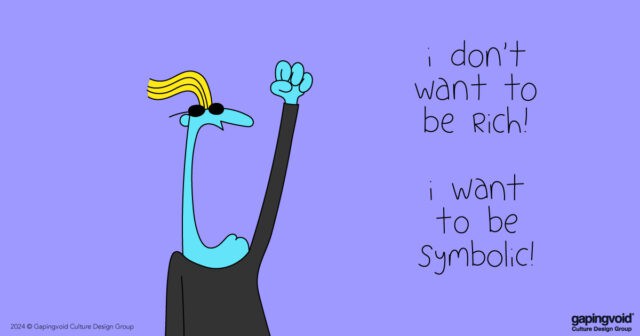
Business Porn is just like Ordinary Porn or Real Estate Porn, except instead of it being about the women we wished we could sleep with, or the houses we wish we owned, it’s about all those cool, lucrative, exciting jobs and businesses that we wish we had, instead of the normal, tedious, schleppy crap most of us end up doing to pay the bills.
I drew this cartoon this morning, while thinking about a conversation I had a couple of years ago:
I was on the phone to an old friend of mine, a guy in his late forties, who was born and bred in Michigan, and is living there now. He was telling me about his uncle, who, about four decades ago, got his highschool sweetheart pregnant. So instead of going off to college, he found himself with a new wife, a child on the way, and an assembly-line job at General Motors. But even though this situation clipped his wings considerably, he still ended up having a nice life in the end, with a home, a big yard, two cars, a steady paycheck, weekends fishing or hunting deer, and vacations in Hawaii every year or so. “The days where a blue collar guy like my uncle could have a nice life without doing much,” my friend said, “those days are gone. Gone forever.”
And in the back of my mind, I’m thinking the same is starting to happen to white collar guys more and more, as well. But it’s not quite out in the open yet. Society’s not quite ready to have that conversation.
I also heard a statistic a couple of weeks ago that there are at least thirty million children in China currently taking piano lessons. Thirty. Million.
We live in interesting times…
[Update: ]“Thousandists”: My long-time Spanish blog buddy, Nia left an interesting comment below:
That conversation about white-collar jobs is four years old in Spain.
This is the short version: The people who were in their 20-30s in the 1970s saw that a University degree made a big difference in your job and salary. They made their kids (anyone born 1970 – 1985) study, and that young generation believed for a while that we could do the same trick as our parents. Get a degree. The job will follow.
We now have a word for people of my generation with a handful of degrees: mileuristas. Thousandists. As in, someone who makes around 1,000 euros a month. There’s so many of us, no one’s willing to pay us more than a (barely) living wage.
Your Inner Whining Artist (IWA) is the part of you that tells you you’re a genius waiting to be discovered. If only the big bad world would sit up and recognise your talent, the IWA tells you, all your problems would be over. Audiences and critics would bow at your feet, agents would queue up to represent you, and all the people who’d ever rejected your work would be gorging themselves on humble pie. You just need to get your break, to be discovered. It can only be a matter of time …
It’s quite simple, really: People who spend a lot of time listening to their Inner Whining Artist get the shit beaten out of them by the world in general on a daily basis.
And as long as IWA plays a plays a significant role in your life, the daily beatings don’t stop. Ever.
A very respected journalist once told me, “I’m always telling students, if you want to be a journalist, for God’s sake don’t be a Journalism Major. Study something else, like The Classics or Architecture. That means when you start looking for work, you’ll be bringing something to the table besides ‘Shop Talk’.”
Great, great advice. And what’s true for aspiring journalists is also true for artists. We get so fixated on our own shtick– and the shtick of our peers, and whoever is in fashion that week– that we close ourselves up to the very kinds of experience that will make our work deeper, richer and more interesting in the long run, and “Talk Shop” instead [And bloggers are the worst. Why? Because it’s so much easier for a blogger to write about social media than it to write about something more original. I’ve been as guilty as anyone.].
Then again, it’s hard to make a significant body of work long-term, unless you’re totally obsessed and single-focused. Besides eating, drinking and screwing, Picasso didn’t do much else with his time, except make art.
On this subject, the best thing I’ve heard recently came from the composer, Phillip Glass, who my Twitter buddy, Hazel Dooney quoted recently: “I have one secret. You get up early in the morning and you work all day. That’s the only secret.”
My advice? Don’t worry about being an artist. Worry about getting the work made. If you’re any good, the rest will follow. Rock on.
Recently I did something dramatic: I got rid of my Blackberry, and I started leaving my computer at the office.
So now I am without (GASP!) Internet access 12 – 16 hours a day!
The “Always-On Culture” had been feeling oppressive for a while now. Finally I decided to do something about it. Basta.
The biggest benefit so far is; I’m drawing a hell of a lot more. This is, after all, what I get paid to do, and what I’ll be remembered for. Nobody will ever care how many Twitter followers I had or how SEO-optimized my blog was.
The Internet liberates us from so much; it’s our duty not to become again enslaved by something else.
Simon Thornhill is a good friend of mine. He and his lovely wife own The Troubadour in London, the legendary restaurant and nightclub. Jimi Hendrix and Bob Dylan played there, back when they were still unknown. The Thornhills bought the place from the previous owners a few years ago.
Before that, Simon was an officer in The Black Watch, perhaps the most respected Scottish regiment in the British Army. He’s tough as nails, but a bit of a hippie, too. If you ever visit Earl’s Court, look him up. He’s terrific company.
I don’t know what we were were talking about that night in The Shackleton Room, but somehow the conversation got on to the subject of young Army officers. Some of the kids I went to high school in Edinburgh with ended up joining Regiments straight after finishing their exams, so Simon’s previous life wasn’t a world completely unknown to me. These kids sign up at age seventeen or eighteen, take their two-year training at Sandhurst, and the next thing you know, they’re in the field, armed to the teeth, and giving orders to experienced Sargeants and Corporals twice their age.
I don’t know about you, but I would find that REALLY intimidating. Those young kids must have cojones, I’ll tell you that. I was telling Simon how terrifying I thought it it must be, to be a kid barely out of school, with all the men FAR more experienced than you under your command, holding you in the traditional squaddies’ contempt reserved for all new, young officers.
“Yes, that certainly happens,” said Simon. “But then you finally have what they call in the Army, ‘The Moment’. The Moment when you stop trying to be your men’s new best friend, and actually start to lead them. That’s when you REALLY become an officer– not before, when you receive your commission.
“That happened to me when we were on a night exercise. I had only received my commission a few months previously. Things were going terribly wrong, nobody was doing their jobs. Everything was in shambles. Finally I had my ‘Moment’. I just pulled my finger out, and firmly said to the men, ‘I’m in command, you’re not, you will do as I say or I will have you all up on charges, Boys. Now fucking go do your jobs.’ Somehow they knew I wasn’t joking.
“And so they went off and obeyed their orders, without any fuss. A few of them were easily ten or fifteen years older than me… The thing is, they might not think much of the young kid giving them orders at first, but at the same time, soldiers do want to be led.”
As with Simon, I think we all need to have that “Moment”, eventually. That moment when we stop futzing around and actually start behaving like proper adults. That moment when we actually start acting like “Officers” commanding our own lives.
I remember mine. I didn’t think too much about it at the time, but over the years I realized just how key it ended up being.
I was a young freelance advertising creative, living in London, meeting a friend for a drink at my regular Soho watering hole, The Coach & Horses.
The bar was crowded and noisy that evening. The barmaid was a young, pretty Chinese lass, who’d only been in the country a short while, who spoke pretty good English, but not great.
I asked the barmaid for a glass of wine for my friend, and for me, a gin & tonic with FOUR slices of lime. I even held up four fingers to help make it clear to her.
So the poor barmaid ended up bringing me back five drinks– my friend’s glass of wine, with FOUR gin & tonics, each with a SINGLE slice of lime. Oops. We’re talking a round that I suppose easily exceeded thirty or forty dollars.
A simple misunderstanding, I guess, plus like I said, her English wasn’t very good. I told the barmaid about the mix-up. “No, I asked for a SINGLE gin & tonic with FOUR slices of lime” etc.
Up until that moment, like any young pub drinker, I probably would then have just asked the barmaid to take the surplus three drinks away, and add more lime slices to the remaining gin. Easy. But I didn’t.
Instead, I asked her, “Will this mistake be coming out of your wages?”
“Yes,” she replied. I already knew enough about the bar’s owner to know that she wasn’t lying.
The thing is, unlike here in the US, the people working in London pubs don’t work for tips, mainly because nobody really tips there. You might get five or ten dollars a night if you’re lucky. They get paid by the hour, usually minimum wage, in one of the most expensive cities in the world. Hence London bartenders tend to be really, really poor. The mistake the barmaid made would be, for her, extremely expensive. Two-three hours’ wages or so, maybe even more.
“Never mind,” I said. “Just put three more limes in one of the glasses, and I’ll pay for the other three gins as well.” Which I did.
Then it was just a matter of finding three random people in the bar who were not above accepting free gin & tonics from a total stranger with an American accent. This being The Coach & Horses, that took all of twenty seconds. “Cheers, Mate!”
A year or two before that, I would’ve just probably allowed the young barmaid to take the hit. “You made the mistake, not me, not my problem” etc.
London was being kind to me at the time; life was good. Whereas this young Chinese girl was living thousands of miles away from her family, and probably doing so very close to the poverty line. So I chose to take the hit instead of her. I know I didn’t have to, I was perfectly within my rights, but…
I didn’t want to be that kind of person anymore. I really didn’t. So that was my “Moment”.
And every enterprise I’ve ever started or been involved with, had its Moment as well. That moment where you finally decide not to cut corners, not to make excuses, even if you can get away with it. Even if 99% of other businesses wouldn’t have bothered.
These moments are gold dust, they really are.
Has your business had its “Moment” yet? If not, what can you do to make it happen sooner? Serious question.
[Update: Molly made a lovely point in the comments:]
The Moment is a confluence of empathy, understanding and clarity that enables you to elevate yourself to your next stage of development. I have a true Moment about once a year, and it falls within a different category each time (ie. Parenting, personal, professional).
Now that my October travels are over, I’m sitting at my desk again, working on my second book, EVIL PLANS. Here are some notes:
1. The definition of an “EVIL PLAN” is, quite simply, a great idea that the world isn’t quite ready for yet, or at least, doesn’t think it is. Think of all the world-changing ideas that met resistance when they first came out. The motor car (“What’s wrong with a good horse?”). The telephone (“Hey, if someone wants to speak to me, they can damn well come and visit me at my office, or write me a letter.”). Universal Education (“We can’t have commoners learning how to read– it’ll give them all these fancy ideas they have no business thinking!”). Personal Computers (“The world is perfectly happy with $5 million mainframes, Laddie.”). Women’s Suffrage (“Women? Voting? But they’re not mentally stable enough to choose a good leader!”).
2. Everybody needs their own EVIL PLAN. Because that’s our ticket off the treadmill, the nine-to-five, the working for The Man. Being a wage slave in the post-industrial world sucks. Besides, the latter doesn’t pay very well.
3. Everyone needs to find meaning in the brief time they’re living on this planet. Besides Love– friends, family, babies, your fellow man etc– I believe the best way to achieve that is to find a way of making a living that (A) pays the bills and (B) creates something that you can believe in. We are happiest when the work we do fulfills a sense of purpose. This isn’t rocket science. This is just an EVIL PLAN to get our sorry asses out of the salt mine and on to doing something that matters.
4. EVIL PLANS are not really “Evil”, of course. Maybe “Impish” would be a more accurate term. But calling it “Evil” is really pretty “Impish”, so hey, it works. There is something rather mischievous about having something up your sleeve that will surprise everybody eventually– something that will carry “the joyfully unexpected” to a place it wasn’t before.
5. My good friend, John T Unger once said, “Probably the easiest way to create good in this world, is by starting a small business that makes cool stuff.” I totally agree. That’s how I’ve chosen to spend my life; the point of EVIL PLANS is to reach out to those who have done the same. There are MILLIONS of us. It’s damn exciting.
6. “It’s not just enough to make money. One needs Personal Sovereignty as well.” My Scottish grandfather was poor as dirt his whole life. But he died a free and proud man, and loved by countless many. One thing Grandpa didn’t like, was being told what to do by other people. Especially bureaucrats. “Wee Mannies”, he called them. Small men who used their State-given authority to push bigger men around. They never really pushed Grandpa around, though– frankly, they weren’t that dumb. As I get older, the more I realize how much I take after Grandpa MacLeod. Which is why I own my own business, which is why I would never do well in a large corporation. I don’t like having bosses. I don’t like being told what to do. Again, there are millions of people out there who feel the same. Again, it’s exciting.
7. I’m not writing a “How-To” book. A library of How-To books won’t tell you as much as the following sentence: “Work your ass off for twenty years and THEN, JUST MAYBE you’ll finally get a frickin’ clue.” Like my first book, IGNORE EVERYBODY, I’m just compiling a list of all the stuff that has helped me over the years. But it’s true– a little talent & a good work ethic goes a lot farther than a lot of talent & a poor work ethic. As a lot of my hapless, talented-but-lazy friends found out far too late.
8. I’ve been an artist, I’ve been an entrepreneur. Sometimes it’s hard to tell the difference– they’re far more similar than the popular myths would have us believe. A fortysomething musician sent me an email recently. He told me that, although his life for the most part has been a happy one– good health, lovely wife, great kids, good friends, nice house, etc– his career has always been a bit foggy for him, like he was never sure what would happen next. I replied, “No worries, your situation happens A LOT with creative people, even among the super-creative-successful types. The never-ending fog of being an artist.” Whether we’re talking art or being an entrepreneur, “The Fog” is always with us. There is no cure, there is only building up a tolerance. And a good sense of humor helps, as well.
9. I think human beings inherently want to do “Something That Matters”. I think it’s in our DNA. I think the people who say they don’t want do something that matters are liars. I also think having an EVIL PLAN constantly in the back of our minds– quitting our day job and opening a bar, writing the Great American Novel, whatever– is also in our DNA. EVIL PLANS is a meditation about finally waking the hell up and going off to do something meaningful.
10. Life is an adventure. EVIL PLANS is my way of proving the preceding sentence correct. And the people who want to prove me wrong? They’re welcome to try– even if they’ll probably fail. Screw ‘em anyway.
Rudy’s BBQ, my favorite restaurant chain in Texas, serves REALLY good “Sause”, which they also sell by the bottle.
Being the total “Social Object” geek, I’ll say it again– It’s not the sauce in the bottle which makes the Rudy’s “Sause” brand interesting– it’s the social interaction that happens around it that’s interesting.
It’s fun to go to Rudy’s with your friends to talk and eat. It’s fun to buy some ribs at the supermarket, get the smoker in the back yard fired up, douse the meat with Rudy’s Sause, fill up the cooler with beer, crank up the Willie Nelson and invite some friends over.
And yes, if Rudy’s sucked, if Rudy’s BBQ sauce sucked, it would be less fun. And so we wouldn’t buy it; we’d go with something else. It’s the friends and fun we’re actually paying for– the human interaction– not the red stuff in the bottle.
Too many brand managers ask the question, “What message do I have to craft in order to get people to buy my product?” It’s a dead end. A far more useful and profitable question would be, “What can I do to make my customers’ lives more interesting and meaningful?”
And “Meaningful” always has a social dynamic. We find meaning via our relationships with our fellow creatures. “People matter. Objects don’t.”
A bottle of barbecue sauce isn’t going to instantly change anyone’s life for the better. But that 4-hour-long conversation with an old friend, sharing a plate of ribs and brisket, with some Shiner Bock… Well, that might. So you want your product to be there when it happens; you want your product to be around during your customers’ significant moments.
Rudy’s understands this. How about you?
P.S. If that latter “Interesting & Meaningful” question sounds like a hard one to answer, that’s because it is. There’s a reason why the companies who manage to pull it off on a fairly consistent basis –Apple, Nike etc– are worth tens of billions.
[Outside the venue, 6pm: John St., Toronto, 22nd October, 2008.]
Just got back from a brief, 2-night stay in Toronto. I was there for Mesh, where I gave the keynote. Here are some notes:
1. I talked a lot abut social objects, and the fact that I think “Passion Is Social”. It was a good crowd, with lot of corporate PR and advertising types. When dealing with corporate types, I always run up against the same question at least once or twice: “I work in a corporate environment, I get paid to pull levers on behalf of my client. Please show me where the lever is in the Web 2.0 space”. To which I always answer, “I can’t tell you where the lever is, because it doesn’t exist.” Then I tell them, “You don’t create social objects by pulling levers; you create social objects by creating social gestures.” Then I tell them, “Virals don’t start life out as virals, they start life out as gifts. And gifts are always in conflict with their own value.” Then I tell them, it’s a brand’s job to be interesting. And what makes a brand interesting is the human interaction around the brand, not the inherent qualities of the brand itself. Some people get it, some people don’t, some people kinda get it, even if they’d rather not.
I said a lot more than that, of course, but this is what I came away with. All in all, it was a lovely little conference, and I REALLY appreciate being invited.
2. At the event we had some of my prints on display, which I ended up selling more than a few of. Big Thanks to Amrita Chandra for helping me out with that.
3. I really like Toronto. Hard to believe a city that big, diverse and culturally vibrant could be that laid back.
4. On Friday I had breakfast in Toronto, lunch in Manhattan, dinner in DFW airport, and a nightcap in my hotel in El Paso, Texas. A long day, to say the least. I had to pop in to my printer’s in New York quickly to sign the Portfolio Number Two prints, which will be starting to ship out next week. Manhattan added an extra half-day to my travels, but it saved a lot of time and hassle in the long run.
5. October has been a very busy month for me for traveling. Drove back and forth from the airport three times this month already (a 440 mile round trip from Alpine, Texas). Now that’s the current traveling phase is pretty much over, I’m hunkering down to get on with the Cube Grenade project. That, and the second book to get finished. No rest for the wicked etc.
[Bonus Link:] A WONDERFUL slideshow re. The Internet & The Advertising Business from Toronto’s David Gillespie:
11“x14”, Rives-Arches French made paper, hand-printed, limited-edition serigraphs, hand-signed and numbered by me, i.e. the exact same format as before.
This portfolio will be smaller versions of prints we have already published on the gallery. People like the bigger prints (“Purple Cow”, for example, is 39“x28”), but small ones have their place, too (especially if you like hanging art in downstairs bathrooms etc.).
Also, with the Holiday Season coming up, these wee “Cube Grenades” will make a lovely gift for people. Because of their relatively small size, you don’t have to worry so much about where the person receiving it is going to find room to hang it etc.
You can buy the entire portfolio of four prints, framed, for $495 plus Shipping & Handling. Or you can buy them individually, framed, for $150 each, plus Shipping & Handling.
I’ll announce when the Portfolio is up on the gallery site and ready to go, or you can reserve yours now by clicking on one of the two PayPal Deposit buttons below (one for the portfolio of four, one for buying a print individually etc.), and we’ll put you first on the list. The other advantage of using the PayPal button instead of waiting for the offering to go live on the gallery website is, the earlier you place the deposit, the easier it is to reserve a certain number of an edition you may care to have.
The plan is to have these printed, signed and shipped out within the month, so plenty of time before Christmas and Hannuka.
I hope you like what you see, this going to be a great little series. If you have any questions, please feel free to leave a comment below. Thank You.
[TO PURCHASE PORTFOLIO #3 — $75.00 DEPOSIT]
[TO PURCHASE AN INDIVIDUAL “PORTFOLIO # 3″ PRINT — $50.00 DEPOSIT: Once the prints are up on the gallery site, we’ll e-mail you to confirm which one of the four you want specifically etc.]
Back in July, I interviewedHazel Dooney, a very successful Australian artist. Asking her about how she manages her business, she made a very lucid point, one that has really stuck with me:
But none of it works without discipline. Early on in my career, I was told that success demanded one thing above all others: turning up. Turning up every bloody day, regardless of everything.
Besides the famous Woody Allen quote, this reminds me of when I wash about 18, living in Edinburgh. I was talking to the cartoonist, Hugh Dodd, who was a regular in the bar I worked in at the time. I asked him what was the secret of being a successful cartoonist, in his opinion.
“Continuity,” he said. “Anyone can draw a good cartoon… ONCE. But not everyone can draw a good cartoon, every day, day-in-day-out. It’s something you have to work VERY HARD at for many years before you even get close…”
Heh. Many years later, and I still don’t feel anywhere near “close”. Does anybody? But that’s what keeps us going, I suppose…
What can I say? It was a blast. Everybody seemed to have a great time. More than one person came up to me and said it was a lot more fun than any art opening they’d ever been to. You can see what people are saying on Twitter (for the time being, anyway) by following the #purplecow hashtag…
Thanks to Seth Godin for being such a gracious co-host, thanks to everybody who helped out, thanks to everybody who came along for it.
A special big thanks to Martha Burzynski, Carlo Balistrieri, and Cecilia Feret for volunteering their time to help us out at the door. That was so kind of you, seriously. Thanks to David Parmet and Sandi Bachom for the great photos and videos [posted above].
And a final thank-you to my business colleagues, Jason and Laura, who worked tirelessly for SO LONG behind the scenes to make sure the evening was nothing short of a massive success. You guys rock. Ok, I’m going to go off and sleep for a week…
Within 1 week of meeting this person you realize that not only have you found your soulmate, but you’ve found your soulmate who likes to have sex 4 times a day in the bed, on the dining table, on the kitchen floor, in the changing rooms at Bloomingdale’s etc.
Within 2 weeks you’re already talking about moving in together.
Within 3 weeks you’re talking about having babies together.
Within 4 weeks you realize this person is a complete psychopath.
Within 5 weeks this person also thinks you’re a complete psychopath.
Within 6 weeks you’re sitting at a restaurant with an old friend who is giving you the “How come you only call me when you’re single” speech.
Last night I was in the West Village bar I drew that cartoon in, back in 1998. The cartoon ended up in the book…
I’m in The Big Apple, running around like a tormented lunatic, getting all the last-minute-stuff done for the Purple Cow print party on Thursday [Tomorrow night!]. So far it hasn’t been too stressful, he lied…
As a working artist, I divide my day into two parts. “Bleed and Feed”.
The Bleed Part. Taking care of business. Doing work for my clients. Working on new Cube Grenade ideas etc. Trying to find new clients etc. Trying to get my bills paid etc etc.
The Feed Part. I go and make drawings for myself. Completely non-commercial. Often no more than doodling in my sketchbook. Just me and a pen, trying to feed my well. Often accompanied by a nice glass of red.
I try to do both every day. “Bleed” gets my morning and afternoons. “Feed” happens mostly after dinner, before bedtime.
All successful artists “Bleed and Feed”, in their own way. The ones who don’t– who just try to do one or the other– tend to burn out rather quickly. That’s just Reality.
Somebody just emailed me to ask, why did I use red and gray for the New York print?
Besides aesthetic reasons [Red & Gray gives the piece a sort of retro-hipster Ben Shahn vibe, which I like], here’s a little more insight.
I have a thing I call “The Red Zone”. The Red Zone is the state of consciousness when you are fully alive– when you are creating something, making art, making love, watching the sun set, whatever. When all your synapses are firing.
I have a thing I call “The Gray Zone”. The Gray Zone is the state of consciousness when you are NOT fully alive– when you’re just bumbling along, half-awake, sleepwalking through life. We’ve all been there, probably a lot more often than we’d care to admit.
“New York” is not just a geographical place to me. It is also a metaphor for the archetypal urban experience.
And I find with this archetypal experience, the battle between the Red Zone and The Gray Zone to dominate one’s mind is at its most intense.
I’ve been playing around with this line a lot recently: “Art For The Real World”.
I’m interested in how art affects what some people call “The Real World”- the workplace, the world of work, the world of business. That’s what the Cube Grenade idea is all about.
My advertising buddy, Vinny Warren, grew up in a Roman Catholic household in Ireland. He was telling me that his parents would always have a few religious icons hanging on the wall somewhere. Pictures of Saints, Mary & Baby Jesus, that kind of thing.
Why? Says Vinny, “To remind us who we were.”
Art that reminds you who you are. Exactly. What applies in Catholic households also applies in places of business. Shared Meaning. Exactly. Social Objects. Exactly.
I think surrounding ourselves with icons, art, books and such to remind ourselves of who we are, where we have been and where we hope to go is essential to keeping our hearts alive. It is too easy to lose our way. My office is full of these things.
In a rather random moment of clarity, I wrote this line on Twitter a couple of weeks ago:
“A good customer base is the best marketing department there is.”
One thing I remember fondly about my college buddies, back in the day: Not only did they all spend a lot of time and energy listening to Grateful Dead records and attending Grateful Dead concerts, they also spent a lot of time and energy trying to get me to do the same.
Though I never became much of a Dead fan in the end, it sure wasn’t for my friends’ lack of trying. Their mojo may not have worked on me, but hey, it worked on plenty other impressionable young people, so it’s all good.
My college buddies were self-appointed team members of one of the greatest marketing departments in history: The Deadheads.
So who are your customers? Are they your marketing department? If they’re not, they should be, yes?
[This reminds me: Seth Godin cited The Deadheads in his wonderful book, “Tribes”. I interviewed him here about the book etc.]
The “A Story [Blue]” print is now available as a pre-publication offer: $245.00
This print is different than the ones I’ve done to date. It has a sort of Abstract-Expressionist feel to it, as I felt that was more in keeping with the sentiment. It’s a beautiful thought, one of my favorites. “A story without Love is not worth telling.” Like Saint Paul wrote to The Corinthians, “Without Love, I am nothing.” The best stories are about things we care about, told to the people we care about. This is true whether we’re talking fiction, fact, people, ideas or yes, the story about the business you’re trying to get off the ground. Love matters. People matter. Everything else is secondary. Amen to that.
With many people saying that small is beautiful, we will be editioning this in a slightly smaller format. Still a hand-pulled serigraph, by Master Printmaker, Jamie, printed on heavy French Rives Arche Paper. Hand-signed and numbered by me. We won’t know the actual size until we proof the image, but I’d estimate it will be 18“x24” or so.
The print will be posted on the gallery page soon enough, selling at $450.00, but for now, it’s only available here exclusively on my blog for the special pre-order price of $275.00.
Just click on the $50 PayPal Deposit button above to secure your order. We’ll invoice you for the rest once they’re printed and ready to ship, which should be late October.
We’re now also offering a lovely framing deal, where we frame it properly for you for an extra $125, so you can hang it right out of the box. We’ll post the details on the gallery once the print is up on there, and also e-mail you the details along with the invoice etc.
Anyway, I hope you like it. As always, I love receiving the pictures of the hanging art in people’s homes and offices, so please keep them coming, Thanks!
I was quite amused by this, in a weird kinda way.
A few days ago, some groovy cat in Japan spotted my book in a bookshop in some town I’d never heard of before.
And he went and took this picture of Page Sixty Four. Why Page Sixty Four? I have no idea. I guess that’s what intrigued me.
[I saved the photo right then, I went back to try to find the link a few days later but couldn’t find it, sorry…]
Some random dude in a Japanese bookstore. Some random cartoonist in West Texas, with an equally random book serving as asocial object in a now hyper-connected world.
I told a fellow author the other day, “If your book isn’t a social object, your book isn’t selling. End of story.”
He scratched his head for a minute, so then I filled him in all about “Baked-In Sociality.” He got it, then.
And the Internet makes all this far more apparent than it ever was before, of course.
I got this story from Derek Sivers, about a musician who bought a quarter-page ad in a big magazine. The magazine had a circulation of a million readers:
The musician had pressed up 10,000 copies of his CD in anticipation of 10,000 orders that were sure to come through that week.
He kept saying, “If only one percent of the people reading this magazine buy my CD… that’ll be 10,000 copies! And that’s only one percent!”
He bought 10,000 padded mailers and mailing labels. He converted his garage into a big mailing center.
He kept saying, “Maybe we can get like 10 percent! That’s 100,000! But worst case scenario, if only 1 percent… that’s still awesome!”
The magazine issue came out, and… Nothing. He bought an issue. There was his ad. But the orders were not coming in! Was something wrong? No. He tested it. Everything was working.
Over the next few weeks he received four orders. Total CDs sold: FOUR.
My friend telling the story ends it with the best line:
“He forgot there was a number lower than one percent.”
[Untitled. Ink on cardboard, business-card size etc.]
Alpine, Texas.
I’m always on the lookout for new things that inspire me; it’s part of my job. Here’s one to add to the list:
It was last March or so, just after I had gotten back home from SXSW Interactive ’09 in Austin.
I was drinking a beer at The Railroad Blues, like I often do. Instead of the usual Blues, Country and “American Roots” bands they were used to having, the band playing that night was a young Indie/Powerpop/Alternative group from Limerick, Ireland, called “We Should Be Dead”. Female lead singer, female lead guitar, male drummer and bass. Average age, I’d say, was around 24.
Now, Celtic Indie/Powerpop/Alternative is not exactly the kind of music I’m into (Imagine “The Cranberries meet The Go-Go’s” etc). But man, I was so impressed with these kids. They sang and played their hearts out. Not to mention, there were a lot of cowboys and shitkickers in the crowd that evening– not a crowd you want to piss off. Everyone– including the cowboys and shitkickers– were impressed by how gutsy and fearless these kids were.
The lead singer, a tiny, skinny girl around five-foot-two, would get off the stage in the middle of a number and walk around the crowd, singing into her mike, with these broad-shouldered cowboys, wearing handlebar mustaches, ten gallon hats and boots, TOWERING above her. Like I said, fearless. So even if the music was a bit alien to what people were normally used to, they still got a lot of people whoopin’ and a’hollerin’ that night. It was a great show. Months later and people are still talking about it.
I got talking to their manager– a stocky, Irish dude in his forties. It turns out, though they were now on tour, they hadn’t planned it that way. They had only come over for SXSW originally, and were planning to return to Ireland right after.
Then somehow while in Austin, the manager made some connections, and the next thing you know, the band were headed West to California, ready and willing to play in every dive bar and dance hall along the way that would let them. Hiring a van, throwing their instruments and amplifiers in the back, living on a few bucks a day plus gas money, sleeping rough if they had to.
And they were going to keep on doing it, till they had spent their last nickel, till they had burned their last drop of gas. Only then, and not before, would they fly back home.
Sure, they could have gone back to Ireland instead, and continue being a fixture around the local pub n’ club circuit. No, they wanted to bust out of that routine– and here was their chance. Not a huge chance, but a chance nonetheless. And they were going for it, no questions asked. Like the equally tiny-skinny lead guitarist told me in her cute little Limerick accent, “We don’t want to go home. We want to keep doing this forever.”
Would you be willing to put in that kind of effort and commitment, to make your business a success? How willing to “sleep rough” are you? Are you that brave? Am I?
God Bless ‘em…
[UPDATE: You can follow the kids over on Twitter at @weshouldbedead. Looks like they’re now based in L.A. Looks like their EVIL PLAN worked! Rock on…]
Dave would always be telling me stories about this lovely person– this rather eccentric, crazy-ass artist, living out in the boondocks, who’d he go visit once or twice a year.
“This rather eccentric, crazy-ass artist, living out in the boondocks,” I remember telling myself, “I want that guy’s job one day.”
I admit it was a weird thing for a twenty-something advertising guy to be aspiring to, but I genuinely felt that this was where I wanted to be headed in the long run. I never really told anybody about it (until now, even). I just kept it to myself: a strange dream which back then, I firmly believed would never happen.
Fast forward over 15 years later, and I’m starting to feel that I was wrong, that the dream is finally starting to come true. I’ve been in Alpine, Texas for just under two years, and I think I’m here to stay. My big-city days are well and truly over. Every day, I can feel myself becoming more and more like Howard.
I believe the next phase of my life has begun. I believe after many decades of being distracted by social convention, I’m finally becoming the person I was born to be.
[Me holding up one of the Purple Cows, right after they were printed. An exciting day for all concerned, indeed…]
[UPDATE: The 6-9pm signing party is now fully booked. Sorry about that. However, if you want to RSVP via email at gapingvoidvip@gmail.com, we can put you on the waiting list, or just RSVP for the 9pm-12pm after-party: it’ll still be fun, and we still have plenty of room left for that. Thanks!][UPDATE: Space is running pretty tight on the 9pm after-party as well, so please RSVP ASAP, Thanks!]
When we were looking around for venues to host The Purple Cow print-signing party, the obvious thing to do was to talk to some New York art galleries about hiring their venue for the evening. And so we did.
These conversations, however, soon got old. It wasn’t that we didn’t have the budget– we did– and it wasn’t that they weren’t nice enough people– they were– it was just this nagging feeling I was getting.
The fact is, I’ve been to maybe hundreds of art openings over the years. And my main take out from that? People don’t like them. People are never at their best at them. Everybody’s invariably hanging around, looking awkward, looking down at their feet, trying hard not to say anything stupid.
I never liked that socially oppressive aspect of art gallery openings, and I never assumed I was so special, that this exact same phenomenon wouldn’t be happening here again.
So I said, to hell with it. I don’t want people looking down at their feet. Not at my show. I had such a good time at my last New York tweetup, so let’s just use that venue instead. The ilili Bar, just north of Union Square. Easy.
This morning I awoke to find my inbox FLOODED with other, new commission requests. Wow. I guess people liked what they saw.
Looks like things are going to be busy around here… No, wait, things are ALREADY busy around here. Whatever.
I like the commissioned work. It means I don’t have to drive 200 miles to El Paso airport and hop on a flight to Chicago. It means I don’t have to spend thousands of dollars on a silkscreen job. It means I don’t have to mess around with a PowerPoint deck, or proofread a book manuscript.
Just me, a few pens, some paper, a Tablet PC, an internet connection, a pot of strong coffee, and I’m in business.
Of course, if commissions were all I was doing, day in, day out, I’d be bored shitless within a month. The fact is, I like the flights to Chicago; I like the silkscreen jobs, the proofreading and the PowerPoint decks. I like the conferences and the speaking gigs. I like to keep mixing it up, even if yeah, it does exhaust me sometimes.
The problem with being an artist isn’t the art. It’s the crazy, unrelenting, over-extended existence that comes with it.
The groovy cats over at Shit Creek Consulting commissioned me to design them their own “Cube Grenade”. After looking at the half-dozen or so ideas I presented to them, they chose the one above. I believe they’re looking to use it for their business cards, for example.
Shit Creek are a Microsoft Gold Partner. It seems a big part of their business is coming in and cleaning up the mess left behind by the large tech consultancies [I’m not naming any names]. So that’s the idea I ran with.
The name of their company implies they have a lot of attitude. They wanted a cartoon that conveyed this. Easy. It was a fantastic commission and I’m very happy with the cartoon they chose.
I’m looking to take on more of these kinds of commission. Feel free to e-mail me if you think you could use my work, Thanks.
The rumors are true. I’ve landed a second book deal.You can go see the details here. Same publisher and editorial team as my first book, IGNORE EVERYBODY. The title of the second book will be called, you guessed it, “EVIL PLANS”.
EVIL PLANS had an interesting genesis. I was just tooling around with some ideas on the blog, which all ended up being collectively piled onto the EVIL PLANS page, just like what happened with the original web version of IGNORE EVERYBODY. Somebody at my publisher’s saw the blog page, got really excited by it, printed it out, and went to show everybody else on the Editorial team. Next thing you know, my agent gets a phone call from them.
Up until that point, I hadn’t submitted any book ideas to anyone– not even my agent– mainly because I didn’t really think I had any to submit. This was only a month or so after IGNORE EVERYBODY had come out in June 2009, and I was planning on giving myself at least another six to twelve months before giving another book idea much thought. Events proved otherwise.
I remember when IGNORE EVERYBODY was just taking shape as a book idea, and me thinking, “Wow, I think I can do this.” It was an exciting feeling. I’m glad it still feels that way.
Thanks to Adrian, Jillian, Will and Maureen over at Penguin/Portfolio for giving me a crack at it. Thanks to my agent, Lisa, for negotiating the deal on my behalf. Rock on.
It has never been easier to make a great living, doing what you love.
But to make it happen, first you need an “EVIL PLAN”.
But how does one go about finding and executing their own EVIL PLAN? And besides, why should any one want to?
I’ll tell you why:
Like the old Scottish proverb says, “Be happy while you’re living, for you’re a long time dead.”
Life is too short not to have an EVIL PLAN. Life is too short not to do something that matters. Life is too short to sleepwalk through it, hoping, dreaming, but never quite waking up. Life is too short not to become the person you were born to be.
[UPDATE: The 6-9pm signing party is now fully booked. Sorry about that. However, if you want to RSVP via email at gapingvoidvip@gmail.com, we can put you on the waiting list, or just RSVP for the 9pm-12pm after-party: it’ll still be fun, and we still have plenty of room left for that. Thanks!]
Here’s the invitation for the Purple Cow Party on October 8th. Full details here.
Space is limited, so the first 100 people who e-mail an RSVP to gapingvoidvip@gmail.com will be allowed in 6-9pm [PLEASE NOTE: IT’S A DIFFERENT E-MAIL TO MINE etc.]. There will be more room for people after 9pm, so if you miss being one of the first 100, come after that.
If you wish to bring a guest please remember to include their name in your RSVP. Also, if you could specify whether you’re hoping to come before or after 9pm, that would be great, thanks.
The party goes on to midnight or so. Seth Godin, sadly, won’t be there the whole time. He likes to turn in early.
[CONFIRMED:] The print party will be held at Ilili, 6pm-Late, on 8th October, 2009.
The restaurant will be supplying food, Stormhoek will be supplying wine. Plus there will be a cash bar, if you’d rather have beer or liquor.
[The Purple Cow Print. Click on image to enlarge etc.] Seth Godin and I will be there, signing more Purple Cow prints. Plus I’ll have some more of my art on display & for sale.
It’ll be a fun evening. A good opportunity for Seth and gapingvoid readers to meet & greet, and concoct EVIL PLANS for world domination. I can’t wait! Rock on.
I’ve made a lot of t-shirts in my life. The one for blip.tv is without question one of my all-time favorites. The shirt had an interesting genesis. I met up with blip.tv’s Charles Hope for lunch the last time I was in New York. While we were waiting for the coffee to arrive, I drew him the cartoon, right there at the table. Within a few weeks Charles had taken the design and turned it into a t-shirt. The rest is history etc. Hmmmm… Maybe I should be doing more of these.…. [Charles blogged both the lunch and the cartoon here.]
Just thinking outloud…
AFTERTHOUGHT: I don’t think I’d want to be in the shirt business per se. That being said, a fun t-shirt now and again for my hardcore blog readers wouldn’t be a bad thing. Again, just thinking outloud…
Some people like choosing their own frames, some people like hanging the print right out of the box. Which is why we’re now offering both options over on the gapingvoid Gallery. It’s all good. Rock on.
[Update:] Dan asked me in the comments if the framed prints are insured when they ship. Short Answer: Yes. And the unframed ones, as well.
[One of my favorite early ones. Laminated. February 1998, NYNY. Funny, it was drawn on the back of this business card a certain girl gave me. She and I never saw each other again after that evening, in spite of what transpired in the back of the taxi.]
In the comments of my recent blog post, “Thoughts On Being An Artist”, John T. Unger said something that really struck me:
The thing about working as an artist is that you never realize how much of the work is on top of making the actual art. I was remembering how when I started out, I would visit the studios of more established artists and couldn’t begin to grasp how they ran the show. It’s taken years to slowly put each piece in place. Every day there’s new problems to solve, but if you can solve them in a way that sticks— so that from now on that issue is covered, eventually you come up with an efficient system for supporting the most important work you do, which is the art.
I guess this is pretty much true with all businesses, no? It’s not the thing you make and sell that is the problem, it’s the thousands of other things that spring up around it…
I’m starting to think that writing about a lot of issues that artists have to deal with, would be interesting to a lot of other people, besides just other artists.
Artists– successful ones, anyway– have to create stuff out of thin air, then somehow find a way to sell it at a profit.
The Art Purists will be horrified to hear this, but yeah, you really do need the mind of entrepreneur and a marketer to be able to do that.
“Artists cannot market” is complete crap. Warhol was GREAT at marketing. As was Picasso and countless other “Blue Chips”. Of course, they’d often take the “anti-marketing” stance as a form of marketing themselves. And their patrons lapped it up.
The way artists market themselves is by having a great story, by having a “Myth”. Telling anecdotal stories about Warhol, Pollack, Basquiat, Van Gogh is both (A) fun and (B) has a mythical dimension… if they didn’t, they wouldn’t have had movies made about them. The art feeds the myth. The myth feeds the art.
I sent the above cartoon in high-rez format to everybody who subscribes to my CDF Newsletter. So they can put it on their desktop, print it out as a “Cube Grenade” etc. etc.
I had this idea of making certain high-rez cartoons “CDF-only”. A way of me saying “Thanks” for their support etc.
I’m not really publishing new high-rez cartoons on the blog these day. For now, you’ll need to sign up to the newsletter for that. Though, who knows, I may change my mind back again. It’s all a work in progress…
[UPDATE: Laura tells me that a total of £300,000 GBP was raised that evening. Hurrah! She also told me that my print was finally auctioned for £1,300 GBP (approx $2100 USD), and was the most heavily bid-on piece of the event! Very cool.]
Laura, who handles PR, Marketing & Sales for Gapingvoid Gallery, is currently in London, visiting family.
Through her efforts, we donated one of my prints, “We Need To Talk” to a lovely cause: “Liver Good Life”. As Laura explained in an email to me:
The“We Need To Talk Talk” print will be auctioned at Christie’s tonight. This is part of an effort to raise money to build a new research centre at King’s College Hospital in London. Professor Giorgina Vergani is the head of the unit and renowned expert in the field of paediatric liver disease, treatment and research. She is an exceptional woman, she has known me since I was 3 years old.
Jazzy de Lisser is seventeen years old and was born with Hepatitis C, she is a patient of Professor Vergani’s, she is the founder of Liver Good Life, she is hoping to raise money for a new research centre at King’s College Hospital. They need £1.8m investment to create this new research centre that will enable King’s Scientists to realise their vision of discovering what triggers certain liver diseases and organ rejection, and pioneer new targeted treatments.
The committee list for this charity is notable — Sir Elton John, Thandie Newton, Rachel Weisz, Giorgio Locatelli, Mario Testino, Trudi Styler, Robbie Coltrane just to name a few…
The charity auction will take place today at Christie’s of London, the famous auction house. It’s a wonderful cause, and I’m delighted that gapingvoid can be a part of it. Kudos to Laura for setting it up. Thanks, Laura, you’re a rock star!
That smoker’s been there over 3o years, they tell me. And the guy who smokes the meat has been there even longer.
One more reason to love living out here.
People were quite surprised when I moved out to Alpine, nearly two years ago. They had gotten used to me being from New York or London.
But I had always imagined ending up somewhere like here eventually. It was just a case of waiting for both the Internet and the ol’ art career to reach a certain critical mass. When that day finally arrived, the move happened rather quickly.
And it could not have happened at a better time. In the last few months business has gotten a lot more hectic. For reasons still unclear to me, the private commissions just started coming in faster and faster. Why now, I wonder? I don’t think I cold have coped with it nearly as well, living in a big city.
As I’m fond of saying, Success is more complex than Failure. This quiet, pared-down, unglamorous, low-maintenance West Texas life in the high desert seems to be my way of dealing with it.
EnglisCut.com was a blog I started with a Savile Row tailor, Thomas Mahon, back in January 2005. The enterprise proved tremendously successful– enough that the story has been retold many times in magazines, blogs, bestselling books and national media. Three years ago in London I gave a talk all about it– I thought it was now worth re-publishing the accompanying blog post I wrote at the time. Enjoy:
[Originally published here, September 21, 2006.]
MacLeod says he “started filling Mahon’s head with Cluetrain and blogging stuff,” and slowly Mahon got interested. “We started thinking that if Mahon could talk about tailoring on a blog about the same way that Seth Godin talks about marketing, then the people who care will see it. Mahon wouldn’t try to sell suits on the blog. Instead, he would show his knowledge and love of the craft. He would explain the labor, and materials involved and why the cost of each suit was justified.” The idea was that the people who cared either about suits or how a master craftsmen creates them would find their way to the site.
My father remarked to me the other day, “I bet you had no idea in the beginning that the blog would work as well as it did, eh?”
True, I had no idea. But looking back, we had a few things going for us.
1. A great product. Thomas is one of the best tailors in the world. His suits REALLY ARE that good. If we were just selling commodified drek, I doubt if anyone would’ve paid much attention. 2. A unique story. When he started, Thomas was the only Savile Row tailor writing a blog, and this gave him a unique voice in the blogosphere. This fuelled the interest. Had masses of tailors already been blogging, it would’ve been much harder for his own unique “idea-virus” to spread. The first-mover advantage rule still applies. 3. Passion & Authority. Thomas has both in spades. That’s what kept people coming back. That’s what built up trust. That’s what turned his readers into customers. Which is why “Share what you love” is the best advice there is. 4. Continuity. He kept at it. He didn’t expect the blog to transform his fortunes overnight. As I’m fond of saying, “Blogs don’t write themselves”. Based on our experience, if you want blogs to transform your business, I’d say give yourself at least a year. 5. Focus.It was always about the suits. It was never about what he had for breakfast, Technorati rank or frothy gossip about other bloggers. 6. Thomas spoke in his own voice. Thomas is a straightforward, affable fellow, and the voice on the blog is the same as the voice you meet in real life. He never tried to misrepresent himself on his blog, nor try to create some over-glamorized image of his profession. He just told it like it is. And people responded well to that. As he once put it, “We’re so lucky we don’t have to create the brand out of thin air. We just tell the truth and the brand builds itself.” 7. Sovereignty. The only people we had to please were the two of us. No bosses or outside investors to keep happy. Bosses and investors like guarantees, but there aren’t any. 8. We were both broke when we started. Had we had masses of money at the beginning, we would have had a lot more options on how to get the word out. In all likelihood, these options would have been a lot more expensive and not nearly as effective. Sometimes lack of capital is a definite advantage.
A blog is a great way to build one’s own personal “global microbrand”. As the Job-For-Life no longer exists, as the value of the social “position” erodes and the value of the “project” takes its place, personal brand development becomes far more important to one’s career. Blogs are a good place to start. Hey, if a Savile Row tailor can do it, what’s your excuse?
Like I said back in April, it’s what the art DOES that’s interesting to me, more than what it IS per se.
We’ve always seen the Kinetic Quality working in marketing, working with brands. “By buying Brand X, I feel hipper, cooler, sexier, more secure, more in control” etc etc. But what I’m finding out is, this also works with art. To me, the interesting thing about art is not the usual “Heroic, absinthe-soaked, vision quest lone individual archetypal artist crap”, but how the art is USED by the person who has it hanging on the wall. What’s it actually there for? Decoration? Showing off? A conversation starter? An ice breaker? A way of telling a story? Something to brighten up the room? A symbol of social status? An expression of individual worldview? An expression of emotion? A totem to remind oneself of something inspirational and/or important? Perhaps a bit of all these?
So I’m seeing two worlds collide here: The internal, solitary part of making the art, and the external social part of how the piece of art is actually used. Art? Used? Is art actually allowed to be “used”? Would the Art Police allow that? Instead of calling them “Patrons”, can we call art buyers “Users” instead? Would you be offended if I called you that? There’s no wrong answer…
Anyway, as always, I love it when y’all send in photos. Keep ‘em coming, Thanks! Rock on.
The “Nobody Cares” print, part of the Portfolio # 2 series, is now for sale individually over on the gapingvoid gallery site. Price: $100.00, signed and numbered. Rock on.
Probably the hardest thing for a young adult to learn is JUST HOW LITTLE the rest of the world cares about you. We’ve all been there, right? Took us forever to learn the hard way, right?
Hell, it’s still hard, even after you get older.
It’s REALLY hard for marketers, for some reason. So many of them waffle on endlessly on, like we’re actually paying attention. Or something.
But of course, once you’re able to Internalize “Nobody Cares”, it’s very liberating.