May 30, 2011
Archive for May, 2011
If your marketing fails to create Social Objects, your marketing will fail..
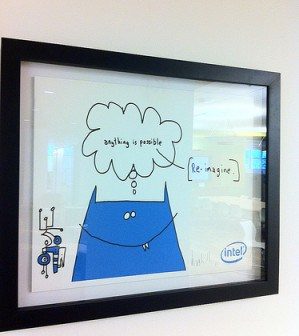
Ken Kaplan brought this to my attention: One of my little blue critters hanging on a wall inside Intel Corp.
Ken called it a “Sign of Super Intelligence and Creativity Inside Intel”. Thanks, Ken!
A cartoon all by itself changes nothing. A “Social Object”, however, can move mountains.
As I’m fond of saying, if your marketing fails to create Social Objects, your marketing will fail.
Think about it some more then get back to me…
May 19, 2011
Note to Social Media Marketing Dorks: The hard currency of the Internet is “Social Objects”.

[One of my favorite recent “Social Objects”: a cartoon I did for Rackspace.]
The Social Object, in a nutshell, is the reason two people are talking to each other, as opposed to talking to somebody else. Human beings are social animals. We like to socialize. But if think about it, there needs to be a reason for it to happen in the first place. That reason, that “node” in the social network, is what we call the Social Object.
For as long as I’ve been involved with the Internet, I’ve seen the SAME OLD DISCONNECT appear again and again AND AGAIN i.e. the disconnect between how the Internet ACTUALLY works and how the social media marketing dorks like to PRETEND how it works.
Case in point: From Steve Jones’ blog:
Today I received an e-mail that said “Like us on Facebook and win”. Later in the day I walked into a store and on the door was a sign that said “Like us on Facebook”.
That’s like Billy Joel asking me to buy his album. It is like walking into a party and having someone say “Be my friend and I’ll buy you a drink”. In a word, it is pathetic.
Damn right it’s pathetic.
Note to Social Media Marketing Dorks: The hard currency of the Internet is not Facebook “Likes” or Twitter “Retweets”, as flavor-of-the-month as they might be. By themselves, they’re worthless.
The hard currency of the Internet is “Social Objects”.
i.e. Social Objects for people to SHARE MEANINGFULLY with other people.
You’re either creating them or you’re not. And if you’re not, you will fail, end of story.
Daily Bizcard # 50: The Holy Within
Today’s Daily Bizcard goes to the celebrity property developer, Donald Trump, who’s been having a whale of a time recently.
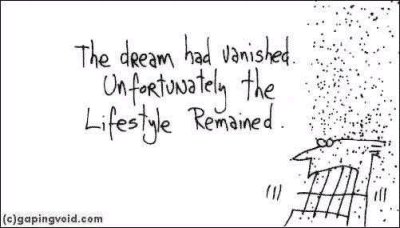
All that razz-ma-tazz must be terribly exciting and all, but damn, I know I would tire of it quickly. I prefer a more quiet, spiritual existence, which I guess is what this cartoon is all about.
[Mr Trump, please contact us via gapingvoid@gmail.com, and we’ll send along a free box of 100 printed business cards for you, with this cartoon on the front, Thanks!]
[The Daily Bizcard archive is here.]
[NB. Yes, the Daily Bizcard is up n’ running again, after a year offline. We finally got our act together etc etc.]
May 18, 2011
Edited my “About” page…
[I added the following to the “About” page. Thought it would be useful to clarify what it is exactly gapingvoid does for a living. Hope it helps etc.]
“Social Media happens around Social Objects, not the other way around.”
At the core of any social media campaign, there are Social Objects.
Social Objects are the Alpha and Omega of Social Media. Without the former, THERE IS NO LATTER, end of story.
So that’s what gapingvoid does. We make Social Objects; that’s what the cartoons are, that’s what “Cube Grenades” are.
We make social objects, big and small. For businesses, brands and individuals.
Check out the Cube Grenade page. We’ve made social objects for large companies like Microsoft, Rackspace and Purina; we’ve made them for small startups and individuals.
I went on record years ago, saying, “Social Objects are the future of marketing.” With the Internet, time has proved me right.
My business partner, Jason Korman and I are experts at this stuff. Feel free to email us anytime at gapingvoid@gmail.com, Thanks.
May 16, 2011
Find Your Starfish…
I drew this “Starfish” cartoon earlier today.
I’ve always loved The Starfish Story, first told by Loren Eisley:
One day a man was walking along the beach when he noticed a boy picking something up and gently throwing it into the ocean.Approaching the boy, he asked, “What are you doing?“
The youth replied, “Throwing starfish back into the ocean. The surf is up and the tide is going out. If I don’t throw them back, they’ll die.”“Son,” the man said, “don’t you realize there are miles and miles of beach and hundreds of starfish? You can’t make a difference!”
After listening politely, the boy bent down, picked up another starfish, and threw it back into the surf. Then, smiling at the man, he said, “I bet I made a difference for that one.”
Drawing cartoons. Those are my starfish.
Whatever it is you choose to do– be it art or working for a large corporation, find out what your own starfish are.
Then keep throwing them back into the water. Every day. Do that, and you will be be happy.
May 4, 2011
@darylcook says,…
My @gapingvoid print now takes pride of place above the desk in my office… a daily reminder!
A daily reminder. Exactly. That’s the whole point of the “cube grenades” etc.
[PS You can buy that same print here…]
May 2, 2011
“How To Be Creative” downloaded 4.5 million times!
My manifesto, “How To Be Creative”, is still the most downloaded manifesto on ChangeThis.com. The editors there recently told me that at last count, it’s been downloaded 4.5 million times.
If you want the more deluxe version, HTBC eventually was reworked, extended and turned into a hardback book, “Ignore Everybody”, which went on to become a Wall St. Journal Bestseller.
Four point five million. Wow. That’s a lot.
Thanks to everybody who took the time to read it over the years. It means a lot, Seriously.
[PS: I also have a second manifesto on ChangeThis, called “The Hughtrain”. Check it out.…]
May 1, 2011
The Future Of Publishing: What Really Matters
Radio Litopia has a TERRIFIC audio interview with my friend, Seth Godin, on the future of publishing, and how his latest enterprise, The Domino Project, is attempting to embrace it.
Seth’s take on the future of publishing is similar to what I’ve been saying for a while: “The book doesn’t matter. The conversation matters.”
A book, as an object, has no inherent, objective power. Which is why it’s so hard to predict bestsellers, why you can’t judge a book by its cover.
The REAL power of a book comes from lots of people reading it and, MORE importantly, people talking about it.
Or as Mark Earls would say, what makes any object REALLY interesting (in this case, a book) is how it changes the human interaction around it, not the actual object itself.
Again, “The book doesn’t matter. The conversation matters.”
But this has always been the case.
A famous author has always been a global microbrand. A publisher’s power has always been in its ability to provide a platform for the author, not in its ability to chop down trees and create printed paper products.
And an author’s power has always been in her ability to affect human interaction through her writings, not in some magical, superhuman quality.
And of course, all the Internet has done is make these truths even more self-evident than they already were.
“The book doesn’t matter. The conversation matters.” That, my friends, is the future of publishing. The actual media– be it Kindle, iPad, hardpack, paperback, whatever– is irrelevant.
And if your publisher doesn’t really get that, then find another one. Seriously.
PS: Seth mentions me about eight minutes into it as a case study of what he’s talking about (Thanks, Seth!).
[Check out my two books here etc.]