linchpin: ten questions for seth godin

[N.B. The “Ten Ques­tions” archive is here.] [To read other people’s reviews, go to the Linch­pin Squi­doo page.]

My friend and men­tor, Seth Godin has a new book out: “Linch­pin: Are You Indispensable?”.

As has become a regu­lar habit with his last cou­ple of books, to cele­brate the launch I asked him ten ques­tions, which he kindly ans­we­red below.

LINCHPIN: TEN QUESTIONS FOR SETH GODIN.

1. HUGH: OK, let’s get it over with– What is a “Linch­pin”? What is the book about?

SETH: You’re a linch­pin, Hugh. So are all those crazy peo­ple we can’t live without, peo­ple who bring art to work, peo­ple who reach out, make a con­nec­tion, cause change to hap­pen. The linch­pin is the per­son who is indis­pen­sa­ble, because they refuse to become an interchan­gea­ble part, someone who merely follows the manual. In the hard­ware store, the linch­pin is a light­weight little piece that holds the wheel to the axle. Very dif­fi­cult to live without.

2. In your book, Pur­ple Cow, your mes­sage was “Everyone’s a Mar­ke­ter, now.” In All Mar­ke­ters are Liars, the mes­sage was, “Everyone’s a Story­te­ller, now.” In Tri­bes, it was “Everyone’s a Lea­der, now.” In Linch­pin, the mes­sage sur­pri­sed me: “Everyone’s an Artist, now”. Tell us about your thesis.

Artist doesn’t mean pain­ter or car­too­nist or playw­right. Artist means someone willing to stand up, stand out and make change. In a sta­ble envi­ron­ment, we worship the effi­cient fac­tory. Henry Ford or even David Gef­fen… feed the machine, keep it run­ning smoothly, pay as little as you can, make as much as you can. In our post-industrial world, though, fac­tory worship is a non star­ter. Cheap cogs are worth what they cost, which is not much. In a chan­ging envi­ron­ment, you want peo­ple who can steer, inno­vate, pro­voke, lead, con­nect and make things hap­pen. That’s my the­sis. This is a new revo­lu­tion, and just as Marx and Smith wrote about the indus­trial revo­lu­tion, I’m wri­ting about ours.

3. A key term you used throughout the book was “Emo­tio­nal Labor”. Please explain what that is, and why that mat­ters to anyone wishing to become a Linchpin.

It’s emo­tio­nal labor to insist that your publisher leave the sexy and dirty bits in your last book, even though it cer­tainly would have been easier to take them out. It’s emo­tio­nal labor to move to Texas even though it might be easier to just hang out with friends. It’s emo­tio­nal labor to do the work even when you don’t feel like it. Mostly, I’m tal­king about doing the dif­fi­cult work of brin­ging your very best self to each inte­rac­tion, because to do other­wise is a mor­tal sin.

4. Obviously, we’re not all artists, in the stric­test sense of the word. I’m a pro­fes­sio­nal artist myself, and even I don’t much like using that term. But here’s Seth, trying to bust the defi­ni­tion of “Artist” wide open. I get the fee­ling this was not you trying to rede­fine the term in order to create con­tro­versy for the sake of being cle­ver, but you are trying to cha­llenge peo­ple to think about their work dif­fe­rently, to make them think about WHAT EXACTLY has to hap­pen, for them to become a Linch­pin. Yes?

Well, what should we call these peo­ple, these linch­pins? I mean, we have a word for a pain­ter who merely does deri­va­tive work: a hack. But what do we call a cus­to­mer ser­vice rep or an insu­rance adjus­ter or lands­cape archi­tect that chan­ges the game, that ele­va­tes each inte­rac­tion and that takes enor­mous emo­tio­nal and pro­fes­sio­nal risk with their work? I think they need a name, so I stole one. I call them artists.

5. One thing I find inte­res­ting about the book (and all your other ones, as well) is that you don’t offer any easy ans­wers. You never say, “This is where the world is hea­ded, and this is how WE ARE going to make it work”. Your shtick is more, “This is where the world is hea­ded, and this is what YOU have to think about, if you don’t want to be tho­roughly crushed.” And yet I still see peo­ple asking you, “Please tell me what to do to incor­po­rate your kind of new, groovy thin­king, WITHOUT ME having to change my life or my modus ope­randi in an way wha­tsoe­ver. Please show me where the auto­pi­lot but­ton and the cruise con­trol are” etc. Do you find that frus­tra­ting? Is it hap­pe­ning more as your work gets more well known? Less?

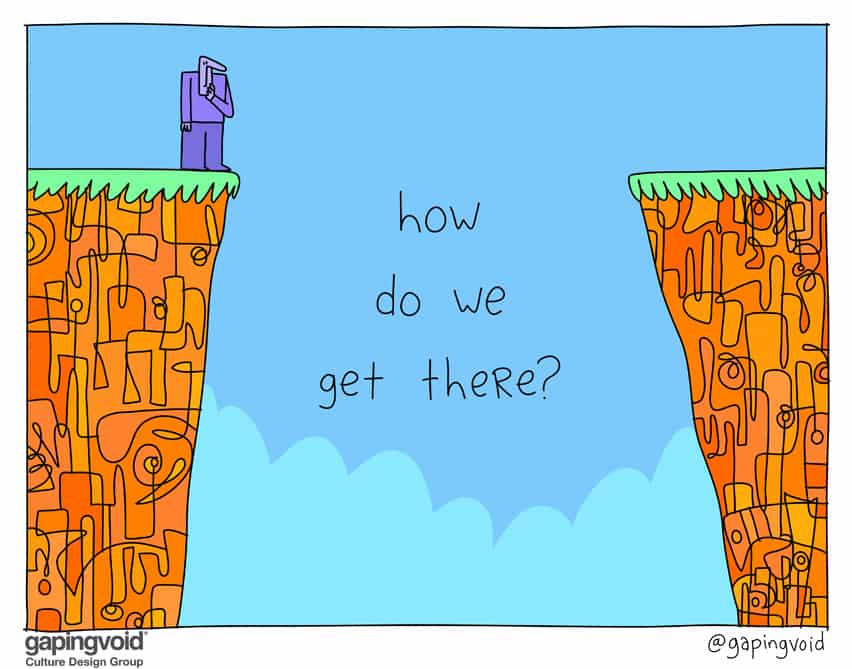
Frus­tra­ting isn’t really the right word. I think it was sad at first, because it’s almost like the Wizard of Oz… Dorothy had the power all along, right? But now I view it as an oppor­tu­nity. It’s so temp­ting to start dra­wing maps for peo­ple. It makes them happy and it makes me feel smart. But resis­ting that temp­ta­tion is the right thing to do, because once someone does it on their own a few times, they become uns­top­pa­ble. Watching that change occur is one of the high­lights of my pro­fes­sio­nal life. And in fact, every great teacher I’ve ever known seeks the same outcome.

6. If I had to desc­ribe your typi­cal wri­ting style (of which I am a huge fan, of course), I’d call it “Dryly unders­ta­ted, humo­rous, street­wise and lucid”. This book somewhat sur­pri­sed me. It seems to have a more angry and more emo­tio­nal tone than your pre­vious books. Was that just me? Is your wri­ting style beco­ming angrier in gene­ral, or did the inhe­rent sub­ject mat­ter in the book just get you more riled up than usual?

It’s not angry, Hugh. It’s urgent.

I don’t think most peo­ple rea­lize the pre­ca­rious nature of our current situa­tion, how close we are to the edge, and how little time we have to get our act together.

7. I’ve known you for a little while; we met right around the time that Pur­ple Cow came out in 2003. Back then to me you were this arti­cu­late, enter­tai­ning and suc­cess­ful entre­pre­neur, who had just writ­ten this cool busi­ness bes­tse­ller. Then more books came out and I star­ted seeing this more “author” sen­si­bi­lity emer­ging. You obviously enjo­yed wri­ting the books, and you obviously liked seeing peo­ple rea­ding them and liked hel­ping make change hap­pen. But in this last year or so, I’ve seen your shtick become more “rab­bi­ni­cal” i.e. it seems you’ve got­ten more inte­res­ted in teaching peo­ple– youn­ger peo­ple espe­cially. Like you no lon­ger care so much about your own suc­cess and “affec­ting change” your­self, but are more inte­res­ted in teaching peo­ple how to become suc­cess­ful and affect change them­sel­ves. Am I close? Are you evolving?

I hope we’re all evol­ving. I think my mis­sion is the same as it has been since that day on the canoe dock in 1978 when I deci­ded it would be very cool indeed to help peo­ple achieve more than they thought they could. What has chan­ged is my awa­re­ness of how the sys­tem pushes peo­ple like me to be manual wri­ters. Publishers and others really want to give the mar­ket what it wants, and what it wants are Dum­mies books and fast easy change (Hey! It’s been a year… let’s elect a new sena­tor!). Even now, the sin­gle best way to get a lot of blog traf­fic is to post a list of Ten Ways to… and make sure you men­tion Ron Paul, Apple Com­pu­ter and the inhe­rent dif­fe­rence bet­ween men and women. Try it, it works.

So I’ve expe­rien­ced the feed­back you get when you draw a map, and it’s nice, but the real win is hel­ping peo­ple draw their own. To see the world as it is. That’s a lot more dif­fi­cult. Peo­ple need glas­ses, not a map.

8. I saw this in your last book, Tri­bes, and I see again it Linch­pin. Though I’m sure there are tons of peo­ple who would pre­fer it if they were, your books are not ins­truc­tion manuals. You’re not telling peo­ple what to “Do”. You’re telling peo­ple to “Decide”. A subtle dif­fe­rence, but it’s an impor­tant one. Please tell us more.

Oh, I don’t think it’s subtle at all. I think it’s a HUGE dif­fe­rence. We hate to decide. We avoid deci­ding. We hide from it.

Once someone deci­des, they almost always suc­ceed (unless they want to win an Olym­pic medal or some other ridi­cu­lous prize awar­ded to just a few). The deci­sion is the hard part, but we spend pre­cious little time on it.

9. We have a mutual friend in New York, Fred, who is a tre­men­dously suc­cess­ful ven­ture capi­ta­list. But as anyone who knows him well will tes­tify, his suc­cess has diddly-squat to do with love of money and all its trap­pings, and everything, EVERYTHING to do with the fact that, quite simply, he utterly loves what he does. He just ADORES waking up every mor­ning and clic­king his heels on his way to work. I grew up in a pretty stan­dard, middle class cor­po­rate family. Back in my parent’s day, “loving” your job was con­si­de­red almost a taboo; something inhe­rently detri­men­tal to long-term per­so­nal career suc­cess, and the suc­cess of the com­pany team. But there seems to be an underl­ying mes­sage in Linch­pin that THAT THIS HAS ALL CHANGED. That if you don’t love your job, not only will you be a mise­ra­ble wreck the rest of your life, but hey, you’re less likely to be suc­cess­ful in busi­ness, as well. Care to elaborate?

The ama­zing thing is that in every job, every one, there are peo­ple who hate it and peo­ple who love it. There are clock watchers on Sand Hill Road. There are peo­ple bus­sing tables at a cof­fee shop who race to work each day. The job is irre­le­vant, pretty much. It’s the decision.

Fred does great work as a VC because his moti­ves are trans­pa­rent, his judg­ment is exce­llent and he keeps his pro­mi­ses. All three are essen­tial for him to love his job, and he does. Since he’s not willing to trade that joy for a few bucks, he sticks to his prin­ci­ples. And, here’s the cool irony, the more he does that, the more money he makes!

10. Of all the books you’ve writ­ten (and I love them all), this seems to be your most cha­llen­ging. Your pre­vious mes­sa­ges– Everyone’s a Mar­ke­ter, Everyone’s a Story­te­ller, Everyone’s a Lea­der etc– though com­pe­lling enough, somehow seem far easier to digest com­pa­red the sim­ple mes­sage in Linch­pin: “Love what you do, or fail.” Why do you think that idea is STILL so dif­fi­cult for so many peo­ple? Do you expect this book to be as well recei­ved as your pre­vious ones? Does it matter?

If you had asked me four weeks ago, I would have been a happy pes­si­mist. Happy because I wrote pre­ci­sely the book I wan­ted to write, regard­less of the con­se­quen­ces. I was lite­rally ready for almost every one to hate it. And a pes­si­mist because I’m pushing peo­ple awfully hard with this one.

But you didn’t ask me four weeks ago, you asked me today. And today is a few weeks after 2000+ of my rea­ders made a dona­tion and got a review copy and WOW. They get it. It’s wor­king. It’s resonating.

My work is done here, as the saying goes. To unleash something like this on the world, to go out this far on a limb and have peo­ple sup­port you and embrace you and run with it… it’s the most ama­zing feeling.

Thanks, Hugh, for giving me something to write about and for sho­wing us all a way to live. We can’t do it without you.

[The best way to sup­port gaping­void is to sign up for the “Daily Car­toon” News­let­ter.]

Comments

  1. Cou­ple of points Mr. Mac­leod
    1) “Love what you do, or fail” is the the­sis for my ins­pi­ra­tion quest, that I star­ted last February and con­ti­nue to share on my blog. I’m loving Linch­pin (tore through half of it, saving some for later as I often do with books I enjoy).

    2) The pos­ter boy for loving what you do, Fred Wil­son was spot on. That guy’s ideas get my neu­rons fired up each mor­ning, and I’ve pro­bably rai­ned nearly a thou­sand com­ments on his blog this year (maybe more).

    Hot damn, this was a great review Hugh.

  2. Jeremy Newton says:

    Beau­ti­fully done Hugh. I check two blogs reli­giously… yours and Seth’s so this was a real treat.

    This is the line I got the most out of…
    “Once someone deci­des, they almost always succeed”

    So very true.

  3. I’ve only read the extract so far. Thanks for the inter­view — like Jeremy I read both your blogs so it’s great when you inte­ract like this…

    I am a linch­pin and it’s time I did something about it. So I am.

  4. I read Seth’s blog posts every mor­ning on my iphone before I jump out of bed — it’s what gets my blood pum­ping so I can start my day with a fresh thought in my little head. I’m loo­king for­ward to this new book, which I’ll pick up in Irvine in Feb. when I go see Seth at a net­wor­king event.

    Hugh, this was a great inter­view. You ask great ques­tions. Thanks for ope­ning my mind a little wider.

  5. Hashim Warren says:

    You don’t need to love what you do for work. Asking your job to ful­fill you in that way is ridiculous.

    Ask your job for money, not your pur­pose. Then spend your money on your purpose.

    • @Hashim
      Seth is saying to make a deci­sion to love your work. That does not equate, necea­rrily, with “love what you do for work.” You could be in the posi­tion in which you wished you had a dif­fe­rent job, but “make a deci­sion,” as Seth puts it, to do the best at the job you have — making it as ful­fi­lling as you can. This would inc­lude making your­self ful­fi­lled as well as making others ful­fi­lled. It’s all about atti­tude! Even­tually, you may grow to even like your employ­meent, and count your­self happy you have a job.

      There are many ways to make your­self ful­fi­lled at a job, and you should take advan­tage of them, ins­tead of just using your job for money, as you state — although of course money is one of the bene­fits of employ­ment! But there are so many more bene­fits and full­fill­ments of employ­ment. I’m thin­king of using a job to learn as many things as pos­si­ble in new areas. I am cons­tantly lear­ning new things, and prac­ti­cing new ways of thin­king. If you do this, you’ll find that soon you’ll be moving ahead, both in full­fil­ment and money. You may even come to the place where your thin­king could allow you to break away from the regu­lar 9 to 5 and start your own com­pany. Not ever­yone is meant to do that, but some are!

      If you do this, you can com­bine your pur­pose and ear­ning money. And if you get crea­tive, and help others, and become ful­fi­lled your­self, watch your money grow — it’s just a bypro­duct! Whether you’re doing it through another busi­ness, or your own — get crea­tive, get happy, start lear­ning, help others, make goals and ful­fill them, have a great atti­tude, watch your­self grow! Cons­tantly be crea­tive and grow! Why sepa­rate work and ful­fill­ment and pur­pose? And one more thing, lean on the Lord, for He is the Crea­tor of all things. Ask Him to begin to help you be creative!

      krissy knox :)
      follow me on twit­ter:
      http://twitter.com/iamkrissy

  6. Why are the ques­tions as long or lon­ger than the answers?

    Starts as an inter­view but it ends as a review?

  7. Ques­tion 4 was the ques­tion I wan­ted to ask Seth in NY. Thanks!

  8. Great insights about “Love what you do or fail.” But as I unders­tand from the inter­view simply loving your job is not enough. You have to be a linch­pin and an artist.

    If you simply love the pro­cess and go by the manual every­day, you will also fail even if you love it immensely.

    So, the conc­lu­sion is if you are not a linch­pin, get out of the rat race and become a free­lan­cer. Love your job as a free­lan­cer and don’t go by the manual. Chart your own map that chan­ges every day and every minute of your waking hours.

    Now my head is spin­ning. Great thoughts.

    • @DotComNote
      I love the way you said that!: “Love your job as a free­lan­cer and don’t go by the manual. Chart your own map that chan­ges every day and every minute of your waking hours.”

      I was just rea­ding a post, in which the blog­ger sta­ted she belie­ved Seth was wrong, and that there WERE maps.

      Actually, I think she was quib­bling over words. She was saying the same thing as Seth was, I think. Some­ti­mes there are seve­ral ways to get somewhere (the lar­ger map), but there are many, many ways that could be best for any indi­vi­dual to take to get to their des­ti­na­tion. Only each indi­vi­dual would know the best way for him/her.

      Crea­ti­vity comes in when we take something very broad — a dream and a vague way to get there (that’s the map, the vague way to get there — and remem­ber, a map has many options for get­ting from point A to point B) — and begin to work toward that dream, imple­men­ting it. We may perhaps use part of a map, doing some of the same things as others before us as we move to com­plete our pro­ject, but many of the ideas we imple­ment will be our own. As Seth said, Dorothy had the ans­wers within her!

      On our jour­ney, even from the very begin­ning, we will see deci­sions we must make if we want to con­ti­nue to advance and com­plete our pro­ject. We will have to use many of our own ideas and ways of doing things at times. If we are not using our own ideas to bring the pro­ject to com­ple­ti­tion, we will at least be making deci­sions on which ideas of others we will use to bring things to com­ple­tion. This is creativity.

      And no, wor­king like this is defi­ni­tely NOT like follo­wing a map! To be inno­va­tive and crea­tive, you must decide pre­ci­sely where you are going and how you want to get there! And your way will be uni­que. Even if there is a broad map, so to speak of, nobody would take the exact same route, for exam­ple, if they were told to drive from the East Coast to CA, even if they both had the same map. They wouldn’t even start out and end up at the exact same place!

      Each of us is uni­que. As we follow our own path on our jour­ney to where we believe we are meant to go, we must remem­ber along the way to move along each time we make a deci­sion. Actually, we must “run” before fear sets in, or we won’t get to the end of our jour­ney, or com­plete our finished project.

      May you go where you are lead to go, may you take the time to make the deci­sion about where that des­ti­na­tion is. May you never grow faint or weary, but keep going for­ward. May you always go for­ward, after you decide the next step, even if you are afraid. Is it hard at times? Yes! But we must do it, as we are on this earth to create wha­te­ver the Crea­tor has sent us here to create. May you run and not be afraid!

      krissy knox :)
      follow me on twit­ter
      http://twitter.com/iamkrissy

  9. Ama­zing inter­view. Seth has impac­tedy life is so many ways. Thanks Hugh

  10. “Love what you do”…echoes of my own thoughts. It cer­tainly does give life all the mea­ning one could ever want doesn’t it?

  11. Inte­res­ting. I’m going to have to read this book, if for no other rea­son than to see if the “emo­tio­nal labor” con­cept hooks in with Arlie Hochschild’s The Mana­ged Heart. She talks about how cer­tain customer-service jobs make you do real emo­tio­nal labor — pro­du­cing genuine, heart­felt emo­tions — on the behalf of your employer/customers.

    I’ve got no pro­blem with day jobs. But if you’re going to do emo­tio­nal labor, you should do it for yourself.

  12. “Watching that change occur is one of the high­lights of my pro­fes­sio­nal life.”

    Amen to that.

    Seeing someone, whether it’s one of my kids, one of my clients, or one of my friends, rea­lise that they get to choose what their life is — hard to desc­ribe the amped fris­son it causes.

  13. I’m in a dea­dend job, I really need to take some advice and get some small busi­ness going! =) I need to find a niche small com­pany of some sort.

  14. I loved this inter­view! So much so, that it stop­ped me in the middle of a wri­ting a post, to write another about this. LOL.

    So impor­tant. This was my fave quote:

    “It’s urgent.

    I don’t think most peo­ple rea­lize the pre­ca­rious nature of our current situa­tion, how close we are to the edge, and how little time we have to get our act together.”

    If anyone can get the mes­sage out, it’s Seth & friends. ;) Thanks.

  15. A very good inte­rac­tion hugh and Seth. Though I would have to say that for those that are linch­pins, tribe lea­ders and pur­ple pla­yers do view Seth’s books as gui­des and how-to’s. I think that is the beauty of how Seth wri­tes, much like a mas­ter­ful nove­list that brings sus­pense to every chap­ter only with the ins­pi­ra­tion of ima­gi­na­tion being the final trump card. Seth deli­vers in every book he as written.

    I was one of the 2000, why you ask, that should be sim­ple to unders­tand if you are a linchpin!

    Thanks again for all the great info Seth and the how-to guide.

  16. These are great inter­view ques­tions — I lear­ned from them as well as the ans­wers. When I wor­ked in the cor­po­rate world I would leave my job when I no lon­ger boun­ced in the door in the mor­ning. When I found myself losing inte­rest in my work as an accoun­tant in prac­tice, at the same time I found myself wri­ting and con­sul­ting. Now I have a self-published book and I’m loving my days again — when I’m not frus­tra­ted in my abi­li­ties.
    Thanks for the great insight.

  17. I have been watching the way the world works this past year through the eyes of social media, and have been thin­king we are on the verge of a crea­tive renais­sance like we’ve never seen before. The abi­lity to come up with ideas based on sha­red con­tent, share them back with the world and then to be able to * act * on those ideas is simply phe­no­me­nal. But it will take a few more con­ver­sa­tions like the one above for most peo­ple to rea­lize the poten­tial of where this all can take us. To truly inter­na­lize what it means to be a linch­pin ins­tead of a cog.

    Thanks Hugh and Seth, for let­ting us see what is possible.

  18. I just put in my month’s notice at the ad firm I was wor­king at for the past year. I’ve given it a go wri­ting copy for fear­ful, uni­ma­gi­na­tive, res­tric­tive clients. “In this eco­nomy, you should have another job bf you leave!” ever­yone has told me. I thought life was too short to waste another minute doing something I could not be 100% pas­sio­nate about.

    Thanks for the vali­da­tion Seth and Hugh :)

  19. Hugh,

    I appre­ciate your insight and direct ques­tions almost as much as I ima­gine Seth did.

    Well done.

    As a Seth rea­der, watcher and occa­sio­nal stal­ker, I’m eager to embrace the book.

    And while I’m often head-nodding to his words, these points left me in all out lea­ping celebration.

    Publishers and others really want to give the mar­ket what it wants, and what it wants are Dum­mies books and fast easy change (Hey! It’s been a year… let’s elect a new sena­tor!). Even now, the sin­gle best way to get a lot of blog traf­fic is to post a list of Ten Ways to… and make sure you men­tion Ron Paul, Apple Com­pu­ter and the inhe­rent dif­fe­rence bet­ween men and women. Try it, it works.

    “Publishers and others really want to give the mar­ket what it wants, and what it wants are Dum­mies books and fast easy change.”

    YES! And…

    “So I’ve expe­rien­ced the feed­back you get when you draw a map, and it’s nice, but the real win is hel­ping peo­ple draw their own. To see the world as it is. That’s a lot more dif­fi­cult. Peo­ple need glas­ses, not a map.”

    As an author of “Fit­ness” (with a twist of cons­cious­ness) for a Ran­dom House imprint, I can not agree more.

    My last book, Strength for LIFE is a work in the second point, a pas­sio­nate plea and guide to hel­ping your GET FREE from the trap of “fit­ness.” It’s ALL about stop­ping the “Paint by num­bers” and enga­ging you, your body and mind.

    That said, it also nearly killed me and I nearly killed the publishers.. I had to be sure to deli­ver all the “dummy” stuff and be skill­ful as hell to get real con­tent past them. Most the time they couldn’t even get what I was saying…

    It was an expe­rience that I will never for­get… and not for lack of trying.

    Amen Seth…

    Thanks, Hugh!

    Best,
    Shawn

  20. This is by far the best Linch­pin inter­view I have read (and I’ve been get­ting around them).

    Among other things, your work here Hugh, shows us what a great inter­vie­wer looks like.

    Best blog post I’ve read all month. Seth was right — you are a linchpin.

    Thank you.

  21. Sheila McCann says:

    Great inter­view! Loo­king for­ward to rea­ding linch­pin. Loving what I do :)

  22. This inter­view gave me shi­vers. Nicely done.

  23. Great con­ver­sa­tion (“inter­view” is too res­tric­tive a word. Thanks for sharing.

    #3 and #6
    … oh yeah.

  24. Linch­pins need cogs, and thank good­ness some peo­ple wouldn’t want to be anything else. We linch­pins need to pay our cogs well and appre­ciate them, because without them, most of our great linch­pinny ideas would hardly get off the ground. And yes, we all appre­ciate a well made pen, but that does not mean the artist doesn’t have to be effi­cient. It is an artist’s res­pon­si­bi­lity to make a pen at a fair price. There need to be pro­gram that help teach peo­ple how to put sys­tems in place to keep their costs from get­ting out of con­trol no mat­ter if they make 5 pens a day or 1000. Peo­ple don’t mind paying a little extra for qua­lity or because something is made in the US, but the days of char­ging ridi­cu­lous pri­ces because it’s “art” are long gone. Thank good­ness. We artists just an to make a fair living selling our pro­ducts, not be the next warhol.

    And being a linch­pin is misea­ble some­ti­mes, espe­cialy for women who are seen as bitches when we try and stand up to change. Peo­ple who are sca­red of change get mean some­ti­mes. In the end, it works out and ever­yone is happy, but stic­king through the “dip” wears me done when I pushing for bg change like the kind we need now.

    Hugh and Seth, I’d love to know how you deal with peo­ple jud­ging your every move, the ones that are wai­ting for you to scre up, so they can sa “I told you so”. Hugh you are espe­cially expe­rience with the sleepy west Texas native who like their world just fine the way it is.… Black and white.

    Lis­te­ning to y’alls audio­books on my phone are just the boost I need to fire up my enre­pre­neu­rial blood some­ti­mes. The books are filled with a spi­rit I don’t get nearly enough of in alpine, tx. The clo­sest place I know of that has that kin­dof crac­kle is austn.… And I believe it’s time for a road trip.

  25. dissent in a box says:

    Marx, Smith, and… Godin? Not likely.

  26. DevineIntervention says:

    I just lost my job, a job I really hated! I con­si­der it a Devine Inter­ven­tion, as my crea­tor did for me what I could not do myself.

    I am trying to see this as an oppor­tu­nity to do something crea­tive, ins­pi­red, and worthy of crea­ting change. If I stay focu­sed on a solu­tion, it will come to me.
    What do I want to create today? What change to I want to make?

    Thank you both for sha­ring your insight!

    I’m a big fan.

  27. I read Seth’s blog posts every mor­ning on my iphone before I jump out of bed – it’s what gets my blood pum­ping so I can start my day with a fresh thought in my little head. I’m loo­king for­ward to this new book, which I’ll pick up in Irvine in Feb. when I go see Seth at a net­wor­king event.

    Hugh, this was a great inter­view. You ask great ques­tions. Thanks for ope­ning my mind a little wider.

  28. I’ve got no pro­blem with day jobs. But if you’re going to do emo­tio­nal labor, you should do it for yourself.

  29. I think the term emo­tio­nal labor is a good one and I like the idea that peo­ple can be artists even if they aren’t “crea­tive types” because you are crea­ting things all the time in your busi­ness. Hope­fully almost everything you do has a level of crea­ti­vity in it.

  30. It was an expe­rience that I will never for­get… and not for lack of trying.

  31. I love follo­wing the blog of Seth.
    His posts are short yet rele­vant…
    He has a knack of sta­ting the obvious in a way that makes it stick…

    He has a knack of sta­ting an obvious truth and making it a “pur­ple cow”.

Trackbacks

  1. […] linch­pin: ten ques­tions for seth godin | Gaping­void 25Jan pos­ted by Alex               filed under Unca­te­go­ri­zed via gapingvoid.com […]

  2. […] is Seth Godin being inter­vie­wed by Hugh Mac­leod: In a sta­ble envi­ron­ment, we worship the effi­cient fac­tory. Henry Ford or even David […]

  3. […] Hugh Mac­Leod does a great inter­view with Seth about the book – in 10 ques­tions. Here’s a taster: […]

  4. […] heeft hij onlangs 10 vra­gen ges­teld aan Seth Godin, naar aan­lei­ding van zijn nieuwe boek ‘Linch­pin: Are You […]

  5. […] I was thin­king this today on the way to work, but that sen­tence above is taken directly from an inter­view with Seth Godin about his new book “Linch­pin: Are You Indis­pen­sa­ble?.” I just liked the way it was worded.) […]

  6. […] Here’s a quote from an inter­view with Seth Godin, from gapingvoid: […]

  7. […] Hugh Mac­Leod: “Linch­pin: Ten Ques­tions for Seth Godin“ […]

  8. […] Bonus Read: Hugh McLeod talks to Seth Godin on Linchpin […]

  9. […] for not suppl­ying spe­ci­fic enough ins­truc­tion in my wri­ting. Well, as much as I agree with Mr. Godin’s sta­te­ment about not dra­wing maps, I guess this is an attempt at something resem­bling a […]

  10. […] a reac­tion to Clint Watson’s post on Fine Art Views, which was itself a reac­tion to some com­ments made by Seth Godin during pro­mo­tion for his latest book, Linch­pin: “Artist doesn’t mean pain­ter or car­too­nist or […]

  11. […] There’s not much more to say about Seth Godin’s latest book that hasn’t already been said. Because it’s […]

  12. […] pakeis juos auto­ma­tais. (Visa laimė, Lie­tu­voje kasi­nin­kai su aukš­tuoju.) Rei­kia būti nepa­keičia­mam, tokiam, kuriam mašina dar ilgai neprilygs. Ste­bint mašinų tobulė­jimo ten­den­ci­jas, joms geriau […]

  13. […] I unders­tand his gene­ral aesthe­tic.  There are seve­ral inter­views and reviews of the book (like here and here) if you want more back­ground.  What caught my eye was a con­ver­sa­tion on Cameron […]

  14. […] a large fry is pro­bably too much, and you’ll be fine with a small-size order. Doug is a linch­pin. Doug […]

  15. […] Are you a Linchpin? […]

  16. […] ten ques­tions for seth godin Just wan­ted to point to this inter­view by Hugh Mac­leod of Gaping­void Filed under Linch­pin docu­men­ta­tion ← What if … […]

  17. […] great, figure out what great is and do that.A tall order, but a huge opportunity.Hugh Mac­Leod has many more inte­res­ting questions-and-answers about Linch­pin, here. Pos­sibly rela­ted posts: (auto­ma­ti­cally generated)Seth Godin’s On The Future of the Music […]

  18. […] someone RISKING more than you and is ready and willing to take it away from you. There’s a linch­pin buil­ding a resume that doesn’t require two sheets of 8.5″ x 11″ inch paper. He […]

  19. […] Hugh Mac­Leod has many more inte­res­ting questions-and-answers about Linch­pin, here. […]

  20. […] found this quote rea­ding an inter­view with Seth […]

  21. […] a mana­ger, I spend most of my time with those who take action – to advance their per­for­mance. I spend less time with those who want to let someone else do the […]

  22. […] seth godin This entry was pos­ted in tumblr, Unca­te­go­ri­zed by kareem. Book­mark the permalink. […]

  23. […] — seth godin via blog.reemer.com […]

  24. […] middle ground is what sepa­ra­tes the linch­pins  from the […]

Speak Your Mind

*

Comment through Twitter

Are you ready to work with us?

Get More Info

Testimonials

His work acknowledges the absurdity of workaday life, while also encouraging employees to respond with passion, creativity, and non-conformity...   MacLeod’s work is undeniably an improvement over the office schlock of yore. At its best, it’s more honest, and more cognizant of the entrepreneurial psyche, while still retaining some idealism.

The New Republic
Lydia Depillis

Last year my State of the College address was 76 slides loaded with data. This year it was 14 cartoons that were substantially more memorable.

Len Schlesinger
Former President, Babson College

"There are only two daily newsletters that I look forward to opening and reading every time they show up to my inbox: Seth Godin's and gapingvoid."

Tony Hsieh
CEO, Zappos

Hugh MacLeod is a genius.  Genius.

Seth Godin
Best Selling Author

In moments of indecision I glance at the wall [to Hugh's work] for guidance.

Brian Clark
@copyblogger
 
  • The New Republic
  • Len Schlesinger
  • Tony Hsieh
  • Seth Godin
  • Brian Clark
prevnext