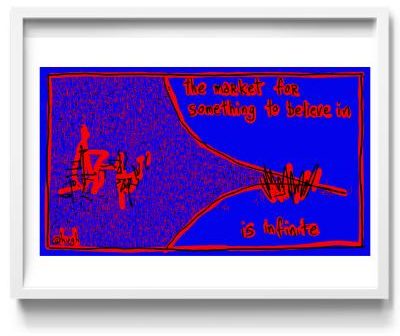
These eight smart, kind, great people, some more well-known than others, are masters at what I call “Selling by Giving”.
They put stuff out there, as gifts. Great content, great ideas, great insights, great personal connection. By giving so much of themselves, for free, every day, they build up huge surpluses of goodwill, so when you’re finally in the market for something they’re selling (and they’re ALL selling something, trust me), they’re first on your list.
I do it, too, just not as well as these guys. I’ve published thousands of cartoons on this blog over the years, and that’s gotten me a lot of business. And not just fine art prints, either. It’s gotten me consulting gigs, full-time salary jobs, book deals, paid speaking gigs, marketing jobs, I could go on…
Selling by giving. Anybody who’s been watching any of these guys for a long time will know exactly what I’m talking about.
But here’s what’s interesting to me: I can remember not that long ago, say 5 years, when this type of marketing seemed pretty freaky to most people. Now it’s considered normal, at least to smart marketers. FIVE years. That’s all.
I could see that in another five years, ANYONE who wants to market ANYTHING successfully– be they small mom n’ pop shops to large companies, will have to be fluent in Gift Economics, to a level that seemed COMPLETELY alien only a few years ago.
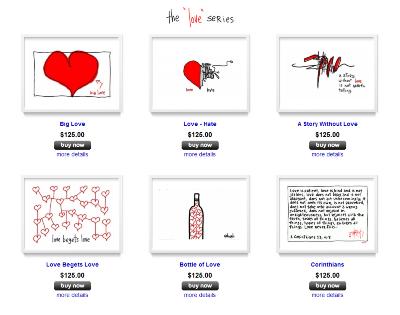
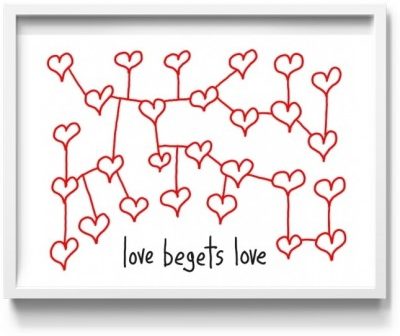
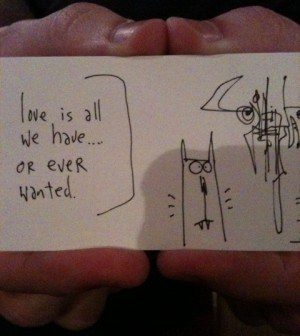
With Valentine’s Day coming up, we thought we’d do a series of prints for all you love junkies out there.
Voila! The ‘Love’ Series. Order them now and get them in plenty of time before February 14th. Exactly!
You did the chocolate and flowers thing last year, anyway…
This cartoon series first came out of the Stormhoek “Love Tour” three years ago, when I was doing some Valentine’s promo for wine at Tesco’s, the large British supermarket chain. That was a very crazy two weeks; watch the video if you don’t believe me.
And Ladies, please always remember The Golden Rule: Men Are Stupid. So if you want your man to get you one of these beauties for Valentine’s Day, do not assume he and his walnut-sized brain will be smart enough to figure it out on their own. Best to drop him a hint. Maybe kick him in the shins. Or something.
I’ll be sending these cartoons out on my “Hugh’s Daily Cartoon” mailing list for the next week or two, then the plan is to do something less “cute and cuddly” after that. Rock on.
[UPDATE: My email service, Mailchimp, was down last night for a couple of hours, Aaaargh. But it’s up and working now. So if you had any problem signing up last night, please try again etc.]
The first print I published via gapingvoid was The Bluetrain, pictured above. It debuted in early 2009 at around the $175 mark.
The last one we sold fetched $1095.00.
Meanwhile, two weeks ago we launched “Hugh’s Daily Cartoon”, where I email my subscribers a new cartoon every weekday.
So far it’s been a huge success, but now that it seems to have a bit of momentum behind it, I naturally want to keep it going.
So I’ve decided to experiment: I’m going to give away, for free, one copy of my most expensive (and now-very-rare print) i.e. one of the Bluetrains.
Who to? Some random person who signs up to “Hugh’s Daily Cartoon” any time between now and 12.01am, Saturday morning, the 30th of January. Just over 24 hours from now Monday morning, 1st February (We extended the deadline 48 hours, due to the fact that we had server issues with our email server).
I’ll be interested to see what happens. Like I said, this is just an experiment.
Feel free to tell your friends, Thanks.
P.S. For those of you who have already subscribed, no worries if you’re missing out. I’ll figure out something to do with y’all as well, sooner than later. One step at a time, Thanks Again.
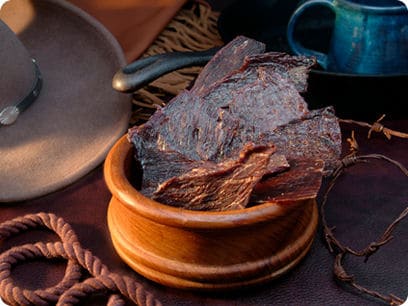
I’m happy to report that The Lights Jerky Company, based in my hometown of Alpine, Texas, has finally gotten their new website up.
What can I say? It’s the best store-bought jerky I’ve ever had. Locally, it’s really popular. Glenn Short, the owner, sells it in all the bars, convenience stores and supermarkets in the Far West Texas area. He’s a great guy and he really puts his heart and soul into it. And people can tell…
Glenn and I meet up about once a week or so for beers…
All you jerkyheads can order it here in one, three and five pound boxes.
Seriously, Guys, this stuff is the bomb. A global microbrand in the making? I hope so.
[Disclosure:] The new website was designed by Outhink, the same folk who redesigned gapingvoid.com a few months ago. I recommended them to Glenn etc.
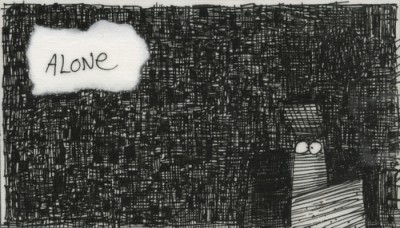
Another one from my New York days, circa 1999. It captures well the feeling you get when you’re still new in town– surrounded by a sea of people, yet nobody really knows you.
I wrote the “Alone” bit is on a separate bit of card, tore around it, stuck it on the main card, then I laminated the two pieces together in clear plastic.
I laminated the very early ones– maybe a hundred or so of them. They’ll be worth a lot of money once I’m dead. Heh.
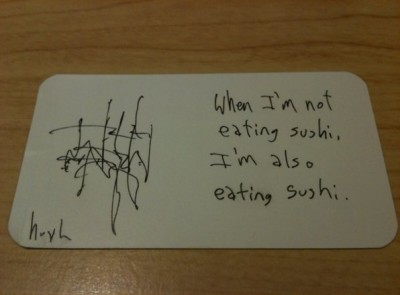
Earlier this week there was a fun little Tweetup at a sushi restaurant here in Miami Beach. I drew this cartoon on the back of @sushi_pro’s businesscard… Rock on.
As has become a regular habit with his last couple of books, to celebrate the launch I asked him ten questions, which he kindly answered below.
LINCHPIN: TEN QUESTIONS FOR SETH GODIN.
1. HUGH: OK, let’s get it over with– What is a “Linchpin”? What is the book about?
SETH: You’re a linchpin, Hugh. So are all those crazy people we can’t live without, people who bring art to work, people who reach out, make a connection, cause change to happen. The linchpin is the person who is indispensable, because they refuse to become an interchangeable part, someone who merely follows the manual. In the hardware store, the linchpin is a lightweight little piece that holds the wheel to the axle. Very difficult to live without.
2. In your book, Purple Cow, your message was “Everyone’s a Marketer, now.” In All Marketers are Liars, the message was, “Everyone’s a Storyteller, now.” In Tribes, it was “Everyone’s a Leader, now.” In Linchpin, the message surprised me: “Everyone’s an Artist, now”. Tell us about your thesis.
Artist doesn’t mean painter or cartoonist or playwright. Artist means someone willing to stand up, stand out and make change. In a stable environment, we worship the efficient factory. Henry Ford or even David Geffen… feed the machine, keep it running smoothly, pay as little as you can, make as much as you can. In our post-industrial world, though, factory worship is a non starter. Cheap cogs are worth what they cost, which is not much. In a changing environment, you want people who can steer, innovate, provoke, lead, connect and make things happen. That’s my thesis. This is a new revolution, and just as Marx and Smith wrote about the industrial revolution, I’m writing about ours.
3. A key term you used throughout the book was “Emotional Labor”. Please explain what that is, and why that matters to anyone wishing to become a Linchpin.
It’s emotional labor to insist that your publisher leave the sexy and dirty bits in your last book, even though it certainly would have been easier to take them out. It’s emotional labor to move to Texas even though it might be easier to just hang out with friends. It’s emotional labor to do the work even when you don’t feel like it. Mostly, I’m talking about doing the difficult work of bringing your very best self to each interaction, because to do otherwise is a mortal sin.
4. Obviously, we’re not all artists, in the strictest sense of the word. I’m a professional artist myself, and even I don’t much like using that term. But here’s Seth, trying to bust the definition of “Artist” wide open. I get the feeling this was not you trying to redefine the term in order to create controversy for the sake of being clever, but you are trying to challenge people to think about their work differently, to make them think about WHAT EXACTLY has to happen, for them to become a Linchpin. Yes?
Well, what should we call these people, these linchpins? I mean, we have a word for a painter who merely does derivative work: a hack. But what do we call a customer service rep or an insurance adjuster or landscape architect that changes the game, that elevates each interaction and that takes enormous emotional and professional risk with their work? I think they need a name, so I stole one. I call them artists.
5. One thing I find interesting about the book (and all your other ones, as well) is that you don’t offer any easy answers. You never say, “This is where the world is headed, and this is how WE ARE going to make it work”. Your shtick is more, “This is where the world is headed, and this is what YOU have to think about, if you don’t want to be thoroughly crushed.” And yet I still see people asking you, “Please tell me what to do to incorporate your kind of new, groovy thinking, WITHOUT ME having to change my life or my modus operandi in an way whatsoever. Please show me where the autopilot button and the cruise control are” etc. Do you find that frustrating? Is it happening more as your work gets more well known? Less?
Frustrating isn’t really the right word. I think it was sad at first, because it’s almost like the Wizard of Oz… Dorothy had the power all along, right? But now I view it as an opportunity. It’s so tempting to start drawing maps for people. It makes them happy and it makes me feel smart. But resisting that temptation is the right thing to do, because once someone does it on their own a few times, they become unstoppable. Watching that change occur is one of the highlights of my professional life. And in fact, every great teacher I’ve ever known seeks the same outcome.
6. If I had to describe your typical writing style (of which I am a huge fan, of course), I’d call it “Dryly understated, humorous, streetwise and lucid”. This book somewhat surprised me. It seems to have a more angry and more emotional tone than your previous books. Was that just me? Is your writing style becoming angrier in general, or did the inherent subject matter in the book just get you more riled up than usual?
It’s not angry, Hugh. It’s urgent.
I don’t think most people realize the precarious nature of our current situation, how close we are to the edge, and how little time we have to get our act together.
7. I’ve known you for a little while; we met right around the time that Purple Cow came out in 2003. Back then to me you were this articulate, entertaining and successful entrepreneur, who had just written this cool business bestseller. Then more books came out and I started seeing this more “author” sensibility emerging. You obviously enjoyed writing the books, and you obviously liked seeing people reading them and liked helping make change happen. But in this last year or so, I’ve seen your shtick become more “rabbinical” i.e. it seems you’ve gotten more interested in teaching people– younger people especially. Like you no longer care so much about your own success and “affecting change” yourself, but are more interested in teaching people how to become successful and affect change themselves. Am I close? Are you evolving?
I hope we’re all evolving. I think my mission is the same as it has been since that day on the canoe dock in 1978 when I decided it would be very cool indeed to help people achieve more than they thought they could. What has changed is my awareness of how the system pushes people like me to be manual writers. Publishers and others really want to give the market what it wants, and what it wants are Dummies books and fast easy change (Hey! It’s been a year… let’s elect a new senator!). Even now, the single best way to get a lot of blog traffic is to post a list of Ten Ways to… and make sure you mention Ron Paul, Apple Computer and the inherent difference between men and women. Try it, it works.
So I’ve experienced the feedback you get when you draw a map, and it’s nice, but the real win is helping people draw their own. To see the world as it is. That’s a lot more difficult. People need glasses, not a map.
8. I saw this in your last book, Tribes, and I see again it Linchpin. Though I’m sure there are tons of people who would prefer it if they were, your books are not instruction manuals. You’re not telling people what to “Do”. You’re telling people to “Decide”. A subtle difference, but it’s an important one. Please tell us more.
Oh, I don’t think it’s subtle at all. I think it’s a HUGE difference. We hate to decide. We avoid deciding. We hide from it.
Once someone decides, they almost always succeed (unless they want to win an Olympic medal or some other ridiculous prize awarded to just a few). The decision is the hard part, but we spend precious little time on it.
9. We have a mutual friend in New York, Fred, who is a tremendously successful venture capitalist. But as anyone who knows him well will testify, his success has diddly-squat to do with love of money and all its trappings, and everything, EVERYTHING to do with the fact that, quite simply, he utterly loves what he does. He just ADORES waking up every morning and clicking his heels on his way to work. I grew up in a pretty standard, middle class corporate family. Back in my parent’s day, “loving” your job was considered almost a taboo; something inherently detrimental to long-term personal career success, and the success of the company team. But there seems to be an underlying message in Linchpin that THAT THIS HAS ALL CHANGED. That if you don’t love your job, not only will you be a miserable wreck the rest of your life, but hey, you’re less likely to be successful in business, as well. Care to elaborate?
The amazing thing is that in every job, every one, there are people who hate it and people who love it. There are clock watchers on Sand Hill Road. There are people bussing tables at a coffee shop who race to work each day. The job is irrelevant, pretty much. It’s the decision.
Fred does great work as a VC because his motives are transparent, his judgment is excellent and he keeps his promises. All three are essential for him to love his job, and he does. Since he’s not willing to trade that joy for a few bucks, he sticks to his principles. And, here’s the cool irony, the more he does that, the more money he makes!
10. Of all the books you’ve written (and I love them all), this seems to be your most challenging. Your previous messages– Everyone’s a Marketer, Everyone’s a Storyteller, Everyone’s a Leader etc– though compelling enough, somehow seem far easier to digest compared the simple message in Linchpin: “Love what you do, or fail.” Why do you think that idea is STILL so difficult for so many people? Do you expect this book to be as well received as your previous ones? Does it matter?
If you had asked me four weeks ago, I would have been a happy pessimist. Happy because I wrote precisely the book I wanted to write, regardless of the consequences. I was literally ready for almost every one to hate it. And a pessimist because I’m pushing people awfully hard with this one.
My work is done here, as the saying goes. To unleash something like this on the world, to go out this far on a limb and have people support you and embrace you and run with it… it’s the most amazing feeling.
Thanks, Hugh, for giving me something to write about and for showing us all a way to live. We can’t do it without you.
Paul Fabretti, an old social-media PR buddy from my UK days, asked me to draw him a “cube grenade” for his Manchester-based PR 2.0 company, Gabba. Rock on.
“A bit like being a shrink,” he told me, “but more business-focused.”
A big part of his modus operandi is not telling people what to do with their businesses, but trying to get them over their fears of achieving that which they MUST do, if they want to become the people they one day hope to be.
“The issues my clients fear the most tend not to be the actual stuff out there– competition, cashflow, marketing,” he says, “but the worst-case imaginary scenarios. ‘The Monster Inside Their Heads’, as it were. So a central tenet to what I do is helping them to get over The Monster.”
So he commissioned me to draw a Monster-themed “Cube Grenade”, as a signed, fine-art print to give away as presents to his best customers and allies. Something to keep on the office wall as a constant reminder.
I was glad to do it. I’ve always got my fair share of Monsters, myself. Rock on.
During the dotcom boom in early 2000, I was out in Los Angeles for six months, working for a startup, renting a house in Venice, near the beach. The usual…
One night I was at a big party in the Hollywood Hills, with my friend Colin, and his girlfriend, Amy.
Colin and Amy were a nice couple. Colin was a bit of a clown and a rogue, but pretty lovable. Amy was a real sweetheart, and cute as a button.
The party was pretty typical LA: a large herd of twenty and thirty-somethings wandering around rather aimlessly on the make, trying to score romance and/or useful business and social contacts. We’ve all been there…
About one a.m. Colin and Amy approach me.
“Ready to drive back to Venice?” asks Colin.
“Sure, not a problem,” I say. “This scene blows.”
Suddenly, this other cute girl comes up.
“Excuse me,” she says. “Are you going to Venice? Would you mind dropping me off on your way home? My ride already left an hour ago. I live just off Santa Monica Blvd…”
Sure, no problem.
So there we were, driving home, the four of us. Colin and Amy in the front, me and the cute girl– her name was Cindi– in the back.
The back seat was huge– Colin and Amy were probably four feet in front of Cindi and I, making in hard to talk to them without shouting. Besides that, Colin and Amy were already lost in conversation, the radio was playing pretty loudly, so Cindi and I just carried on by ourselves, talking to each other.
It was a fun conversation. Cindi was smart, funny and delightful company. I can’t remember what the conversation was about– just the usual young single’s LA banter, I suppose.
We’re talking away, when suddenly I interrupted her quite suddenly.
“Hmmmm…” I say, “You’re kinda cool… I’m kinda cool…”
A slight pause.
“We should kiss!” I exclaim, rather jokingly.
Cindi looks at me for a moment, says nothing, then suddenly leans over and plants a big one on the ol’ lips. Hurrah!
I won’t tell you what happened after that, only to say that, with Colin being the biggest gossip-monger on the planet, for the next few months I couldn’t go into my local bar in Venice without one the barflies jokingly saying, “You’re kinda cool… I’m kinda cool… We should kiss!” every time I walked by.
The thing had gone viral at the bar. A few years later the bar’s owner told me that the regulars still liked to use it at the bar, when they wanted to tease a friend. It had become a legend. Thanks Colin! Heh.
Don’t worry, I didn’t really come here to tell you about my love life.
I was just thinking earlier today about how this story relates to Cube Grenades. Seriously. Hear me out:
Cube Grenades aren’t designed to work like traditional advertising messages.
“Here’s why you should buy my product” would be a bit like me saying to Cindi in the back of the car, “Here are my recent bank statements and a compete list of all my former sexual partners; would you like to go bed with me…?” Human beings are far too sophisticated for that attitude. It wouldn’t have worked with Cindi, why would it work on our customers?
The way the Cube Grenade works, is more like a gift, a social gesture. “You’re kinda cool… I’m kinda cool…” i.e. a social object that expresses the idea, “I’m into the same things you’re into.”
And I’m starting to think more and more, as marketing gets more and more about The Social, the ability to make these kind of “You’re kinda cool… I’m kinda cool…” social gestures with one’s market is going to get increasingly important. Just sayin’.
I drew the cartoon above over five years ago. It still applies.
Brian Clark and I were chatting on the phone yesterday about the end of the “Utopian” phase of blogging and social media.
Yes, all that talk about “Conversation”, “The Social Graph”, “End of Marketing”, “Advertising Is Dead”, “Authenticity”, “Transparency” and “Bypassing The Gatekeepers” had its place.
At the same time, I think we all collectively wasted a lot of time by endlessly yakking on about it. “Building Brand Advocates through Influencer Engagement” and similar corporate drivel.
I think 2010 will the year we all start actually being more TRANSPARENT about why we’re really here in the first place: To make money.
i. The Book. Sometime on Sunday I finished the first draft of “EVIL PLANS”. Sent it off to the publisher yesterday. Now begins the editing and the production. It hits the bookshops January 2011.
I’m already thinking about a third book…
About mid-December I had this big ol’ panic attack; thinking I’d better get to work on EVIL PLANS or else I’d miss the deadline I’d set for myself. So I buried myself in the office and pulled my hair out for a couple of weeks. All this while the Holiday Season was kicking in– more hair pulling there as well, but that’s a story for another day etc.
Ok, so the deadline was met in good time, but I’m a nervous wreck now…
“From early January, 2010, I’m starting a newsletter for you guys. The plan is to e-mail y’all a new, free cartoon every morning at 6am, New York Time. I may include other stuff along with them– written observations, tips, useful links etc– but regardless, I’m hoping it’ll be something that starts your day off with a chuckle.”
Daily Cartoons and the occasional long “Crazy, Deranged Fools” written piece. I hope you’ll sign up, Thanks. I’m hoping that launches any day now.
iii. Ummmm… Did I mention that I’m a nervous wreck now…?
I have a feeling that I’m going to be asked the following question a lot in the next couple of years:
“How do I execute my EVIL PLAN within the limits of my current job at a big company?”
I’m probably the wrong person to ask– I’ve never fitted into corporate culture very well. But I did write few initial thoughts below, just to get the gears turning. Feel free to add your own in the comments. I’m going to be thinking about this for a while, Thanks.
1. An EVIL PLAN’S success is 90% the people around you. This so true whether we’re talking small business or large, salaried or freelance, boss or employee. So if you have smart, nice, dynamic, successful people around you– both colleagues and customers– I don’t see why you can’t execute it from anywhere. It all depends how aligned your EVIL PLAN with the people you work with and sell to.
2. If your EVIL PLAN is not aligned with what your company is doing, you have two choices. Quit and go do something else, or give up your EVIL PLAN.
3. Patience is a virtue. Things tend to happen more slowly at big companies, especially the more edgy stuff. A lot more time and effort is needed to corral your allies into critical mass. That’s just reality.
4. Risk. I always liked Robert Scoble’s line, “If what you’re doing doesn’t risk getting you fired, it probably isn’t that interesting.” People who are very risk averse don’t get to play in the EVIL PLANS sandbox. That, too is just reality, and no crazy-ass cartoonist’s blog post will change that.
5. Create your own luck. Create your own job description. None of the best jobs in large corporation are ever created by your boss. They’re created by you taking the initiative. And there’s a definite art to that.
6. Practice. Fail. Practice some more. Fail some more. Keep practicing and failing. Eventually you’ll get there.
[UPDATE:] Ian Wallace left a comment below. Samuel Beckett’s advice to anyone who dares to follow their own EVIL PLAN:
Have a story. And make sure it’s a good one. A DAMN good one.
I have a very old, dear friend in New York, call him Andrew.
Andrew is about forty, and a pretty successful film director. One of his films aired on HBO recently. He also has a thriving corporate video business, which he works on when business in Hollywood is going slow that month. He’s not famous, but he’s done very well.
When I first met him he was in his late twenties, working as a bartender. Back then he had a vague idea of getting into the film business some day, but I didn’t know how serious he was, to be honest. A lot of twenty-somethings in New York blether on about getting into film, one tends to mostly ignore it.
But how he eventually broke into the film business is one of my favorite tales.
In the very late 1990s he finally decides that he’s serious about breaking into the industry. So he goes out and buys himself a small video camera, a sound recorder, a new Macintosh computer to do his editing, a few lights, some microphones, that kind of thing.
So the good news is, he now has all the gear he needs to get started.
The bad news is, having spent all his savings to acquire the gear, suddenly he needs money in a hurry. New York is expensive, and he’s broke.
But because he had pretty much zero experience in the film business at that point, he soon realizes that it’ll be a while before anyone in the traditional New York film industry will hire him for the kind of money he’s looking for.
He can’t afford to wait that long. So how does he pay the rent?
He decides to go into porn.
But not just any kind of porn. He does PERSONALIZED porn.
Let’s say you and your Significant Other want to create, shall we say, a special memento [*cough*] of your love [*cough*], and want something a bit more upmarket [*cough*] than just the normal, amateur, single-angle, unedited video from a camera [*cough*] that’s standing on a tripod near to the bed.
That’s right. You’d give Andrew a call. And Andrew and his sound man would come over to your apartment and shoot you and your significant other [*cough*] going at it. With proper edits, lighting, sound and camera angles. You and your loved one in the full throes of passion [*cough], with Andrew and his sound man hovering around you in silence, getting the perfect shot.
After he had shot the video, he would then take out his computer and edit the job right then and there, on the kitchen table. So before he left your home, he’d have already given you the SINGLE and ONLY copy that existed of the video. He and his sound man would then exit with nothing i.e. with no backup copy on his computer, so there was no chance of the footage ending up on the internet. At least, not from Andrew’s side.
He charged a few hundred bucks for his services. The average shoot only took an hour or two. He’s often do two or three shoots a day. Damn good money for an ex-bartender. A lot more money than I ever made in New York.
Business was brisk from Day One, to say the least. When he first told me what he’d been up to, back around 2000, I liked the story so much I pitched the idea to a journalist friend of mine. Andrew ended up being featured in a pretty high-end magazine soon after, which raised his profile even more. Within no time the phone was ringing off the hook, with all sorts of interesting people, both inside and outside the film industry, wanting to do business with him.
Great story. There’s only one catch:
I was talking to Andrew on the phone yesterday, wishing my buddy a Happy New Year’s. I asked him if he minded me using his “Personalized Porn” story for a chapter in EVIL PLANS, as a possible case study for interesting and original business models.
“Sure, Hugh, go right ahead,” he says. “Just one thing. None of it is true.”
“Huh?”
“I made the whole thing up.”
“What?” I say. “My favorite story about you ever, the one I’ve been telling folks with glee for the last ten years, was a total lie???”
“Yes.”
“Man, you’re a good bullshitter,” I say.
“You knew that about me already,” he says.
“Wow.”
“Look,” he says, “Back then I was just one of thousands of young wannabe film knuckleheads in New York, trying to get my foot in the door. I needed to have a story to tell people. One that was interesting. One that was different. One that got people’s attention. One that made me stand out from all the other knuckleheads. One that didn’t require me having a massive showreel. Hey, it worked. That story got me my first few editing jobs in the business. And since then I’ve been nothing but successful.”
He pauses for a second.
“A little present-tense success, forgives a lot of past-tense failure,” he says, chuckling with delight.