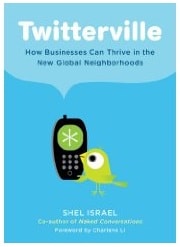
Shel Israel and I have known each other since 2005, when he interviewed me for his seminal book on blogging, “Naked Conversations”, that he co-authored with Robert Scoble. Since then he’s been running around, writing books and consulting with large companies on all things to do with social media. His second book, “Twitterville: How Businesses Can Thrive in the New Global Neighborhoods” is launching September 3rd. As he and I have the same publisher, they sent me an advance copy to read, which I was really impressed with. I asked him ten questions, and he kindly agreed to answer them below.
TEN QUESTIONS FOR SHEL ISRAEL
1. Congrats on Twitterville coming out. Please tell us all about it.
In many ways, Twitterville is the de facto sequel to Naked Conversations. The older book gave the argument of why businesses should blog. Twitterville does the same thing, except it goes beyond business to include government, nonprofits and media.
Essentially, I tell the stories of people who use Twitter in interesting and useful ways. The hope is people will read the book and get ideas for using Twitter to help them in whatever it is they wish to do.
2. This book was actually a long time coming. After Naked Conversations, you had a wee bit of trouble getting your second book up and running. A symptom, I believe, not so much of your talents as an author, but of the inherent subject matter itself. A book takes about a good year and a half to write and produce, often far longer. Social Media changes overnight on a regular basis. Please elaborate.
There are two pieces of conventional wisdom for business books: A. Take one bone-dead simple idea and repeat it with some variations for 16-20 chapters such as The World is Flat. B. Write about a subject that will not change while you are writing it such as Thomas Edison and the marketing of electricity.
Obviously, I’m bad at following conventional wisdom. I take a different approach in that I like for something that is just taking off which can be enduring. I interview a ton of people and I look for stories that may maintain value for a few years even as they age.
Social media does change overnight, but people don’t and business rarely does. So I look for stories that deal with enduing issues such as profitability, the long slow death of traditional marketing ethics, access to information, making government more accountable and so on.
3. You wrote in your book about South By South West 2007, which has now become legend in social media circles. It was there and then that Twitter launched their website to the public, and everybody went crazy for it. I remember- I was there. The first thing that struck me about SXSW ’07 was that suddenly, unlike a lot of the Web 2.0 conferences I had been to before, the star of the show wasn’t some personality, web celeb, “A-Lister” etc… but an actual, non-living, non-breathing, digital website. At the time, I felt like a real shift in Web 2.0 was taking place. From hierarchical, personality-driven, to something else. You?
I think SXSW 07 is the classic story of a star is born overnight, except in this case the star was a flawed little social media platform originally designed to solve an internal problem.
I have always felt A-List focus was vastly over rated. When you look at luminary numbers and put them against the growth rate of Twitter every day, those who are prominent reach a smaller percentage of the entire Twitter universe every day. Each of them is in fact becoming influential to a smaller–not larger– share of the mainstream.
Twitter is decentralizing by its very nature. Of course there are dramatic stories from Twitterville- @JamesBuck arrested in Egypt; @jkrums taking a photo on the Hudson. But just the drama and luminary angle is much smaller than how Twitter serves everyday people, who just have a few followers, who just post a few times every day. Yet Twitter is changing their lives and their business, all the time.
4. Like yourself, I can totally see the value of Twitter (Very cheap, very fast and very easy- even compared to blogs or Facebook etc). Yet, like blogs before it, mainstream adaptation seems to be taking its own sweet time, yet again. As Ben Hammersley said about new media in general back at Reboot 2005, it’s not because the technology is hard to use (it isn’t), or that it’s intellectually hard to get one’s head around (it isn’t), but that to use it properly requires learning A NEW SET OF MANNERS, a new set of social codes. And getting people to do that is really, really hard. As a Web 2.0 consultant with corporate clients , getting these folks to “learn some new manners” must be the hardest part of your job, I’m guessing. Yes?
Ben has a point, but I would take issue with both of you on just how fast Twitter -and social media in general- is changing the world. If you sit on the equator, sipping a beverage with an umbrella in it, watching a coconut tree sway in a soft breeze, it feels motionless; like nothing is happening.
But as you sit there, you are spinning around the world at something like 2400 mph. You are orbiting the Sun at a speed much faster than that and you are hurtling through the universe at a speed humans cannot yet calculate.
Yet, sitting on that porch it may feel like not much is happening.
Those of us who are passionate about social media; who stand in front of rooms where some of the senior people have there arms crossed and there heads going from side to side, often vastly underrate the speed of change.
To understand that, I advise people to go speak to some young people. Watch their habits; watch how they get influenced on what to buy, watch, listen to; where to work. Watch young people going to the workplace and how they use social media as communications and information and productivity tools.
I maintain that we are at the very beginning of a fundamental global social revolution. And it is moving at a blindingly rapid speed.
5. Like Naked Conversations before it, Twitterville is rich in case studies. You talked to a LOT of people. As a fellow author, allow me to pick your brains. When an interesting story was breaking in the “Twittersphere”, one that might have made an interesting case study at some point, did you make a note, put it on file and save it for later? Or did you just rely on memory (and Google) when it came time to write the book?
Organizing for Twitterville was like taking a speed tour through Dante’s Inferno. I am a poor organizer to begin with. I created 17 Word documents on topic and kept dropping links into it. I had post its on my wall and in my reporter’s notebooks. Then something would break like Mumbai and that wouldn’t fit into any of my proposed chapters, but how could I not cover it. While pondering that, Gaza–Israel broke, so then I had to rewrite Tables of Contents.
The other thing that is a challenge is that I try to be more of a story teller, and most business books are not written that way. In the end, I followed the stories and built chapters around them and then restructured- and restructured the flow of the book to respect the people whose stories I told.
6. It’s the worst-kept secret in publishing: Books RARELY make a lot of money for their authors. That being said, since my book came out in June, the number of emails I get, asking about art commissions or other paid gigs has risen NOTICEABLY. I’m utterly swamped. As I’ve been saying forever, “Blogs are a good way to make things happen indirectly”. It turns out, the same is true with books. It’s all about “Leverage”. What’s been your experience?
You and I have discussed this before, but on the fame-fortune continuum, we are both much stronger so far on the fame side. I made much more money last time by advising companies and through speaking engagements.
With less than a week to go before Twitterville is available, I of course have dreams of being a #1 Best seller. It is far more likely that once again I’ll do better with speaking and business advising than from actual book sales.
When I first started, someone advised me that you write a book to get the speaking engagements. You use speaking engagements to set the stage for your next book. That’s what my strategy will be.
7. Your background is in Silicon Valley PR. With Naked Conversations, your focus morphed towards Social Media. What drove this personal evolution, do you think?
I am very curious by nature. For a long time I was simply amazed at the disruption and innovation that exploded from Silicon Valley. Now, the technology of the last 30 years has become part of everyday lives in the developed world.
My curiosity is very much focused on how this technology is changing the lives of the world’s people. If given the choice of following social media’s role in Iran’s election larceny, or the beta glitches in the iPhone battery, I’ll spend my time following Iran.
8. When Naked Conversations came out, blogging was new. Web 2.0 was new. Now it’s mainstream. I often get nostalgic for those early days, when the blogosphere was tiny, everybody knew each other, and a brave new world seemed to lie just a few pixels beyond the horizon. Now I find myself caring much less about “the future of media” or whatever, and finding I care a lot more about what I can do TODAY with social media, to help MY business. Has social media grown up? Has it become “like our parents”?
Every enduring technology has been introduced with an associated mania. The inventors are brilliant, the early adopters are passionate, and the media is excited because it’s all so new.
This was true probably of every innovation going back to the wheel. But then comes the longer, slower, steadier period of mass adoption, when people adopt these revolutionary concepts just to get their job done. There was a time when hearing a human voice on a telephone must have been mind-boggling. But, over time, the phone just became an everyday tool to let you use in your life and work.
Social Media, dramatic, explosive, disruptive period is now coming to an end, if you ask me. It is normalizing. It is changing more of the world, but is doing it in less dramatic ways.
We are probably starting to get to the stage of development that interests you and I the least. That’s where best practices get established, measurement systems become reliable, bean counters can estimate cost and value. Social media champions are no longer rebels ratting on the gates of large institutions. We have gotten past the barriers. We will soon start taking our rightful places on the org chart, with our own budget allocations.
This is good for business and the world. It’s just a little boring for disruptors like you and me.
9. As a former PR flack, you’ll obviously have more than your fair share of opinions about PR and how that world is changing, fueled on by social media. Anything you feel more strongly than most?
I think when I practiced PR I thought about ten percent of my peers were true professionals who understood that communications is not buzz; that listening is valuable; that customers need to be respected and that those who cover news need to not be on your side if they are to maintain credibility.
I think all of that is true today and the percentage as pretty much remained constant.
But those who practice PR and are skilled at social media–people like Shel Holtz, Brian Solis, Steve Rubel, Kami Huyse, Richard Binhammer, Scott Monty, Todd Defren [the list is long] have discovered that Conversational tools are far more valuable to communications professionals than the aging and inefficiency broadcast tools that I had to use when I was a PR practitioner.
I think this is a great time to be a Communications pro. You no longer need to be the nicely dressed nobody schlepping press kits and whispering into the ear of the official spokesperson. Now you can be the credible spokesperson yourself.
All you have to do is watch closely what the people I just named are doing, and learn from it. It sounds so easy, but I doubt more than 10 % of the communications profession will end up doing that.
10. So now you’ve got a nice little side-career there as a book author. I’m guessing a lot of bloggers reading this wouldn’t mind having the same, one day. What advice would you give to a blogger who one day hopes to get into the book publishing game?
All of it to me centers on the same issue: he ability to find a story and tell it simply and credibly. You do that with cartoons on the back of business cards, for example.
One other tip: writing a book is hard work. If you price it out in dollars per hour, you might do better in the restaurant service industry. I strongly advise you to love writing before you start.
[Twitterville comes out September 3rd, 2009.]
[The “Ten Questions” archive is here.]
[Backstory: About Hugh. Twitter. Newsletter. Book.. Interview One. Interview Two. EVIL PLANS. Limited Edition Prints. Private Commissions. Cube Grenades.]