[Click on image to enlarge etc.] [UPDATE: This offer is only valid until 5 PM EST Monday, August 3rd, Thanks!]
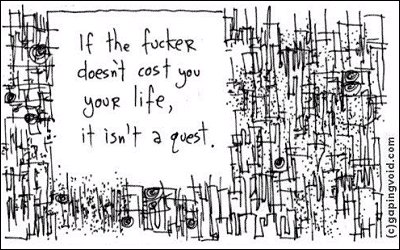
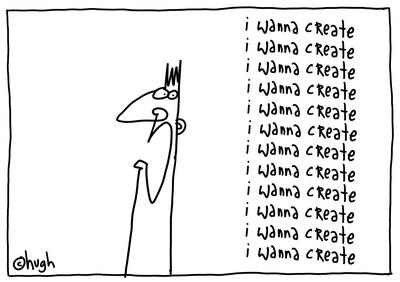
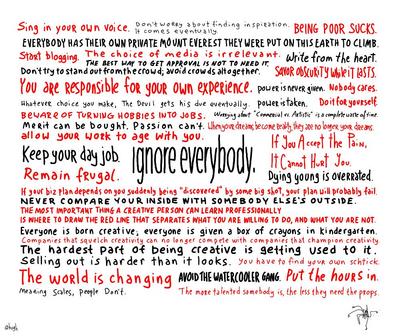
I am delighted to report that the “IGNORE EVERYBODY” cartoon, a fond favorite of computer desktops everywhere, is now on offer as a limited edition print. It will sell on the gallery site for $ 495.00 after it is published [mid-August], but is now available as a pre-order offer of $275.00, with just a $50.00 deposit. To make the deposit, click on the PayPal button below. As always, we’ll send you an invoice for the remainder once the print is signed, numbered and ready to ship.
[$50 Payal Deposit Button etc.]
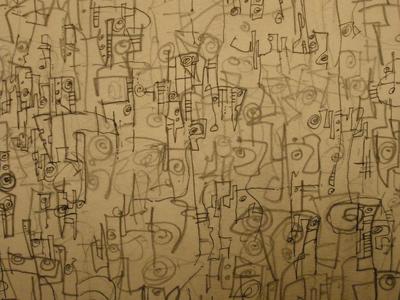
Earlier this year, Patrick Brennan was stuck in an airport lounge for several hours, waiting for his connecting flight. To kill time, he started messing around visually on his computer with the forty chapter titles of my book “Ignore Everybody”. He came up with this, then emailed it to me.
I liked it so much, I went ahead and re-worked it, in my own handwriting. Very cool.
The book began life as a blog post, back in 2004. It had a very simple premise: “So you want to be more creative, in art, in business, whatever. Here are some tips that have worked for me over the years.“
Then I made a list, and kept adding to it…
I never expected it to resonate with so many people, but it did, somehow.
The fact is, there are millions of people out there who want to do something more creative with their lives. Of course there are. “Creativity” is NOT an exclusive domain for those goofy, trendy hipster types. “Creativity” is a basic human need. And I don’t think a life spent fighting like hell, to get that basic human need expressed and fulfilled, is a bad thing.
So I decided to make these prints, in order to have something on the wall to remind us of this, every day. Rock on. [Backstory: About Hugh. Twitter. Newsletter. Book. Interview One. Interview Two. Limited Edition Prints. Private Commissions. Cube Grenades.“EVIL PLANS”.]
I often think that the thing that probably causes the most “quiet desperation” in modern society, is the relentless pursuit of “Having it all”. “Who says you can’t have it all?” were the lyrics of an annoyingly upbeat beer jingle from the mid-1980s.
This campaign for Michelob Lite tritely asked the question, “Who says you can’t love your work, and leave it too?” as an allegory to the question, “Who says you can’t get great, satisfying taste in a beer, that also happens to be kinda light and watery?“
I remember seeing the ad as a kid. Some yuppie who looked good in a suit, looked good in a corporate office, but also looked pretty good on the basketball court with his buddies, and who also looked good wielding an electric guitar surrounded by an admiring group of ladies. Loving his work, and leaving it too, as the jingle reaches its triumphant climax. “Oh YES you caaaaan… have it ALL!” How stirring for the soul etc. Tolstoy or Beethoven would be proud etc etc.
If you read the article from 1987 that I linked to above, you’ll find the campaign wasn’t that successful.
Of course it wasn’t. Why? Because as we all know, life isn’t like that.
How many PhD’s have quit their stellar careers in academe, to go play for the NFL? How many NBA stars, after they retired from basketball, go off to run a division of IBM?
To be the best in the world at something– or even REALLY good at it– the sacrifices are utterly, utterly enormous. “Have it all?” Are you insane?
We ALL know this.
Except Michelob Lite back in 1987, it seems. Which is why, twenty-plus years later after declaring their ability to be all things to all people, their brand is still struggling away, trying hard to be something– ANYTHING– other than unexceptional. I wish them well.
Of course, this “Have It All”, sacrifice-free attitude isn’t just the domain of unexceptional beer brands. It’s the domain of unexceptional individual careers, as well. We can only hope that ours is not one of them.
[UPDATE: Just added this blog post to “Evil Plans”.]
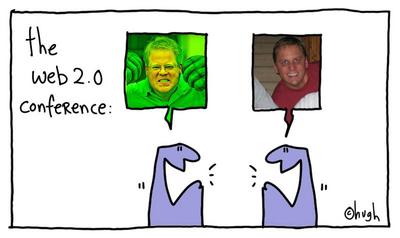
When I visit San Francisco I am always surprised how often the name of my friend, Robert Scoble comes up in random conversation, unprompted by myself. Why is that? Why is he so well known? Is his blog REALLY that good? Is he REALLY that smart and interesting?
Well, I could give a whole stack of reasons to explain why I think Robert’s success is well-deserved. But one major reason that his blog’s traffic is so high, and his name so well-known, is that his personal brand has somehow managed to become a Social Marker inside the Silicon Valley ecosystem. The same could also be said for Mike Arrington, Loic Le Meur or Mark Zuckerberg. Dropping their names into random conversations allows people to quickly and efficiently contextualize themselves.
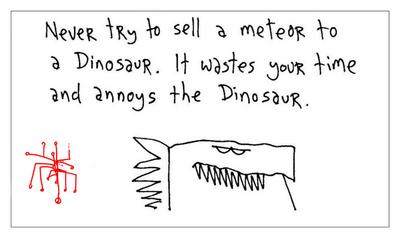
The “Dinosaur” print is now for sale up on gapingvoidgallery…
Derived from the old maxim, “Never try to teach a pig to sing, it wastes your time and annoys the pig.“
Limited edition, signed and numbered, printed with the same high-quality inks and papers as the larger stuff etc.
A nice cube grenade for any office. Rock on.
[UPDATE: Of course, I can’t do this alone. I’ll be needing the help of the Texas Twitter community to help me. If you have any ideas to help make this act of futility somehow less futile, please email me at gapingvoid@gmail.com. Thanks!]
My long-term plan is to continue living out here in Alpine, Texas, writing books and making paintings. An ideal West Texas “creative” life and all that…
BUT BEFORE I settle into that role, I have one LAST marketing fandango to pull off. Namely, making Stormhoek the best-selling South African wine in Texas.
How am I going to do that? Basically, get in my car and drive. Start visiting with people. Start spreading the word. Start finding allies who can help my little adventure along. Stay on the road until I reach my goal. You can read about my adventures on my EVIL PLANS blog page.
When David Brain asked me what was the appeal of writing books, I replied:
I certainly didn’t expect to make any real money from it, and how much it would “help” other people is pretty debatable. But sometimes in your life you have these defining moments, where you draw a line in the sand and declare to the world, “This is who I am, this is what I believe, this is what’s important to me.” I think we all need these moments at some point, to make us better understand who we really are. Writing a book is a good way to force these moments to the surface. That was really the key driver, here.
I have found that marketing can be a pretty good “key driver” in this department, too.
Especially “Futile Marketing”. Yes, this undertaking is insane and futile. It’ll probably fail. I’m going to do it anyway. [The Futile Marketing archive is here.]
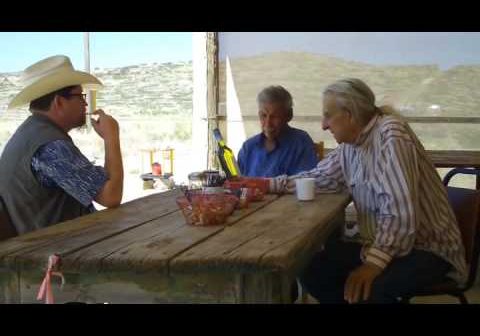
[Never a dull moment in West Texas etc. A video of me telling some local people down in Terlingua all about Stormhoek.]
I recently made the acquaintance of the proprietors of both The Starlight Theater and La Kiva, two prominent bars down in Terlingua. The meetings went well– I liked them both, they seemed to like me. So it looks like we might be selling down there, fingers crossed. Hurrah!
Terlingua, 100 miles South of Alpine, Texas, right on the Mexican border, is probably the strangest place I’ve ever visited in my life– it has an unreality to it quite unlike anything else I’ve ever seen. But there’s a wonderful appeal to it, that’s for sure. If you ever wanted to know what it was like to be living in the old Wild West, this is probably as close as you’re going to get, first hand. The people, architecture and landscape seem right out of a Sam Peckinpah movie.
So why try selling South African wine in Terlingua? “Futile Marketing”, of course…
[A sketch from 2008.…]
There you are, minding your own business, then suddenly you feel “The Call”.
The call to do something totally insane and futile.
But you know you have to do it. You know that if you don’t, a little part of you will be dead forever.
I’ve been feeling a wee bit like that recently. I’ve been feeling another “DesertManhattan” [large painting] calling my name.
“You must create me, Hugh. You simply must. I have to exist, end of story. You have no choice in the matter”.
Aaaargh.… [Backstory: About Hugh. Twitter. Newsletter. Book. Interview One. Interview Two. Limited Edition Prints. Private Commissions. Cube Grenades.“EVIL PLANS”.]
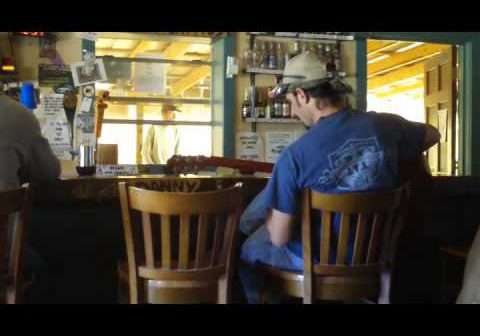
Alpine, Texas. Never a dull moment at Harry’s Tinaja. That’s my buddy, Israel playing on the “gee-tar”.
btw Harry’s was the first place in Alpine to sell Stormhoek…
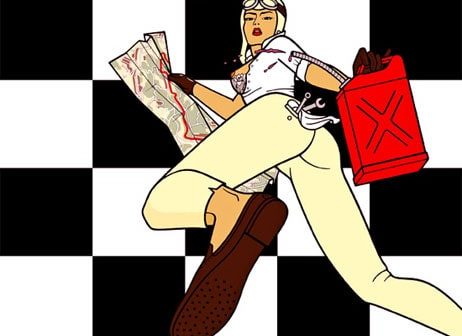
[Hazel Dooney. Study For Dangerous Career Babe: The Race Car Driver (Homage To Hellé Nice). 2009 Acrylic on paper, 40cm x 52cm.] Hazel Dooney is a young and VERY successful Australian Artist. From the blurb on her website:
In December, 2007, Hazel Dooney was the only female artist under 30 with works included in the prestigious auction, Modern and Contemporary Australian Art, held at Christie’s in London. In what was a record-setting sale, with major works by Brett Whitely, Arthur Streeton, Frederick McCubbin, Sydney Nolan, Arthur Boyd, Fred Williams and Tracey Moffat, two modest early works by Dooney fetched over $AU23,000 each.
You get the idea. We follow each other on Twitter, we exchange the occasional email. I’m a big fan. There are A LOT of artists online, but very few as smart, interesting, talented, successful or as driven as Hazel, so I thought a “Ten Questions” session would be in order. She kindly agreed to answer. TEN QUESTIONS FOR HAZEL DOONEY 1. I’ve described your work to the non-initiated before as “Hard-Edge, Erotic Pop meets Tank Girl”. That’s a MASSIVE oversimplification, of course. For the benefit of gapingvoid readers, could you tell us more about your work?
I love your description of it – I think I’ll use it in the future. It certainly describes the attitude that suffuses it. In Japan, artists like Takashi Murakami have been labelled Shock Pop and some critics have included me in that. At its core, my art’s about the way contemporary women’s identities and sexuality are defined by advertising, entertainment, even commercial pornography. I’m no different – which is why versions of me turn up in nearly all my work. Moreover, I try to replicate the physical experience of modern advertising and entertainment media which is why my large enamel paintings are produced in series (just like TV shows and ad campaigns).
In some ways, I want to make it harder to tell art (or artist) from product. My works are, fundamentally, conceptual – even if most, so far, have been paintings. But this’ll change over the next few years as I experiment with other media. 2. You found success at a very early age. Was it skill? Luck? Talent? Bad Craziness? How did it all come about?
Desperation, probably. I had a fairly lonely, introspective childhood and an often crazy, drug– and boy-dependent youth so when I finally recognised that I had a modicum of talent, I seized upon it. And I was determined not to waste an ounce of it. I worked bloody hard to put together a solid body of work – mostly large and in enamel (I was nothing if not ambitious). And when I felt ready to show it, I refused to let anything or anybody get in my way. I paid for and promoted my first shows myself and I learnt very quickly how to respond professionally to collectors and the press. I realised that art was the key not to having some kind of success – although I wanted success very much – but to survival. That drove me hard for ten years. 3. The reason you got my attention initially, was hearing about your decision to bag the traditional gallery route, instead electing to sell your work to collectors via online. Tell us a little bit about your business model. Tell us why you decided to circumvent the gallery system. Tell us about what’s working. Tell us about the hard parts. Tell us your thoughts on how social media plays a part in this.
Four years ago, I decided to quit the two highly regarded galleries in Sydney and Melbourne that were then representing my work. We had a dispute over how they wanted to position me and (believe it or not) constrain my prices. I found some very smart people in technology and business who were prepared to help me figure out a way to manage myself – not just marketing and selling my work but creating an infrastructure to manage every aspect of the business of it, from identifying and communicating with individual collectors and producing my own shows to expanding my online presence and exploiting tools such as social networks and email to develop a wider interest in my work and me. Since then, the value of my work has increased to five, maybe ten, times what it was five years ago, and 15 times what it was a decade ago and my career has radically expanded – as has my collector base.
Traditional galleries and art institutions – and the art publications that depend on both for their advertising – have had fuck-all to do with it. Neither did a traditional, ‘high minded’ artist approach. I regarded myself early on as a post-punk performer, a ‘garage band’ version of a modern artist who ends up owning her own label and promoting her own tours. I don’t deal through intermediaries and I try to maintain a direct connection with everyone who has an interest in my work. Which is maybe why my work has done so well at auction recently. 4. You’ve been called “One of the Pacific Rim’s most controversial artists”. That may be true, but I don’t find your work offensive in the slightest– I find it delightful. Sure, Sexuality– Female Sexuality in particular– features heavily in the work, but what’s controversial about that? Everyone’s got a libido, after all. It seems to me that to from your perspective, Sexuality and the Social Conventions that surround it are two things that are there to be played with, like a toy. Like you’re trying to make a serious statement by having fun with it. Am I close?
I think the controversial part reflects my outspoken attitude towards the gallery system – and my rejection of it. I don’t see my work as erotic, really. It just reflects an aspect of how young women in the developed world see themselves. For better or worse, sexuality is always a powerful element of this. Besides, there’s always been both sexuality and sensuality in art. It’s as visible in the works of Michaelangelo as it is in those of Picasso or Modigliani. However, these days, we don’t have the same social, religious or gender constraints. We’re able to delve more deeply and frankly, creating art that is more explicit, darker and in my case, confessional and/or critical.
That said, yeah, I do like to have fun with it. My Dangerous Career Babes series is a case in point. A lot of women like to dress up to pretend roles as adults. This is different to actually being something. It’s a form of play-acting. So in this series, each figure has exactly the same pose, like an action figure or a Barbie doll, with one hand designed so props can be slid into it, the other formed for gestures or actions. Just as in real life, the costumes are the key. The figure is a dress-up doll. The career that the figure assumes in each painting is identifiable because of the clothes.
Needless to say, the glibness of this concept pisses some critics off. Me, I think it’s a hoot. 5. As a well-known and charismatic artist, suddenly you find yourself with a “Public Persona”. This “Meta-Hazel”, as it were, running around, going to all the right parties etc. You seem quite happy with your relationship with MetaHazel. Was this always the case, or did it grow on you?
In many ways, it was part of my early survival mechanism. I was immersed within her the moment I recognised my future as an artist. Now we’re so thoroughly interconnected, there’s no other Hazel but the Meta-Hazel, as you put it.
Actually, she’s still quite reclusive and rarely goes to a lot of parties. She’s way too busy. But she has a damn fine lifestyle and her sex life is… arcane, involving a very cool, hugely talented man and a bevy of young Asian camp-followers. 6. Everybody has a “Fantasy Version of Themselves”. You know, that fantasy person who manages to get all their work done, while still having enough room left over to do everything else– like getting a life, for example. What does “Fantasy Hazel” do with herself these days?
’Fraid not, in my case. See above. I live every aspect of my dreams to the hilt, even if most of them are still driven by a need to make art and succeed (within a wide frame of definitions) as an artist. 7. No matter how big your “Personal Brand” becomes, at the end of the day, you still have to do the work. As I’m fond of saying, “Success is more complex than Failure.” As your work gets more and more known, beyond Australia and Asia, are you having any trouble keeping up? How do you negotiate the ever-increasing demands placed on you, by your fans, collectors, the media and business interests? This increased complexity is something I always struggle with, so yeah, please do tell.
Some days, the work is tedious, labour-intensive and as repetitive as a production line in a factory. This is particularly the case when I am working with assistants on a handful of large pieces at the same time – and yes, it would be impossible to work on the very large enamels without them, as I’ve become increasing allergic to the medium. On other days, it can be almost languid. I draw or paint alone, in a room overlooking the ocean, and an assistant looks after phone calls, prepares snacks for me, and ensures I’m left in peace.
The most frenetic times are just before my exhibitions – ‘show time’ as my assistants call it. My openings are usually pretty extravagant so the logistics are complicated and usually bloody expensive, mainly because I produce my own shows these days.
The key is having a good infrastructure. Apart from my assistants, I have an excellent business manager and accountant who ensure that the right financial and logistical decisions are made for me. I always listen closely to them and follow their advice. And I have the wonderful Jim, a wise, older man who oversees the work-flow on my commissions and the mundane details of production, like ensuring we have enough frames built or the right colour paints to hand.
But none of it works without discipline. Early on in my career, I was told that success demanded one thing above all others: turning up. Turning up every bloody day, regardless of everything. 8. I’ve noticed a lot of well-known artists, like yourself, like Damien Hirst, are now selling their work via auction houses like Christie’s or Sotheby’s, rather than Blue-Chip galleries. What do you think brought this about? Pros? Cons?
It’s cleaner and a lot less effort than dealing with commercial galleries. Despite what they pretend, very few galleries or gallerists have what is required to develop and manage even a moderately successful career, let alone a stellar one – nor do they even want to. So I manage my own career and encourage my collectors to use auction houses for acquisitions and sales. I don’t yet sell on my own account through them but after Hirst and Sotheby’s… maybe.
I have great relationships with the best of them in Australia and collaborate in their marketing efforts for my works ahead of a major sale. They’re polite, helpful, good to deal with. I haven’t met an art dealer about whom I can say the same. Not yet anyway. 9. You have strong opinions about the art world, especially the big art institutions. What are your pet peeves? What do you think needs to change? What would you change if you could?
Oh, I’d tear down nearly everything and replace it. Or not replace it at all. The dark creed underpinning my attacks on the traditional commercial and institutional gallery system is that the system deliberately attempts to determine, control and sometimes destroy the destiny of individual artists – promoting some at the expense of others, making arbitrary judgements influenced by fad, self-interest, even government funding – for its own interests, none of which are to do with art.
Nowadays, too many galleries, public and private, see their role as somehow superior to that of the artists they represent. Hell, recently I read an interview with a noted curator in New York who tried to argue that curators were more important than artists. Is that really what it’s all come to?
Worse, more for reasons of social status than anything else, galleries like to think of art as something that should not be too ubiquitous or egalitarian in terms of access to it. They have no understanding of new systems of value that have gathered momentum because of the web: for example, the idea that ubiquity not scarcity is likely to drive value higher or that the repository of real value is no longer the artwork, the product, but the artist, the producer. This reflects what has changed even in mainstream business, where it isn’t the individual product that’s important but the brand.
As far as I’m concerned, the traditional art apparatchik deserves to die. It’s an anachronism that’s outlived it’s usefulness. I think there is still a role for individual curators or even ‘show producers’ but they need to work in a more individualised, specialist way within a networked ‘virtual’ paradigm – not old-fashioned bricks and mortar. 10. You’ve got your schtick, you’ve got your modus operandi, and obviously, it’s a good one and it’s working well for you. How do you see it evolving in the next few years?
It’s not schtick at all. Schtick is what Perez Hilton or worse, Paris Hilton live on. Rather, it’s a commitment to a different way of working, both personally and professionally. And it’ll evolve with the ideas within the work. In the end, that’s all it’s about. [The gapingvoid “Ten Questions” archive is here.]
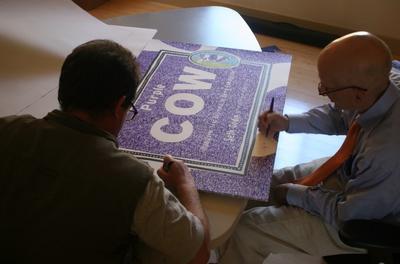
[Me and Seth signing the silkscreen…]
Got back to West Texas last night after almost a week on the road. A quick visit to Silicon Valley for the Techcrunch Party, then an equally brief visit to New York.
I was on the East Coast mostly to co-sign the Purple Cow print with Seth Godin.
That was a great afternoon, visiting his office in Westchester County. He’s a seriously interesting guy. We talked a lot about all sorts of things…
Other highlights were the #NYCtweetup- about 50 people came. Secondly, I got to meet my editing team at Penguin/Portfolio for the first time. They seem very happy with how the book is doing, so it was all good.
Hugh MacLeod (right) became Internet-famous by drawing cartoons on the back of business cards and publishing them online at his Gaping Void blog. Along the way, he gained some valuable insights into marketing and creativity which he also happily shared with readers; that was enough to attract the attention of the Portfolio imprint at Penguin Group, which recently published MacLeod’s first book, Ignore Everybody.
Now, one of MacLeod’s friends (and inspirations) happens to be Seth Godin — if you’ve been reading GalleyCat long enough, you know we’re right there with him on that — and back in April, MacLeod drew a version of the cover to Godin’s Purple Cow (on a much bigger surface than a business card). “To me the book, as a totem, as an icon, represents a huge shift in thinking that came along, almost uninvited, back in the early 2000’s,” MacLeod emailed Godin shortly after. “The drawing represents [to me] my own ability to internalize it.” By the end of the month, he was taking orders for limited-edition prints which he flew into New York City earlier this week to sign alongside Godin. The pre-order price for the prints was $495, but if you want one now, it’ll set you back $1,100.
[UPDATE: Techcrunch posts a nice round up of the day’s events here. Plus some photos here.]
Yesterday was a long one, but I had a blast just the same…
We headed over for breakfast over at the Little Fox Theater in Redwood City for the first annual Crunchup, organized by the groovy cats at Techcrunch.
Panels and demo’s, revolving around the theme, “The Live Web”, with Twitter taking the lion’s share of the conversation, which to anyone who knows this space well, would hardly come as a surprise.
It was a lot of fun, tons of people I knew were there, no shortage of interesting conversations etc.
Techcrunch allowed me to fill the lobby with framed prints, which I sold a few of. It was nice to let people see the work in real life, not just online.
At lunchtime Mike Arrington and I auctioned off a large, hand-pulled serigraph of the 2009 Techcrunch party poster, with proceeds going to the Electronic Frontier Foundation. The winning bid was $1000. Wow. Thanks to Bantam Live, Web-based social CRM service, for buying it. Rock on. [Me and Jackie Danicki standing in front of the big, auctioned print.]
I asked John Rourke, Bantam’s CEO why he decided to buy the print. To paraphrase, it was for a good cause, he knows and likes my work, and because he was launching his product here at Crunchup, it was a nice “social object” to commemorate a big day for his company.
Thanks, John, that was really kind… [Mike Arrington and the print, during the auction, saying “Sold!” to John Rourke…] [Signing the smaller 2009 Techcrunch print version, which I handed out at the party..]
Late afternoon we headed over to August Capital on Sandhill Road for the annual Techcrunch Party. Imagine 1,000 super smart, ambitious, relatively young folk in the Silicon Valley startup sector, throwing their business cards around like confetti and you kinda get the idea.
Again, Techcrunch (and August Capital– with special thanks to David Hornick) kindly allowed me to display my prints, so people could get a good look of them. Every print we had on display there, we sold, and more. It was a sell-out show. Wow.
My job for the evening was to sit at a table at the entrance of the event, and sign small commemorative Techcrunch Party prints that I had designed, for anyone who wanted one.
Instead of just adding my signature, I started drawing on them, just making it up as I went along. I must’ve signed at least 300 of them.
It was pretty intense, I have to say. Often the table was surrounded by 12 or 15 people, standing there, waiting for their turn to get something drawn by me. There I was, trying to be “creative” on the hoof. I was on fire.
The party ended at ten pm. I was exhausted. it was a big, but very, very fun day. I slept well last night night, to say the least.
As anyone who knows me will know, I love these kinds of events. Always great to hang out with so many smart, focused, passionate people. Always good to catch up with my old blogging buddies from the old days, like Mike Arrington, Loic Le Meur, Stowe Boyd, Steve Gillmor,Oren Michels and Ross Mayfield.
As an cartoonist who sells most of his work online, in absentia, it’s good for me to get out there and press the flesh– Hey Guys, I’m a real person, the stuff I make is real, and here and now is a great opportunity for me to prove it.
I suppose the most gratifying thing for me was so many people coming up to me and telling me JUST HOW MUCH BETTER the prints look in real life, compared to online. That’s not exactly news to me, but it’s edifying to hear it from other people.
Special Thanks to Heather Harde, CEO of Techcrunch, Mike Arrington and the rest of the team for putting on such a great show. I can’t wait to be back next year!
I’ve just checked out of my hotel room, I’m writing this down in the lobby, I’m now headed for the airport and a couple of days of hustle n’ bustle in New York City. Wish me luck… [PS. For those of you who asked about buying a large Techcrunch print like the one sold at the auction, we’ll be making them available in a couple of days online. Watch this space etc. Thanks Again…]
In about twelve hours time I head for the airport, heading for SFO for the anual Techcrunch Party. Like I’ve done for the last four years, for the event I designed a signed, limited edition print, pictured above– a play on the “Dream Big” campaign I’m doing here in Alpine, Texas.
Then it’s off to New York, NY the following day to sign prints, including Purple Cow and Create or Die.
Hope to be back home, sleeping in my own bed by Wednesday night.
[NOTE TO SELF: Why is it, that the more internet-enabled the world becomes, the more time we all seem to have to spend on airplanes? Don’t get me started…]
“You can’t drink any more bottled water than you already do. Or buy more wine. Or more tea. You can’t wear more than one pair of shoes at a time. You can’t get two massages at once…“
So, what grows? What do marketers sell that scales?
I’ll tell you what: Belief. Belonging. Mattering. Making a difference. We have an unlimited need for this.”
2. Everyone’s definition of “smarter” will be different. I’m OK with that. To me, it means continually engaging the customer at a higher level, continually raising the bar.
3. The brilliant thinker, Russell Davies identified four keywords that will govern the future of the advertising business. About as succinct a list as I’ve ever seen:
Blurry.
Useful.
Interesting.
Always In Beta.
“Always In Beta” is a popular term in Silicon Valley. In an ideal world, it would be equally popular in the wine trade as well. It’s unfortunate that this is not the case.
The problem with most wine marketing, as I see it, most of it is product-driven, not principle driven.
Most wine makers make what they make, as best they can, then try to find a buyer, somewhere. Anywhere!
Stormhoek wasn’t conceived as an act of love for the Western South African Cape. Stormhoek was conceived as a very simple idea: That if you took New Zealand wine tech, and used it with South African grapes, you could make a wine JUST as good as the New Zealanders, for about two thirds the price.
Idea-driven. Not product-driven. Not geography-driven. That’s what “Smarter Wine” is all about.
Once we had this “Principle” nailed down, it became a LOT easier to market it. Because not only did we get “Smarter” about how we made it, we got “smarter” about how we talked to people about it, how we related to the existing market and the customers about it. Which explains the cartoon below.
It’s REALLY hard to market something, if there’s no higher purpose-idea behind it. Products are not just about price and quality. As I’m fond of saying, every product is some sort of idea amplifier. Every product, whether we’re talking German cars, cans of beans, laptop computers or bottles of wine, is an expression of human potential.
At least, it is, if you want it to be successful.
I don’t think any of this rocket science, but it sure got our competition scratching their heads. Plus ca change… [N.B. This post was written as something to keep in mind, while I plan my “Texas Road Trip”, which starts at the end of this month…] [UPDATE: Just added this blog post to “EVIL PLANS”.] [Backstory: About Hugh. Twitter. Newsletter. Book. Interview One. Interview Two. Limited Edition Prints. Private Commissions. Cube Grenades.“EVIL PLANS”.]
People get “blocked”.
With their jobs, with their relationships, with their marketing, with their own passions and creativity…
And yes, with themselves. I’m as guilty as anyone. So are you.
So then the next question becomes, well, how do you become “unblocked”? How do you get your mojo back?
Wouldn’t it be great if somebody could invent a product– a book, for example, or maybe some audiotapes, or a three-day seminar, whatever– and all people would have to do is pull out their credit card, pay the fee, use the product once et Volia! Problem solved! Blockage removed!
Yes, that would be great, in theory. But knowing what I know from past experience, I’d recommend that if you ever meet somebody trying to sell you something like this, run away in the opposite direction. That fellow is selling you a bunch of psychobabble snake oil. Nobody can unblock you, but you.
Instead, read the following one-word quote. Unlike the snake oil, you can have it free of charge and yes, this actually works, every time:
I’ve been in the “creativity” business for over two decades. I first started publishing my cartoons in The Austin Chronicle back in college, before landing my first “real job” as an advertising copywriter with a large agency in Chicago.
Ever since then, for the most part, yeah, I’ve worked my ass off. With MASSIVELY varying levels of success.
Twenty-odd years later, I can totally see why most sane people opt out of the “creative” career option– I can totally see why they stick to something more conventional, even if it isn’t really all that interesting to them. It’s NOT because they’re stupid, lazy or unimaginative.
It’s because the alternative is really, really hard.
All throughout these past two decades– this long, painful, wonderful adventure– I kept on asking myself the same question: “When will this stuff start getting easier?“
And the closest thing I’ve ever gotten to an answer is, “Probably Never.“
Of course, it wasn’t until I got comfortable with “Probably Never” that, funnily enough, it started getting easier.
I really don’t know what else to tell you…
[P.S. I utterly DESPISE the word, “Creativity”. Every time I write it, a little piece of me DIES. That being said, I don’t know of another word that works better in this context. Damed if you do etc…] [Update: Just added this blog post to “EVIL PLANS”.] [Backstory: About Hugh. Twitter. Newsletter. Book. Interview One. Interview Two. Limited Edition Prints. Private Commissions. Cube Grenades.“EVIL PLANS”.]