June 29, 2009
recession
![]()
[Backstory: About Hugh. Twitter. Newsletter. Book. Interview One. Interview Two. Limited Edition Prints. Private Commissions. Cube Grenades.“EVIL PLANS”.]
Hugh MacLeod
Cartoons drawn on the back of business cards
June 29, 2009
![]()
[Backstory: About Hugh. Twitter. Newsletter. Book. Interview One. Interview Two. Limited Edition Prints. Private Commissions. Cube Grenades.“EVIL PLANS”.]
![]()
[Backstory: About Hugh. Twitter. Newsletter. Book. Interview One. Interview Two. Limited Edition Prints. Private Commissions. Cube Grenades.“EVIL PLANS”.]
![]()
[Cartoon inspired by this blog post.]
[Backstory: About Hugh. Twitter. Newsletter. Book. Interview One. Interview Two. Limited Edition Prints. Private Commissions. Cube Grenades.#evilplans.]

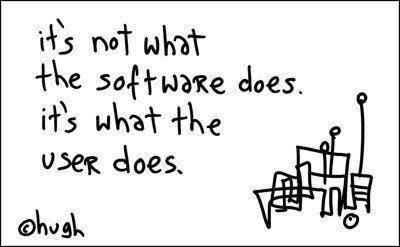
“How Thingamy will revolutionize Enterprise Software.“
Go here to read more.
[N.B. I’m a shareholder in Thingamy.]
[Backstory: About Hugh. Newsletter. Book. Interview One. Interview Two. Limited Edition Prints. Private Commissions. Cube Grenades. Hughtrain. #evilplans.]
June 27, 2009

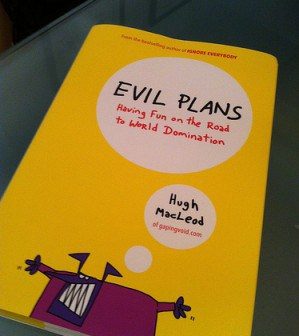
Though I don’t start the Texas road trip for at least another month, I’ve already started working on the second book, EVIL PLANS.
If you click on the link above, you’ll see that I’m pretty much writing it the same way I wrote IGNORE EVERYBODY i.e. I’m just cutting and pasting random thoughts, old writings and cartoons together, trying to get it all to fit somehow. Sure, it’ll take a while to gel, but hey, there’s no rush.
Besides, it’s quite fun, to push the unfinished idea “out there”, and watch it evolve over time. Is it the best way to go about writing a book? Probably not.
[Backstory: About Hugh. Newsletter. Book. Interview One. Interview Two. Limited Edition Prints. Private Commissions. Cube Grenades. Hughtrain.]
June 25, 2009

Amazon.
Barnes & Noble.
Borders.
800-CEO-READ. (great for bulk buys)
[Below is a small taste of the first draft of my upcoming book, “EVIL PLANS”. Published by Penguin/Portfolio, the same people who published my first book, “IGNORE EVERYBODY”. It launchesFebruary 17th, 2011.]
INTRODUCTION: EVERYBODY NEEDS AN EVIL PLAN
Everybody needs an EVIL PLAN. Everybody needs that crazy, out-there idea that allows them to ACTUALLY start doing something they love, doing something that matters. Everybody needs an EVIL PLAN that gets them the hell out of the Rat Race, away from lousy bosses, away from boring, dead-end jobs that they hate. Life is short.
Every person who ever managed to do this, every person who manged to escape the cubical farm and start doing something interesting and meaningful, started off with their own EVIL PLAN. And yeah, pretty much everyone around them– friends, family, colleagues– thought they were nuts.
Thanks to the Internet, it has never been easier to have an EVIL PLAN, to make a great living, doing what you love, doing something that matters. My intention is that by the time you’ve finished reading this book, you will completely concur. More importantly, you’ll actually feel compelled enough to go and do something about it yourself, if you haven’t already.
“TO UNIFY WORK AND LOVE”
Sigmund Freud once said that in order to be truly happy in life, a human being needed to acquire two things: The capacity to work, and the capacity to love.
An EVIL PLAN is really about being able to do both at the same time.
At time of writing, this is my tenth year blogging at gapingvoid.com. I’ve done a lot of stuff with it since I started. Published cartoons, sold wine, sold suits, pimped Microsoft, pimped Dell, sold art, “built my personal brand”, written e-books, ranted on endlessly about marketing, new media and all sorts…
But looking back, I realize it all served a served a common purpose: to unify work and love. I was writing about what interesting and important to me, and trying to turn it into a career somehow.
Then I noticed, the people who read my blog the most avidly, and the bloggers I tend to read most avidly, hell yeah, they’re mostly trying to do the same thing too, in their own way. It’s a definite pattern.
To unify work and love. Are you one of these people? If not, don’t you think you should be? I mean, after friends and family, what the hell is there?
1. THE MARKET FOR SOMETHING TO BELIEVE IN IS INFINITE

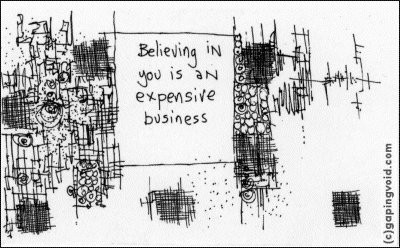
THE HUGHTRAIN MANIFESTO: “THE MARKET FOR SOMETHING TO BELIEVE IN IS INFINITE.”
We are here to find meaning. We are here to help other people do the same. Everything else is secondary.
We humans want to believe in our own species. And we want people, companies and products in our lives that make it easier to do so. That is human nature.
Product benefit doesn’t excite us. Belief in humanity and human potential excites us.
Think less about what your product does, and think more about human potential.
What statement about humanity does your product make?
The bigger the statement, the bigger the idea, the bigger your brand will become.
It’s no longer just enough for people to believe that your product does what it says on the label. They want to believe in you and what you do. And they’ll go elsewhere if they don’t.
It’s not enough for the customer to love your product. They have to love your process as well.
People are not just getting more demanding as consumers, they are getting more demanding as spiritual entities. Branding becomes a spiritual exercise.
Either get with the program or hire a consultant in Extinction Management. No vision, no business. Your life from now on pivots squarely on your vision of human potential.
The primary job of an advertiser is not to communicate benefit, but to communicate conviction.
Benefit is secondary. Benefit is a product of conviction, not vice versa.
Whatever you manufacture, somebody can make it better, faster and cheaper than you.
You do not own the molecules. They are stardust. They belong to God. What you do own is your soul. Nobody can take that away from you. And it is your soul that informs the brand.
It is your soul, and the purpose and beliefs that embodies, that people will buy into.
Ergo, great branding is a spiritual exercise.
Why is your brand great? Why does your brand matter? Seriously. If you don’t know, then nobody else can– no advertiser, no buyer, and certainly no customer.
It’s not about merit. It’s about faith. Belief. Conviction. Courage.
It’s about why you’re on this planet. To make a dent in the universe.
I don’t want to know why your brand is good, or very good, or even great. I want to know why your brand is totally frickin’ amazing.
Once you tell me, I can the world.
And then they will know.
2004 was the year that I drew the cartoon above, which I ended up calling “The Hughtrain”. It appeared in my last book, “Ignore Everybody”, which came out five years later.
Why is it called The Hughtrain? Soon after I drew the cartoon, I wrote a little manifesto on my blog, trying to explain the cartoon in more depth. I called it “The Hughtrain Manifesto”, a pun on a book that had made a big impact on me around that time, “The Cluetrain Manifesto”.
Here’s the point of The Hughtrain: Whatever you’re selling isn’t just a product of capital, it’s also a product of a belief system– your own. And understanding your belief system is crucial. As my friend and mentor, the great marketing author, Seth Godin once told me in an interview I did for him:
You can’t drink any more bottled water than you already do. Or buy more wine. Or more tea. You can’t wear more than one pair of shoes at a time. You can’t get two massages at once…
So, what grows? What do marketers sell that scales?
I’ll tell you what: Belief. Belonging. Mattering. Making a difference. Tribes. We have an unlimited need for this.
Another friend of mine, the film director, David Mackenzie once quipped, “A film is only as good as the reasons for making it”.
What is true for Hollywood, is also true for products and businesses. It’s not what you make, it’s what you believe in. That is what people respond to. That is where your enterprise lives or dies.
The Hughtrain was me trying to articulate my coming to grips with this.
2. WELCOME TO THE HUNGER.
The Hunger to do something creative.
The Hunger to do something amazing.
The Hunger to change the world.
The Hunger to make a difference.
The Hunger to enjoy one’s work.
The Hunger to be able to look back and say, Yeah, cool, I did that.
The Hunger to make the most of this utterly brief blip of time Creation has given us.
The Hunger to dream the good dreams.
The Hunger to have amazing people in our lives.
The Hunger to have the synapses continually fired up on overdrive.
The Hunger to experience beauty.
The Hunger to tell the truth.
The Hunger to be part of something bigger than yourself.
The Hunger to have good stories to tell.
The Hunger to stay the course, despite of the odds.
The Hunger to feel passion.
The Hunger to know and express Love.
The Hunger to know and express Joy.
The Hunger to channel The Divine.
The Hunger to actually feel alive.
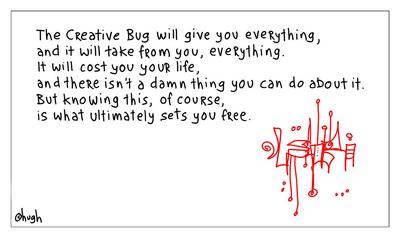
The Hunger will give you everything. And it will take from you, everything. It will cost you your life, and there’s not a damn thing you can do about it.
But knowing this, of course, is what ultimately sets you free.
3. THE GLOBAL MICROBRAND.

[I first published “The Global Microbrand Rant” on my blog back in 2005. Here it is again:]
Since I first coined the term in 2004, I have been totally besotted with the idea of “The Global Microbrand”.
A small, tiny brand, that “sells” all over the world.
The Global Microbrand is nothing new; they’ve existed for a while, long before the Internet was invented. Imagine a well-known author or painter, selling his work all over the world. Or a small whisky distillery in Scotland. Or a small cheese maker in rural France, whose produce is exported to Paris, London, Tokyo etc. Ditto with a violin maker in Italy. A classical guitar maker in Spain. Or a small English firm making $50,000 shotguns.
With the internet, of course, a Global Microbrand is easier to create than ever before. A commercial sign maker in New England. Or a small sheet metal entrepreneur in the U.K. All using the Internet, blogs, social media and whatnot to spread the word, to talk to people from all over.
And with the advent of blogs in the early years of this Century this was no longer just limited to people who made products. We saw that any service professional with a bit of talent and something to say could spread their message far and wide beyond their immediate client base and local market, without needing a high-profile name or the goodwill of the mainstream media. Lawyers, IT consultants, marketing folk, you name it.
But it’s not just limited to cottage industries. In the 1990’s, the great business guru, Tom Peters talked about “Brand You”, a personal brand that transcends your organization or job description. The grand-daddy of this space is probably Robert Scoble, who worked full-time for Microsoft, but whose brand became much, much larger than any job description they could give him; that’s was worth far more than anything they ever paid him.
Once I created my own fledgling global microbrand (i.e. via my weblog) I started helping other people do the same. A bespoke English tailor. A small winery in South Africa. It was something I really wanted to know about. It was professionally the most compelling idea I had ever come come across. I was hooked.
Of course, “The Global Microbrand” is not conceptual rocket science. You don’t need a Nobel Prize in order to understand the idea. What excites me about it is the fact that I now live in a small adobe in the Far West Texas desert, and careerwise I’m getting a lot more done than when I lived in a large apartment in New York or London, for a fifth of the overheads. For one fiftieth of the stress levels.
My job allows me to travel a lot– New York, Miami, San Francisco etc. After three or four days away I start feeling really stressed out. For years I thought it was just me. No, actually, everyone in the big city seems really stressed out. It’s just considered normal.
I was talking to a friend on the phone about this.
“There’s only two ways to deal with life in the big city,” he says. “Alcohol and high prices. Immersing yourself in high rent, luxury items, trendy, overpriced cocktail bars, flashy restaurants, tall leggy blondes who don’t give a damn about you, just to act as a buffer zone between you and the abyss.”
“Which you pay a lot for,” I say.
“Which you pay a hell of a lot for,” he says.
It seems to me a lot of people of my generation are locked into this high-priced corporate, urban treadmill. Sure, they get paid a lot, but their overheads are also off the scale. The minute they stop tapdancing as fast as they can is the minute they are crushed under the wheels of commerce.
You know what? It’s not sustainable.
However, the Global Microbrand is sustainable. With it you are not beholden to one boss, one company, one customer, one local economy or even one industry. Your brand develops relationships in enough different places to where your permanent address becomes almost irrelavant.
Frankly, it beats the hell out of commuting every morning to the corporate glass box in the big city, something I did for many years. Just so I could make enough money to help me forget that I have to commute every morning to the corporate glass box in the big city.
There are thousands of reasons why people write blogs or spend a lot of time building their online equity. But it seems to me the biggest reason that drives the bloggers I read the most is, we’re all looking for our own personal Global Microbrand. That is the prize. That is the ticket off the corporate treadmill. And I don’t think it’s a bad one to aim for.
4. THE MAGIC NUMBER.
![]()
Ten Thousand is my magic number.
The first few years of this century were tough ones for me. My career in advertising pretty much tanked around the same time as the dotcom crash, and I found myself unemployed, broke, living in the boonies, scraping a meagre living writing freelance brochure copy. Then 9 – 11 came along and made it even worse. Not fun or nice.
Up until that point, I had spent my entire working career “chasing gigs”. Whether we’re talking full-time salaried positions, or three-day freelance opportunities, I had spent well over a decade chasing that ever-elusive island of security in a swelling ocean of advertising-industry chaos. And these gigs would never last, they would always end eventually, for whatever reason. Recessions, layoffs, downsizing, incompetence on my part, incompetence on the boss’ part, whatever. And usually the timing was bad, of course it was.
Chase, chase, chase…. And I was sick of it. Really, REALLY sick of it. Over a decade of working my butt off, and those islands of security were no less elusive than before. And I wasn’t as young as I used to be. The hamster wheel was starting to do me in.
Then, in these darkest of days, I had a sudden flash of life-changing insight. Like I told my fellow burnout-advertising drinking buddy that evening, as we commiserated at the bar about our sad lot in life:
“I don’t want to be chasing gigs anymore.”
“What do you want, then?” asked my buddy.
“I just want ten thousand people giving me money every year.”
“Where are you going to find these people?” he asked.
“The Internet,” I replied.
“What do you plan on doing there?”
“I think I’ll start by publishing my cartoons online… on a blog.”
“What’s a ‘blog’?”
The rest, as they say, is history…
There was nothing magical about the ten thousand number. I just reckoned that, as a cartoonist, if I was making t-shirts, books, whatever– and ten thousand people were buying product every year, with me making a few bucks profit off each unit, well, it wouldn’t make me a billionaire, but at least I’d be able to feed myself.
Also, ten thousand people supporting me seemed like a good way of spreading my bets economically. If one person drops out, and all you lose is a t-shirt sale, with 9,999 other people still on board you can easily recover. But in the world of chasing advertising gigs, if the one person you lose happens to be your jackass boss, you’re dead meat.
There’s nothing special abut the ten thousand number. It all depends on what you’re selling. If you’re selling hand-built motorcycles, your magic number will be less. If you’re selling 5-dollar jars of hot Cajun chilli sauce, your number will be larger. Whatever that number will be, I hope you find it one day. I hope you find THOSE PEOPLE one day.
5. WELCOME TO THE OVER-EXTENDED CLASS.
![]()
“If ever there was a time to be overextended, this is it.” – Chris Anderson, Editor-In-Chief, Wired Magazine.
Back in August, 2009 I interviewed Chris Anderson for my blog:
Hugh: You’ve got your Editor job, you’ve got your book deals, you’ve got your blog, you do a lot of speaking gigs… As your name gets more and more known, are you having trouble keeping up with everything? What’s your coping mechanism? How do you find the balance?
Chris: Plus the five little kids, the two startup companies on the side, etc. Obviously, balance is a distant goal. In the meantime, I delegate, work all the time, hardly sleep, totally ignore politics, sports and pop culture, neglect my family too much and probably don’t do any ofmy jobs as well as I could. But these are exciting days, and if ever there was a time to be overextended, this is it.
I agree with him completely. I know what it means to be over-extended all too well. Recently I made a list of all the projects I’m currently working on. The next book. The road trip. The prints. Blogging. Consulting. Drawing cartoons. The list goes on…
All in all, it came down to ten items. Ten. Each one interesting and potentially lucrative enough to be taken on as a full-time job. Ten.
Ouch. Even for me, that seemed like WAY too much.
The other day, a friend of mine was kvetching about having to hold down three jobs. “Three?” I quipped. “Try holding down ten…”
My friend looked at me funny. He was probably right to do so.
Since about 1991, it’s been like that for me. From the moment I woke up till the moment I went to bed, I was working on something. The day job or the cartoons or something else. Sure, I’d have girlfriends come and go, but the girlfriends never lasted too long, and I also ended up inventing, in 1997, an art form that would allow me to carry on working WHEN I was going out to the bars i.e. the “cartoons drawn on the back of business cards”.
I’ve not had a proper vacation in ten years, either. Nor am I planning one.
Call Chris and myself, and probably over 50% of the people who are reading this book, members of “The Overextended Class.
You know who you are. And you know what? In terms of percentage of the population, there were less of us twenty years ago. And there’ll be more of us in two decades.
Our parents and grandparents spent their “Cognitive Surplus” watching television. That’s a thing of the past… a historical accident of the old factory-worker age meeting the modern mass-media age. Of course it wouldn’t last forever. We humans as a species were designed to compete, not to sit around on our asses.
Welcome to the Overextended Class, People. You may opt out of it if you want, but over time it’s going to get harder and harder to make ends meet, let alone be successful, if you do.
Choices.
6. A WORLD-CLASS PRODUCT.

“The curious story of an English Savile Row tailor and an under-employed cartoonist.”
In late 2004, things were still rough for me. I was still broke, unemployed and wondering what the hell I was going to do next. The answer came from a direction I would never have predicted.
At the time, I was living in Cumbria, in a cottage in the Northern English boondocks, not far from the famous Lake District. I was just lying low, scraping a living doing freelance, trying to save money. It was a bleak and miserable time for me, frankly.
In the local village pub, I got friendly with a local fellow named Thomas Mahon. We were about the same age, and his business wasn’t going very well, either.
Thomas was a tailor. He made suits. And not just any kind of suits. He made the best of the best. $5000, hand-made suits. He’d been trained down on Savile Row in London, the legendary English home of tailoring. Some say they make the best suits in the world, there. He had made suits for rock stars, royalty, famous designers and… you name it. He really was that good. The man who trained him, Dennis Halberry, was head cutter for Anderson & Sheppard, one of the most esteemed tailoring firms in the world.
A few years previously, Thomas had got sick of working on Savile Row, decided he missed his beloved Cumbria, and decided to move back home and set up shop in the village he grew up in.
Everyone told him he was mad, but he paid no attention.
Though he was one of the most respected tailors on Savile Row, it turns out he wasn’t very good at getting the word out about his work. His customers loved him, but they didn’t like to tell other people about him. They wanted him all to themselves. So in spite of his formidable talent, Thomas wasn’t getting one-fitth the business he deserved.
So there we were, Christmas approaching, and in spite of us both feeling a wee bit gloomy about our current economic statuses, we were cheerily sitting in the local pub one evening, with Thomas telling me all these wonderful stories about the people and experiences of working on Savile Row.
Finally I interrupted him.
“Tom”, I said, “these Savile Row stories are terrific. You should blog about them.”
“What’s a blog?”
By this time I had been blogging for about three years, and knew all about how it worked. That night, we came up with an EVIL PLAN. I would show Tom how to blog, he would make the suits, I would figure out a way to spread the word online.
EnglishCut.com was born.
Instead of using the blog to hard-sell his suits, Thomas just wrote these great little blog posts about the world he knew and loved– the community of Savile Row tailors. He’d write about it all– his friends on the Row, the pubs they drank in, the other businesses on the Row. He just wrote about it honestly, with great passion and affection. He praised the other shops, his competition. Why not? They were all good people, with second-to-none skills.
A few years later, he would confide in me that he never thought anyone would ever find what he wrote about that interesting, so not expecting anybody to read it, he just wrote it his way. If he had thought a lot of people would be interested in it, he would have written it differently. More uptight. Less transparent.
And boy, was he wrong in the end. People LOVED his blog. They ADORED the transparency and Thomas’ easygoing, unpretentious manner. So much so that, within no time at all, he had gone from under-employed tailor, to having a two-year waiting list, just to get a first appointment.
If you go online and Google Thomas or English Cut, you’ll find a lot to read about. The story got a got of attention in the blogopsphere back then, simply because in 2005, an English Savile Row tailor was probably the person you’d least expect to start a blog. But it worked. It worked AMAZINGLY well.
We worked together for about two more years, before amicably going our separate ways. It was one of the most rewarding career moves I ever made. And I think Thomas would say the same.
My father once remarked to me, “I bet you had no idea in the beginning that the blog would work as well as it did, eh?”
True, I had no idea. But looking back, we had a few things going for us.
i. A great product. Thomas is one of the best tailors in the world. His suits REALLY ARE that good. If we were just selling commodified drek, I doubt if anyone would’ve paid much attention.
ii. A unique story. When he started, Thomas was the only Savile Row tailor writing a blog, and this gave him a unique voice in the blogosphere. This fuelled the interest. Had masses of tailors already been blogging, it would’ve been much harder for his own unique “idea-virus” to spread. The first-mover advantage rule still applies.
iii. Passion & Authority. Thomas has both in spades. That’s what kept people coming back. That’s what built up trust. That’s what turned his readers into customers. Which is why “Share what you love” is the best advice there is.
iv. Continuity. He kept at it. He didn’t expect the blog to transform his fortunes overnight. As I’m fond of saying, “Blogs don’t write themselves”. Based on our experience, if you want blogs to transform your business, I’d say give yourself at least a year.
v. Focus. It was always about the suits. It was never about what he had for breakfast, Google traffic, or frothy gossip about other bloggers.
vi. Thomas spoke in his own voice. Thomas is a straightforward, affable fellow, and the voice on the blog is the same as the voice you meet in real life. He never tried to misrepresent himself on his blog, nor try to create some over-glamorized image of his profession. He just told it like it is. And people responded well to that. As he once put it, “We’re so lucky we don’t have to create the brand out of thin air. We just tell the truth and the brand builds itself.”
vii. Sovereignty. The only people we had to please were the two of us. No bosses or outside investors to keep happy. Bosses and investors like guarantees, but there aren’t any.
viii. We were both broke when we started. Had we had masses of money at the beginning, we would have had a lot more options on how to get the word out. In all likelihood, these options would have been a lot more expensive and not nearly as effective. Sometimes lack of capital is a definite advantage.
A blog is a great way to build one’s own personal “global microbrand”. As the Job-For-Life no longer exists, as the value of the social “position” erodes and the value of the “project” takes its place, personal brand development becomes far more important to one’s career. Blogs are a good place to start.
Hey, if a Savile Row tailor can do it, what’s your excuse?
7. FILL IN THE NARRATIVE GAPS.

If people like buying your product, it’s because its story helps fill in the narrative gaps in their own lives.
Human beings need to tell stories. Historically, it’s the quickest way we have for transmitting useful information to other members of our species. Stories are not just nice things to have, they are essential survival tools.
And yes, the stories we tell ourselves are just as important than the stories we tell other people.
Ergo, The Global Microbrand is not about selling per se. It’s more about figuring out where your product stands in relation to personal narrative.
So where does your product fit into other people’s narrative? How does telling your story become a survival tool for other people? If you don’t know, you have a marketing problem.
Narrative gaps. It’s all about the narrative gaps.
8. AVOID DINOSAURSPEAK.
![]()
Gapingvoid is the perfect website to get your daily blogging fix. Filled to the brim with hilarious cartoons, it also offers timely and insightful commentary on the new realities of advertising and marketing. Indeed, some people would say it’s just not the blogosphere without gapingvoid to enhance their quality blogging experience. Start your day the switched on way– subscribe to get gapingvoid on your RSS feeder today!
I wrote the preceding paragraph to illustrate the intellectual bankruptcy of what I call “Dinosaurspeak”. That rather sociopathic combination of being completely focused on customer benefit and yet completely selfish at the same time.
And yeah, if it doesn’t work with my shtick, it ain’t going to work with your product, either.
What is interesting to me is that this style of language was pretty universal only a few years ago. Sure, you had a few mavericks out there stirring things up, but most external business communication was pretty much stuck in firehose mode.
But when markets become smarter and faster than the companies servicing said markets, thanks to the Internet, language changes. Of course it does.
So your language you use has be on the cutting edge, or at least, well ahead of the curve. Otherwise you’re just going to sound like everyone else, and people will ignore you.
9. WHO ARE YOU, REALLY?
There’s a wonderful metaphor in the Bible [Revelation 2:17] about “a white pebble”.
“Let the one who has an ear hear what the spirit says to the congregations: To him that conquers I will give some of the hidden manna, and I will give him a white pebble, and upon the pebble a new name written which no one knows except the one receiving it.”
The metaphor was once explained to me by a Catholic monk. To paraphrase:
“You have three selves: The person that you think you are, the person that other people think you are, and the person that God thinks you are. The white pebble represents the latter. And of the three, it is by far the most important.”
He then gave me some good advice, something I’ve always kept with me:
“When life gets really tough, just remember the white pebble. Just remember who you really are. Just remember the person that only God can see.”
Whatever your thoughts on God or Religion may be, positive or negative, the white pebble is a very simple metaphor that audaciously asks the question: “Who are you, really?”
Yes, why are you here, exactly? Who are you here for? Yourself? Other people? God? Or maybe some other cause? You tell me…
It’s one of those questions that never gets old. Unlike the poor body that houses us.
10. THE COMPLEXITY WAR i.e. “SUCCESS IS MORE COMPLEX THAN FAILURE”.
Rudyard Kipling once described Triumph and Disaster as “Impostors, Both”. The longer I stay in the working world, the more I start to get what he means.
It’s funny how you can have two guys sitting next to each other in an office, both doing the same job. Both using the same computers and phones. Both with the same academic qualifications. Both with a similar IQ. Both working the same amount of hours. But why does one guy take home five times more sales commission than the other guy? What’s going on? Is it luck? Skill? Justice? Injustice?
The question of what separates success from failure, is something I’ve always liked to ponder on. Suddenly this week, out of nowhere, the following line hit me:
“Success is more complex than Failure.”
Think about it. Being a failure is a no-brainer. All you have to do is sleep till noon, get out of bed, scratch your crotch, have your morning visit to the bathroom, turn on the Star Trek re-runs, help yourself to some breakfast [Leftover pizza and a bottle of Jack Daniels, Hurrah!], light up your first joint of they day, download some porn, and already you’re well on your way. Sure, a few inconvenient variables may enter the picture here and there, to complicate an otherwise perfect day of FAIL, e.g. what you’re going have to say to your brother in order to convince him to lend you that $300, so you can pay off the telephone bill, that kinda thing. But for the most part, the day-to-day modus operandi of your “Average Total Failure” is quite straightforward.
Being successful, however, is a whole different ball game. Breakfast meetings at 7.00am. Conference calls at midnight. Visiting twelve cities in five days. Fielding question from a swarm of hostile journalists. Dealing successfully with an enraged, multi-million dollar customer who’s screaming bloody murder over something rather trivial in the grand scheme of things. Dealing successfully with an enraged, multi-million dollar investor who’s screaming bloody murder over something rather trivial in the grand scheme of things. Making sure there’s enough money in the account to meet the payroll of all your legions of highly-paid, highly-effective, highly-talented employees. All these hundreds of unrelenting issues to deal with, all day, every day. You get the picture.
And as always, what’s invariably true of people is also invariably true for businesses. So when I see a small but insanely-successful business suddenly implode overnight [it seems to happen quite a lot in Silicon Valley], I’m guessing chances are it wasn’t inability to manage growth per se that destroyed the business [a favorite reason cited by those writing business obituaries], but the inability for the business to manage complexity. Complexity increases exponentially with growth, most small companies can culturally only handle incremental increases in complexity. As I’m fond of saying, “Human beings don’t scale”.
Which is why walking around the hallways of large, successful companies can often seem so oppressive to somebody new to it. All that cultural regimentation is there for one reason only: To fight “The Complexity War”. Sure, it might feel a bit ghastly to the more idealist and free-spirited among us, but until somebody can come up with a better way to win this Complexity War at a Fortune-500 level, I don’t see it ever going away.
11. TREAT IT LIKE AN ADVENTURE. AN ADVENTURE WORTH SHARING.

June 23, 2009
If this doesn’t make a good good “cube grenade”, I don’t know what will…
A while ago, I announced that we’d be making smaller prints available, based on the cartoons found in IGNORE EVERYBODY.
On June 11th, the same day the book came out, we announced our first efforts: The “Ignore Everybody” Portfolio Series Number One.
Four silkscreens, 11“x14”, limited edition of 100, signed and numbered, $320 for the set.
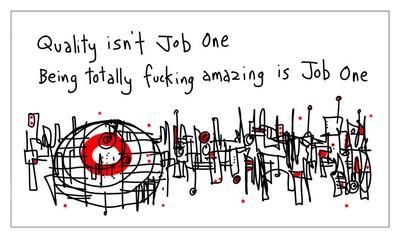
I’m delighted to report, that we’ve just made the “Quality” print available for purchase individually. $100, plus S&H. Here’s the blurb on the gallery website:
A couple of decades ago, Ford had a tagline for its car commercials: “Quality is Job One”.
Well, that may be fine if you’re a big, old car company, but it never quite grabbed my imagination. I figured if you’re a young, small company, or a person wanting to make a difference on a tiny shoestring budget (like I was), stronger words might be more appropriate. Events proved me right– this ended up being one of my favorite cartoons of my blog readers.
I hope you’ll check it out. Thanks!
[etc: About Hugh. Interview. Newsletter. Book. Limited Edition Prints. Private Commissions. Cube Grenades. Hughtrain.]
![]()
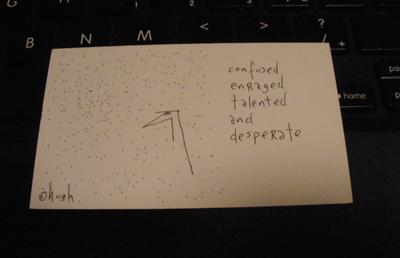
[“Confused”. Click on image to enlarge etc.]
I drew this cartoon earlier this evening.
It’s conveys the state I found myself in, back in New York a decade ago, when I was doing what I consider to be my best, or at least, my most formative work.
No artist wants their best work behind them. No human being wants their best days behind them. Yet my my Inner Doubting Thomas keeps telling me, I’ll never be that young again; I’ll never have my work be that fresh & new again. Nor, sadly, will the world, at least to me.
To Hell with it. I’ll carry on, regardless.
And of course, so will you, at whatever insanely impractical path you chose for yourself. We knew what we were doing, when we signed up for this tour of duty.
We still have a few tricks up our sleeves, don’t we?
Doubting Thomas can go fuck himself…
[etc: About Hugh. Interview. Newsletter. Book. Limited Edition Prints. Private Commissions. Cube Grenades. Hughtrain.]
June 21, 2009
[My pal, Jeffro singing at Harry’s Tinaja, Alpine, Texas.]
I’m taking to the road. Here are some notes:
1. Now that IGNORE EVERYBODY is done and in the book stores, it’s time to do something else. In the last couple of days, I’ve gotten several emails from people that they saw the book selling in airport bookshops. Wow. It doesn’t get any more “mainstream” that that, I’m happy to report. At least I can’t accuse it of being “undiscovered”. And for me, as a blogger, it’s nice to be able to break out of the Web 2.0 echo chamber. Exactly.
2. So I was having a drink with a friend the other day, and he asked me what my next plan was. I told him, in no uncertain terms, that “I’m going to go on the road, and stay on the road, until Stormhoek is the best selling South African wine in Texas.”
3. I’m bringing my computer along. I’ll be blogging my adventures en route. Hoping to be posting travel-diary videos on YouTube as well.
4. I’ll be limiting my travels to the State of Texas. Luckily it’s a big State and there’s plenty to discover.
5. I’m bringing my computer along. I’ll be working on my second book while I’m traveling. I have a vague idea what it’s about…
6. I’m bringing my computer along. I hoping to meet other Texan bloggers and Twitters on my travels.
7. Hoping to draw a lot of new cartoons en route as well. Hoping that some new prints will come out of it.
8. I don’t really have a plan. But I am leaving as soon as I can get organized. You’ll be able to follow my adventure on Twitter easily enough.
9. This idea will probably fail. “Futile Marketing” etc. Rock on.
10. [Update:] Just Twittered this blog post: “@gapingvoid is proud to present: THE WORST MARKETING IDEA EVER!!!!!” Yep. That’s about right…
[etc: About Hugh. Interview. Newsletter. Book. Limited Edition Prints. Private Commissions. Cube Grenades. Hughtrain.]
June 18, 2009
![]()
[This quote was an excerpt from my last CDF Newsletter.]
[etc: About Hugh. Book. Limited Edition Prints. Private Commissions. Cube Grenades. Hughtrain.]
[Marketing. It’s a dirty job, but someone’s gotta do it…]
With all the activity over IGNORE EVERYBODY and the prints these last few months, I was getting frustrated that I wasn’t spending more time on the Stormhoek project.
It’s hard to do everything.…
The wine is selling well here in Alpine, Texas. It’s a small town of six thousand, word is easy to spread if you’re doing something interesting. But I have my eyes set on bigger horizons.
Like I said before, I’m just going to focus the marketing efforts on the State of Texas. Doing the whole country is just WAY too complicated, not to mention expensive.
I’ve asked our distributors to send me a list of all the stores, bars and restaurants that they cover in Texas. I’m thinking of going on a road trip. I’m thinking of visiting some of these places. I’m thinking of bringing a video camera along. I’m thinking of asking Jeffro to come with me, at least for part of it.
I’m just thinking…
[etc: About Hugh. Interview. Newsletter. Book. Limited Edition Prints. Private Commissions. Cube Grenades. Hughtrain.]
June 17, 2009

An excerpt from my latest Crazy Deranged Fools Newsletter, which I sent out earlier today:
“Here’s the reality: The Creative Bug will give you everything, and it will take from you, everything. It will cost you your life, and there isn’t a damn thing you can do about it.
But knowing this, of course, is what ultimately sets you free.”
Feel free to sign up, Thanks!
![]()
One of my Twitter followers sent me this photo.
He had just started working at a new job, was walking around the office to get familiar with his new home, and saw this…
One of his colleagues had used my cartoons to make a big ol’ cube grenade, about blogging and social media.
Now if I can only get these people to start buying the real thing… Heh.
[The printer’s proofs. You can buy the entire 4-piece set here. Click on image to enlarge etc.]
June 16, 2009

Well, Day Six into becoming a “published author”, and according to Google, a lot of people are already talking about my book. Here are some of my favorite reviews so far:
Seth Godin: “Should Hugh swear so much?” This post re-visits a conversation Seth and I had a year ago, when I was first wondering whether or not to keep the “potty mouth” cartoons out of the book.
David Armano: “The title says it all. You have to decide if what you believe in is good enough to fight for, to pursue, to risk everything for. Only you can decide this.“
Rick Segal: “Hugh’s advice and commentary should be required reading for everybody doing a start-up, coming up with a earth changing idea or dreaming of the day they punch out of that Dilbert-like cubicle.“
Sex On The Beach: “Hugh’s not coming from some lofty ivory tower, but from a real process of hard work and grit. He’s not preachy; he’s simply sharing what he has learned along his path.“
The CRM Blog- One of my longest (and best) interviews ever:
CRM magazine: Do you think creativity is a kind of currency now?
Hugh MacLeod: It’s always been a currency, more so right now because if you’re creating a lot of stuff that’s interesting, valuable, meaningful, that’s a lot safer to me than just pushing paper around a desk all day. Those kinds of jobs are being replaced by computers every day.
We want to be creative. We want to be more useful and tap into something deeper and more meaningful. We don’t want to sit around and be a schmuck our whole lives; what I’m hoping the book will do is get people to start a dialogue with themselves and with other people. It’s an interesting dialogue because [creativity] is such a primal need.Jerimiah Owyang: “You see, his book Ignore Everybody, really isn’t a book. Instead, you should think of it as as that friend in high school who never followed the rules, but achieved his goals took you out for a beer 20 years later and shakes your shoulders and wakes you up.”
Well, that’s enough SHAMELESS book-pimping for now. I’m going back to SHAMELESSLY PIMPING my latest batch of Cube Grenades. Rock on.

A few months ago I posed ten questions to David Brain, CEO of Edelman Europe, which he kindly answered. To mark the launch of my book, IGNORE EVERYBODY, he asked me ten questions back. Here they are:
1. In a nutshell, why should someone read the book?
Like it says in the very beginning of the book, “So you want to be more creative, in art, in business, whatever. Here are some tips that have worked for me over the years.” I don’t claim to have any special insight in the nature of creativity. However, it’s something I put a lot of thought and effort into over the last few decades, so I have my opinions. I’m just sharing what I know, for what it’s worth.
2. You say, “The more original your idea is, the less good advice other people will be able to give you”. How do people who work for organisations and companies deal with this?
The same way any one else does. Patience, tenacity and good timing.
3. Does the “ignoring everybody” lead to loneliness?
Yes. It’s the price you WILL pay. Only you can decide if it’s worth it.
4. Is the book your social object?
I consider my cartoons my social object. The book, however, allowed me to present them to the world in way I found compelling.
5. By coincidence, I am reading David Ogilvy’s Confessions of an Advertising Man, and your style is somewhat reminiscent of that book which became a kind of handbook to running an ad agency. Is Ignore Everybody a handbook and if so, for who?
I love that book. The introduction where he wrote about working in that high-end restaurant in Paris in the 1930s is probably one of my favorite pieces of writing, ever.
I didn’t have a demographic or a “function” in mind when I wrote the book. But I did think that there were a lot of people out there who, like me, aspired to do something more “creative” with their lives, than what was expected of them. And I thought there’d be no harm in sharing with them what I had learned the hard way, over the years. The premise was really no more complicated than that.
6. What was the motive behind writing the book? I mean I know how little money these things make, but do you want it to help other people better their lives or is it just another evil plan?
I certainly didn’t expect to make any real money from it, and how much it would “help” other people is pretty debatable. But sometimes in your life you have these defining moments, where you draw a line in the sand and declare to the world, “This is who I am, this is what I believe, this is what’s important to me.” I think we all need these moments at some point, to make us better understand who we really are. Writing a book is a good way to force these moments to the surface. That was really the key driver, here.
7. You name some obviously creative people in the book like Picasso and Bob Dylan but in the hard commercial world where you spend part of your life, who are the people who have managed to stay creative that have most impressed you?
I’ve always been most inspired by small businesses that could have been a lot bigger, but the owners decided to say small, because they didn’t want to commodify something that was very dear and special to them. Thomas Mahon over at English Cut, or Amy’s Ice Cream in Austin. But that’s certainly not my only criteria. Doing what you love AND getting paid for it at the same time is actually a really, really hard trick to pull off. Most people can’t do it, but if you can, yeah, you will have earned my respect.
8. You seem to have a love/hate relationship with advertising and advertising thinking (as do I). What’s with that?
The trouble with working in advertising is that you’re basically paid to perform miracles, by people who actually don’t believe in miracles. And the fact that most of the stuff being produced is boring, noisy and obnoxious doesn’t help, either. That being said, when it works, it works REALLY well, and creates a lot of value in a very short period of time. Like all advertising and marketing folk, I just wish the latter happened more often.
9. Creativity and technology have in the past been seen as different worlds but you seem in this and in other work to really enjoy the combination? Why?
It’s not really about the tech per se, it’s about the people. Like yourself, I like smart, driven, passionate people. The tech industry seems to be a place where these people often congregate. So it’s an relatively easy place to hang out in, an easy place to meet interesting folk with interesting ideas.
10. So what are your plans for the book and what next?
I’m toying with the idea of writing a second book, albeit with some trepidation. When asked why she never wrote a second book after “To Kill A Mockingbird”, Harper Lee answered, “Because after that, there was nowhere to go but down”. I can certainly relate!
Being a book author is not important to me. Neither is being a blogger or a marketing guy. Drawing cartoons is important to me. I know that if I keep on drawing the cartoons, interesting things will come out of it eventually, so my plan is to to just keep focusing on that.
[P.S. This was cross-posted on David’s blog here.]
June 11, 2009
[The printer’s proofs. Click on image to enlarge etc.]
![]()
[“Dinosaur”]
![]()
[“Hughtrain”]
![]()
[“Quality”]
![]()
[“Talked”]
Last week I blogged about a series of small prints I was working on, based on the cartoons in the new book, “IGNORE EVERYBODY”, which as y’all know, launched today.
These cartoons above are some of the most viewed, and have collectively been downloaded hundreds of thousands of times. I know they adorn lots of cube walls, been made into stickers and of course, blogcards.
These four reflect a lot about what I was feeling at the time I drew them, three or four years ago. How we all have a need to find “purpose”, and the stuff we do and the people we interact with each day, in order to find “it”.
So today, being a day that for me is a lot about finding my own purpose, I’ve decided that it would be a poignant moment to make these available for people to own. You can throw away your yellow’d download and own the real thing instead, signed and numbered by me. An edition of 100, sold as a set in a portfolio, for $300 [Plus Shipping & Handling]. In a few days we’ll be offering the individual prints for about $100 each.
These are smaller versions of what we have been doing up until now. They measure 11“x14”, and can be framed and hung, or kept in a portfolio to view or use for meetings and then put away etc.
They are all hand-pulled serigraphs, and printed on Rives-Arches paper. For those of you thinking about collecting the work long-term, this is a good, affordable, and fun place to start. I hope to be making lots more of these portfolio editions in the future. Thanks.
![]()
[Books arriving at my office for signing. It’s a lousy job, but hey, somebody has to do it…]
Now available at:800-CEO-READ. (great for bulk buys)
IndieBound. [to find an independent store]
![]()
[The book jacket– click on image to see enlarged PDF version etc.]
Here are some brief notes:
1. Big thanks to my agent, Lisa, to Jeffrey and Jillian, my editors over at Penguin/Portfolio, to Maureen Cole, who does my marketing over at Portfolio, to my friend and mentor, Seth Godin, for introducing me to Portfolio.
2. Big thanks to all the bloggers and blog readers who inspired and encouraged me all along the way… You know who you are.
3. The book only took me a couple for months to write. It took me four years to find the right publisher. I feel fortunate that it wasn’t the other way around…
4. Some of my favorite cartoons in the book were drawn at this very small, funky West Village Bar in Manhattan, during my New York days. Probably the proudest moment with getting the book published for me so far, was being able to send an advance copy to the bar’s owner, along with the following note:
“Dear Tanya,
Remember that crazy guy with the tweed jacket who used to sit at the end of your bar every night, drawing those weird cartoons on the back of business cards?
I’m happy to report, he ended up alright…”
5. Yes. I am insanely happy, excited and grateful about all this. Thanks and God Bless to you all. Rock on.
[etc: About Hugh. Interview. Newsletter. Book. Limited Edition Prints. Private Commissions. Cube Grenades. Hughtrain.]
June 8, 2009

[etc: About Hugh. Interview. Newsletter. Book. Limited Edition Prints. Private Commissions. Cube Grenades. Hughtrain.]
[etc: About Hugh. Interview. Newsletter. Book. Limited Edition Prints. Private Commissions. Cube Grenades. Hughtrain.]
[Jeffro, donning a Black Flagg t-shirt, singing at Harrys Tinaja, Alpine, Texas. Note the bottle of Stormhoek by his side etc.]
So this is what’s been happening with Stormhoek wine on my end lately…
1. We currently have Stormhoek selling in six places in town (Alpine, Texas), including Harry’s Tinaja, Porter’s Supermarket and Twin Peaks Liquor Store. We’re hoping to double that number. We’re also starting to sell it in other neighboring towns like Marfa and Terlingua.
2. The “Dream Big” bumper stickers are a big hit. I’ve just ordered another thousand of them. Thinking of leaving them in hotel lobbies, for the tourists to take away en masse.
3. Re. Jeffro. Sure, I think a former-punk-rocker, ukelele-playing Texan is the PERFECT spokesman for a bottle of South African wine, don’t you? It screams “QUALITY & VALUE!” from across the room etc.
4. People from outside the State always ask me why I like Texas so much. Well, there are many reasons, but the one I cite the most is, “Here in Texas, you don’t have to be a billionaire, but if you have a cool, little business that adds something positive to the community, YOU ARE GIVEN RESPECT”. I’m a small businessman, after all, so this quality would be important to me. Sure, you can find this quality elsewhere, but I’ve never seen it MORE TRUE than it is in Texas.
5. I’m excited by the prospect of reaching critical mas here in West Texas, then spreading the good word throughout the rest of the State. As I’ve said earlier, I’m just focusing on Texas for the time being. That’s plenty of business for me…
6. With my book coming out in three days and my print business doing well, I actually don’t really have to be doing this for career reasons; I’m just doing it because I want to. Stormhoek and I have been through a lot these last four years, it’s already doing great in Europe, I think I owe it to both myself and to the brand to get it going over on this side of the pond. Besides, I’m a sucker for “Futile Marketing”. Rock on.
[etc: About Hugh. Interview. Newsletter. Book. Limited Edition Prints. Private Commissions. Cube Grenades. Hughtrain.]
June 7, 2009
![]()
[Hat tip to Kilgore Trout, of course.…]
[etc: About Hugh. Interview. Newsletter. Book. Limited Edition Prints. Private Commissions. Cube Grenades. Hughtrain.]

[A picture of me holding up one of the Purple Cow prints. They look UTTERLY AMAZING in real life…]
[etc: About Hugh. Interview. Newsletter. Book. Limited Edition Prints. Private Commissions. Cube Grenades. Hughtrain.]
![]()
[“Advertising Moleskine”. 5“x7”. Click on image to enlarge etc.]
Dave Whittle, an advertising executive down in Australia, commissioned me to draw him a Moleskine, based on an old cartoon print-out of mine, that he had hanging on his office wall.
A Cube Grenade. Exactly.
Yes, I’ll have it framed, like this one.
It was a fun project. It turned out well. I am pleased. Thanks, Dave!.
[gapingvoid commissions…]
June 6, 2009
![]()
Rich Peterson sent me the photo above, with the following e-mail:
Short story about the attached image. I work in an R&D team in a large company. We use these badges to get into the office, get into various conference rooms, etc. Without it, you’re basically hosed (can’t even get into the parking lot). No big deal, but unlike companies where they’re used as name badges as well (with the employee’s photo and name on it) our badges are completely generic. Until Now.
One last note — a few others in the office have asked me for a copy of mine, so it’s spreading![]()
![]()
[Click on image to enlarge etc.]
If you walk around Alpine, Texas (my current home), you might start seeing the “Dream Big” bumper stickers everywhere, the ones I made for Stormhoek.
Alpine only has about 6,000 people. We’ve distributed around 1,000 bumper stickers so far. Plan to do many more. Do the math.
Why can’t a small town in west Texas “Dream Big”? Ditto for a small winery in South Africa.
“Dream Big, Alpine, Texas” isn’t rocket science. But it seems to resonate with folk.
Yes, the bumper sticker is a “social object”.
Watch this space…
“The Dream Begins”. This was the first Stormhoek video put together by Loren Feldman.
June 3, 2009
![]()
[“Dinosaur”]
![]()
[“Hughtrain”]
![]()
[“Quality”]
![]()
[“Talked”]
A week ago I wrote that we’d be producing some new prints based on some of the cartoons appearing in my book, IGNORE EVERYBODY.
After receiving a lot of feedback from y’all, we decided on the four designs above. Here are some notes:
1. They’ll be smaller. Approx 9.5“x14”, roughly the same dimensions as my Mac laptop.
2. They’ll be more affordable. Circa $125.00 US, $400.00 for the complete set of four.
3. They’ll be of the same high-quality. They’ll be silk-screened by hand. Old School. They’ll be signed and numbered by me. Because they are more affordable, they’ll be larger editions, say, 800 or so. We could have saved money if we used digital printing, but we decided against it — hand pulled serigraphs, still.
4. Finding Space: We realized that about 35% of each edition done so far is being purchased by the same group of people. Many of them are saying, we want to collect, but we are running out of wall space. So these images are of a size that can be framed and hung on a small wall, several at a time. Or maybe people will do what I do i.e. keep the images in a small portfolio, for taking out when they have meetings, or entertaining. In any case, it seems to me that making lower cost, true high-quality, limited editions, lots more people will be able to enjoy them. No worries for those with big walls, I am going to continue to do the larger images as well.
Over the next week, I’ll be working out all the details with this new size. Watch this space.
[More: About Hugh. Interview. Newsletter. Book. Limited Edition Prints. Private Commissions. Cube Grenades. Hughtrain.]
June 2, 2009
[etc: About Hugh. Interview. Newsletter. Book. Limited Edition Prints. Private Commissions. Cube Grenades. Hughtrain.]
June 1, 2009
[etc: About Hugh. Newsletter. Book. Limited Edition Prints. Private Commissions. Cube Grenades. Hughtrain.]
[etc: About Hugh. Newsletter. Book. Limited Edition Prints. Private Commissions. Cube Grenades. Hughtrain.]
[etc: About Hugh. Newsletter. Book. Limited Edition Prints. Private Commissions. Cube Grenades. Hughtrain.]
[etc: About Hugh. Newsletter. Book. Limited Edition Prints. Private Commissions. Cube Grenades. Hughtrain.]
[etc: About Hugh. Newsletter. Book. Limited Edition Prints. Private Commissions. Cube Grenades. Hughtrain.]