When I lived in London last year, one of my best pals was David Brain, CEO of Edelman Europe [The largest private, global PR firm in the world]. Our schtick was to meet for breakfast about twice a month, and just talk about the crazy world happening around us. Sometimes we’d invite other friends along, like Steve Clayton or Lee Thomas. Other times we’d meet at The Groucho Club after work, drink some beers, and hatch new secret evil plans. It was fun times all round.
“Crowd Surfing”: 10 Questions for Edelman’s David Brain
1. Let’s cut to the chase. You just co-authored a book with Martin Thomas, “Crowd Surfing”. Please give us the schpiel.
Martin and I were interested in how companies and organisations were managing to deal with the new empowered consumer. There’s been a lot written about the crowd, but less about how the people inside big companies deal with it. As you know we have some experience of this with Edelman clients, so at the heart of the book is a series of interviews with some interesting people who have to juggle the often conflicting demands of the crowd and the company.
2. What made you want to write this particular book? You’re already busy enough, you’re already doing well enough professionally, so what was the motive? What was the conversation you wanted to start with people, that wasn’t happening already?
Well, someone once told me that a great way to start a conversation was to create a ‘social object’….and to some degree this is my social object. There is something about publishing a book that allows you to have a different type of conversation with clients, colleagues and prospects, and that has proven to be the case. We are now talking to many clients for whom this stuff was in the ‘too difficult’ basket, and somehow talking about case studies from the book has made that easier. I also felt that the corporate side of the story has been underplayed. The heroes of this book are not bloggers or consumer activists but the people inside firms who have changed their companies (sometimes at significant career risk) to better serve the new consumer. People like Microsoft’s Steve Clayton and Dell’s Richard Binhammer.
3. It seems both the Microsoft Blue Monster and the folks I’m currently working with at Dell [Lionel, Richard, Bruce etc] feature heavily in the book. What was it about these stories that sparked your interest?
Sometimes it is easy for an entrepreneur or small business to be in tune with their customers or stakeholders, because their scale (or lack of it) means everyone is close to the customer (an obvious point I know, but size does sometimes matter). The bigger a firm gets the more difficult that becomes . Big companies need robust processes and structures to organise, to do what it is they do, and that can mean that the people inside can sometimes begin to focus on those processes and structures to the exclusion of the customer or the crowd. Dell and Microsoft have both worked really hard to find ways to bring the crowd inside the firm (at the cost of significant disruption) so that they don’t make that mistake. For me, where the crowd meets the organisation is where the real action is.
4. We’ve had this conversation many times before in private, allow me to take it public: You and I both believe that in this hyper-digital, post-Cluetrain world of ours, the PR industry has a huge opportunity, simply by taking huge chunks of business away from what was traditionally the domain of the large advertising agencies. I’m thinking the work Edelman did for Dove’s Campaign For Real Beauty would be a good example of this. Care to elaborate on the business model?
Everything these days is work in progress. Customers and stakeholders know that about the companies and brands that are part of their life, and yet many of those companies still seem to over-use the mass communication vehicles of the industrial age, presenting a perfect ‘image’ or a ‘lifestyle’ and looking for aspiration or approval. So much advertising, direct marketing and promotion (and some PR to be fair) is a one-way street and that just does not fit the world I see around me. PR, or good PR at least, was always about things like relationship, influence and dialogue (in the old days focused more on the elite few maybe, but now with the many as well) and so PR now has an even more central role in helping companies align with stakeholders and customers by properly engaging with them. Thankfully many firms and brands are seeing this and many PR people (in agencies and in-house) are embracing this new mandate and the responsibility that comes with it. Every day the false certainties peddled by the old-school advertising agencies look more and more out of place and time.
5. You weren’t always in PR. You also have backgrounds in advertising and journalism. Like you once told me, “Anybody who’s any good at this business, usually ended up working in it by accident.” What’s your story? How did you end up in it?
You have a good memory. It was indeed a distress purchase. I was briefly in journalism but got turfed out by the recession of the mid 80s, and had to parlay my training into something to pay the bills. I have also been in advertising (in Asia in the 90’s) and client side, but have always come back to PR, which I guess shows a lack of imagination to some extent.
6. You’re not just a PR flack, you actually run a pretty sizable business. What’s the toughest part of your job as CEO?
Finding good people. At Edelman in Europe, Middle East and Africa we now have just under a 1,000 people across wholly owned offices in 14 countries, and we always have vacancies for talent. You have helped us find people in the past as you remember, and one of the best things for us about social media has been the ability to spot talent and people who ‘get it’ by what they say and do online.
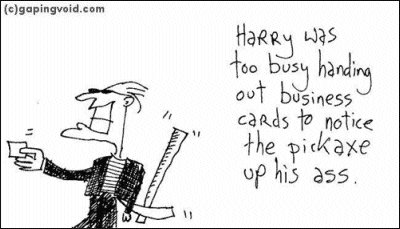
7. When we think of PR, we think of the stereotypical smoothie in an Italian suit, schmoozing away at some fancy sponsored event [See “Pickaxe” cartoon above]. But as we both know, Global PR is actually a pretty sophisticated business. Again, back to a conversation we’ve had more than once, the big challenge for PR firms in the next decade is all about becoming more culturally and technically diverse, AWAY from the typical smoothie archetype, towards something more hardcore, valuable and interesting. How does Edelman Europe see the challenge? Do you see a “new breed” of PR practitioner emerging?
I do see a new breed. PR used to be based on the top-down principle of managing a few relationships with senior journalists or stakeholders. These respected authorities would say good things about your business or firm and the world would gratefully receive their view and act accordingly. Well as you know, that world got blown up and the new democratised world of the enfranchised consumer and the occasional angry crowd has forced businesses (and the PR people and firms that advise them) to open up. It used to be in this business that you could trade on who you know, and now it has swung much more to what you know as well. I can’t imagine hiring people these days who are not actively engaged in the conversation or community in some form . You can’t fake this stuff. And so that means we always look for technical skills, people with a wide set of interests and a passion for something (other than work). Richard Edelman calls this ‘Living in Colour….the idea that if you only live for the office and home you become a little grey. And if you cut off from the world in that way, you are much less use to our clients, who are looking for insight and advice and connection.
8. Of all the global players, it seems to me that Edelman got seriously interested in the implications of Web 2.0 sooner than the other big guys. Hence Richard Edelman hiring Steve Rubel etc. What was it about 2.0 that initially got Edelman all excited, where did you see the opportunity for your business, and what was particularly unique about the company that allowed you to arrive there first?
It really was Richard Edelman. He was banging on about this stuff five years ago when I joined the firm, and I was probably the leading naysayer at the time (I may even have expressed the view that blogging was like CB radio). The Trust Study, the big survey we do each year, had given us some clues when it showed that a ‘person like me’ was becoming a credible source of information on companies and organisations. ‘A person like me’ is now globally the number one credible source of information on companies…the CEO is the seventh most credible! And once we got our heads around that and the seismic changes of which that was just one part, the rest was about putting our money where our mouth was. And Richard hired people who got it, like Steve Rubel, and we invested in research and we bought digital agencies for their technical and creative skills, and we adapted their ways into the mainstream of the firm and invited in people like you who addressed our teams and our clients. And of course training, training, training. But we did make some bloody big mistakes along the way as everybody knows, and boy, did we ever learn from them!
9. Edelman is privately-owned. All your big, main competitors [Weber Shandwick etc] are subsidiaries of the large, publicly-owned advertising conglomerates [Interpublic, WPP etc]. Pros? Cons?
Every shareholder is in the firm, and that means that what’s right for the clients, the people and the business is never diluted by Wall Street or some bully-boy advertising suit. When I worked at some of the advertising-company-dominated, publicly-owned firms you could never point out advertising’s limitations…you were muzzled. We can say precisely what we think is right for the client without worry- and no other PR firm of scale is in that position. On the money front, because we don’t have outside shareholders bleeding cash out of the firm, we can re-invest in intellectual property like research, and in new products and training. I really can’t think of any cons.
10. What advice would you give to a bright young thing wanting to break into the PR business? More specifically, what advice would you give today, that you wouldn’t have given say, a decade ago? In other words, for a young person just entering the trade, how has the world changed in the last ten years?
Be involved and have a voice. When I got into this business in the early Jurassic period those two things were much more difficult to do. But society has changed and it is easy to express opinions and debate and join with like-minded people to pursue your interests. It does not all have to be online, but obviously much of it is now. And we look for that. Someone who is interested and passionate about something and who contributes. I still expect new joiners to be passionate about news, culture and politics in the traditional senses too, but what you read through your aggregator and via your community is as important as what you can buy at the news stand (OK not the most original point, but you would be amazed how many people still come to interviews with no views on news and no understanding or participation in social media). One other thing that has struck me about people joining the business now, especially in the US and the UK, is that they are amazingly conservative about their careers. Many look to progress through the ranks in small linear steps, I guess because the business has become so big and so structured. One of the most difficult things is to find people who will take a risk and go live in the Middle East or Moscow or China and I find that so hard to understand having lived and worked outside my country for seven years . . . something which broadened my horizons significantly.