June 30, 2008
Archive for June, 2008
social object: “sweaty betty”

Sweaty Betty. Though I’m not exactly their target market, I love this brand. They have a store next door to one of my regular London watering holes, which is how I first came across them. From the moment I read their sign, I just “got it”.
The name is fun, it’s memorable, it describes what they’re selling perfectly, and it’s so… English. It doesn’t take itself that seriously. Though Sweaty Betty is going for the upper end of the market, this isn’t gym wear for the uptight, self-important crowd.
And yes, it’s a social object. Their story is easy to relay at a cocktail party, even after a couple of drinks. Some nicely designed gear, a good vibe and a fun name; sometimes that’s all you need.
June 25, 2008
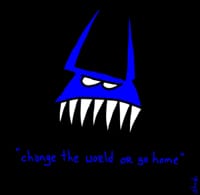
creating “blue monsters”

[BACKSTORY: A year and a half ago, I created the Blue Monster cartoon, which with the help of Microsoft’s Steve Clayton, took on a life of its own inside the Microsoft Corp. It was fun, interesting, Steve and I were well pleased etc.]
A few weeks ago, I talked about “Blue Monster 2.0″. I alluded to a new direction I was taking; I thought I’d elaborate further:
Creating Blue Monsters, I believe, is a fine way for a marketing guy to spend his time. Especially as I’m fond of saying that Blue Monsters are “The Future of Marketing”.
[NB. In its simplest form, a Blue Monster is my pet name for a “Social Object” designed to bring about cultural change within an organization. It certainly worked well enough at Microsoft etc.]
Can another Blue Monster be created? Can lighting strike twice? Can lighting strike outside of Microsoft? I believe it can. Only, there has to be some ground rules. The client in question has to be ready for it, has to want it see it happen.
Ideas within companies are like people within companies. It doesn’t matter how good thy are, there has to be a cultural fit or else it’s a complete waste of time; you’re just fighting a losing battle.
I have an evil plan. Weighing options…
meaning scales, people don’t.

[More thoughts on “How To Be Creative”:]
38. Meaning Scales, People Don’t.
From my blog: “Meaning Scales”. February, 2005:
As Buddha says, there is no one road to Nirvana. Enlightenment is a house with 6 billion doors. While we’re alive, we intend not to find THE DOOR, not A DOOR, but to find OUR OWN, UNIQUE DOOR.
And we’re willing to pay for the privilege. We’re willing to give up money and time and power and sex and status and certainty and comfort in order to find it.
And guess what? It’ll be a great door. It’ll add to this life. It’ll resonate. Not just with us, but with everybody it comes in contact with. The door will useful and productive. Alive and kicking. It’ll create wealth and laughter and joy. It’ll pull its own weight, it’ll give back to others. It’ll be centered on compassion, but will be intolerant of dullards, parasites and cynics.
It may be modest, it may not. It could be a little candle shop; it could be a software company with the GNP of Sweden. It could involve politics or working with the elderly. It could be starting a design studio or opening a bar with Cousin Mike. It could be a screenplay, oil paints, or discovering the violin. It doesn’t matter. Meaning Scales.
Sure, I was pretty drunk on the Kool-Ade when I wrote that, but I think the main point is still valid. The size of the endeavor doesn’t matter as much as how meaningful it becomes to you.
But given a choice between two paths, both valid, how do you know which one to take? How do you know which one has the meaningful payoff?
The answer, of course, is that you don’t. Whether we’re talking about moving to New York to become an “Art Star”, or opening up a humble coffee shop in Alpine, Texas, that’s why they’re called “adventures”. Because you don’t how it’s going to end.
All you can do is admit to yourself that yes, this is an adventure, and to accept it as such, surprises and all. With a little bit of practice you eventually get into the flow of it.
Yes, anything worth doing takes lots of practice. Adventures included.
And when I say “People don’t scale”, I’m stating the obvious: that no matter how meteoric your rise to the top [or not], you are still beholden to the day-to-day realities as any living creature.
Birth, sickness, death, falling in love, watching TV, raising families, mowing the lawn, going to the movies, taking your nephew to a ball game, drinking beer, hanging out with your buddies, playing frisbee on the beach, painting the house, tending the garden. No matter where your adventure takes you, most of what is truly meaningful is still to be found revolving around the mundane stuff you did before you embarked on your adventure. The stuff that’ll be still be going on long after you and I are both dead, long after our contribution to the world is forgotten.
But often, one needs to have that big adventure before truly appreciating this. Going full circle. Exactly.
June 24, 2008
when your dreams become reality, they are no longer your dreams
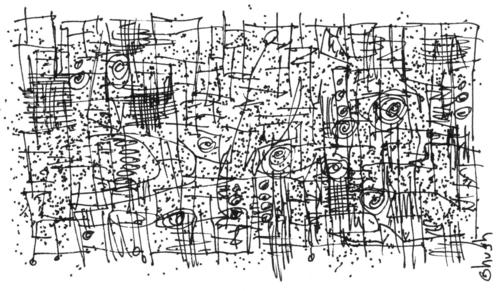
[More thoughts on “How To Be Creative”:]
37. When your dreams become reality, they are no longer your dreams.
If you are successful, it’ll never come from the direction you predicted. Same is true if you fail.
[A Brief History Of The “Cartoons Drawn On The Back Of Business Cards” Format.]
As this book reaches its end, I’m thinking how it’s been OVER TEN YEARS since I first came up with the “cartoons drawn on the back of business cards” format. And it seems like I’VE ONLY JUST got them to the commercially successful level I thought they were capable of reaching.
Better late than never, I suppose.
A friend asked me recently, had I known it would take this long, would I have bothered in the first place? I have in my mind this fantasy version of myself that makes reasonable and sensible decisions, more often than not. This reasonable and sensible person, if he existed, would probably have answered, “No. Definitely not.”
But none of this is sensible. None of it ever was. So yeah, knowing what I know now, I probably wouldn’t have behaved any differently. I’m not proud of that; I’m not ashamed, either. It just is.
Was it worth the cost? Not really. It never is. Van Gough once told his brother, “No painting ever sells for as much as it cost the artist to make it.” I’ve yet to meet in the flesh any artist who could prove him wrong.
Though looking on the bright side, it IS nice after years of struggling away in obscurity, to have a body of work that you’re actually proud of, one that [A] makes you a good living, [B] exceeds your earlier expectations of what you thought you were capable of achieving as a human being, and perhaps most importantly, [C] has given a lot of other people a lot of joy and value.
When I was a kid in college, there very few avenues a cartoonist could take, if she wished to be successful. There was no internet. There were only newspapers, magazines, books, TV, movies, comic books, merchandising, and little else. A world I find hard to imagine now, only a couple of short decades later. And besides, I never saw my work as particularly commercial, so even if I did give it my best shot, I never thought it would ever realistically pay off.
So in my last year of college, feigning maturity, I turned my attention to landing a job that would pay my bills upon graduation. From what I could then tell, writing TV commercials seemed to use the same part of the brain it took to draw cartoons, and I wasn’t a bad cartoonist, so I decided to give Madison Avenue a go. It looked like it could be interesting.
Somehow I managed to get a job as an advertising copywriter, straight out of school. Some skill was needed, most of it was luck, but when you’re in your early twenties and entering the serious job market for the first time, you’ll take whatever you can get.
Though I was in the ad industry off-and-on for over a decade, I don’t think about it too much, now. Some part of me has blacked it out. Besides being VERY hard work, it wasn’t much fun. I was very much in the ranks of what I would call the “In-Betweenies” i.e. those good enough to get and keep a pretty well-paid position in an ad agency, but not good enough to really get ahead in it; not good enough to enjoy it properly. This was the world I lived in, in 1998 New York, when I started drawing the cartoons with a vengeance. And like every other In-Betweenie my age, it was a tiring, stressful time for me.
[And then the internet happened…]
Over the next couple of years, yes, I drew a lot of cartoons, but I didn’t do much with them. They were just a hobby. Besides, I had a lot going on at the time, with the job and the New York lifestyle to maintain. Most of my cartoon audience back then consisted of fellow New York barflies that I had foisted them upon.
But all good things must come to an end. One day I found myself under-employed, broke and pissed off with life in general. With nothing better to do besides waiting for the phone to ring, in May, 2001 I started my blog, gapingvoid.com.
I would like to say that the website took off soon after, the cartoons were a smash hit, and things improved dramatically right away, but sadly that didn’t happen. I just kept at it, day after day, building it up slowly. That’s still how it happens, for the most part.
The million-dollar contract has yet to arrive in the mail. That’s OK, somewhere along the line I figured how to make good money off of them, INDIRECTLY.
How? It’s pretty straightforward, in retrospect. I posted the cartoons online, and because I had a lot of free time on my hands, I then spent a log time tracking what happened to them, once they went out into the ether. This was 2002, just as blogs were beginning to hit the scene. This was the beginning of Google’s rise to the top of the search market. This was the era of Technorati.com, when people wanted to start seeing what was happening on the web RIGHT NOW, not just historically.
Over the next year or two watching the cartoons traveling about, watching what other bloggers were up to, I started getting a pretty good feel for how the internet ACTUALLY worked, not just how the journalists and marketing folk told people how it worked. After a while I started posting my thoughts about this brave new world online. And after a while people started e-mailing me, offering to pay me good money if I would share more of what I had learned online with them.
Sharing this information for me was A LOT MORE FUN and better paid than trying to sell ads to clients, so hey, I went for it.
So far I’ve managed to turn it into a pretty nice business. A lot more money, for a lot let stress and time than Madison Avenue ever offered me. Not a bad outcome.
The thing is, none of it happened on purpose. It just kinda sorta happened, one random event at a time.
I find having two strings to my bow, cartoons and internet, helps the business out a lot. I like to play them off each other. Sorry, I can’t draw you a cartoon; I’m too busy doing internet stuff. Sorry, I can’t help you with your internet problem; I’m too busy drawing something for a client. I totally believe that if I gave one of them up for good, the other one would crash and burn overnight. It’s keeping the creative tension between the two, an extension of the aforementioned “Sex & Cash Theory”, that keeps things interesting. For both me and the good folk paying my bills.
I never intended to be a professional cartoonist. I never intended to become an internet jockey. But somehow the two got mashed up to create this third thing. That’s what I mean by “If you are successful, it’ll never come from the direction you predicted.”
It’s good to be young and full of dreams. Dreams of one day doing something “insanely great”. Dreams of love, beauty, achievement and contribution. But understand they have a life of their own, and they’re not very good at following instructions. Love them, revere them, nurture them, respect them, but don’t ever become a slave to them. Otherwise you’ll kill them off prematurely, before they get the chance to come true.
Good luck.
June 23, 2008
hugh & the rabbi, episode 6

Download the Podcast
Podcast RSS feed

Johnnie Moore, Mark Earls, Rabbi Pinny and myself all met the other week and talked for 70 minutes. It was fun. It was rambling. It was all good. Hope you have a listen etc.
June 19, 2008
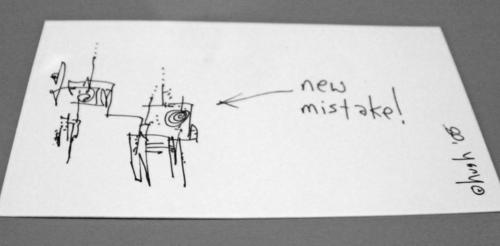
new mistake

When I briefly met Esther Dyson the other day, I gave her the above cartoon, which I had drawn there, right on the spot. It was, of course, inspired by her classic maxim, “Always make new mistakes”.
What a total honor to meet her. People like Esther always remind me of what Loic and I talked about once: That the best thing about being a blogger is the people you get to meet. Exactly.
June 15, 2008
hello from san francisco

[Close-up on Fed 45. Approx 1.5x1.5 inches square. Click on image to enlarge etc.]
[UPDATE: You can follow my goings on at Supernova over on my Twitter page. Also, they have their own Twitter page here.]
Blogging this from a neat cafe here in San Francisco. Heading over to Supernova in a little while, where I’ll be speaking on a panel Wednesday morning.
It’s great being back in town; it’s amazing how many friends I have in San Francisco, even if I’ve spent less than a total two weeks in my entire life here.
But I feel the same way here as I did in New York last week– the Big City doesn’t do much for me any more. It did once, then one day the feeling vanished. I can’t wait to get back to Alpine and crank out some more big drawings.
That being said, this regular traveling stuff is important for me. I think I’d go nuts if all I did was hang out in West Texas. Variety is the spice of life etc.
Besides the cartooning, I’ve got a couple of interesting project stewing in the background. Waiting for a few more planets to line up before going public with them. It’s all good. I’ll let you know how I get on. Cheers.
June 14, 2008
the puck

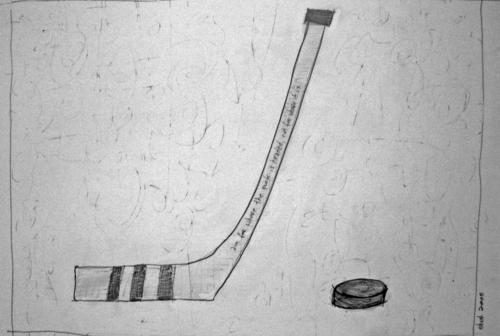
“The Puck”. Pencil on paper, approx. 16 x 21 inches.
“Aim for where the puck is headed, not for where it is”, is a line that my friend, Fred Wilson once quoted to me. It’s his personal mantra for the Venture Capital business. Not hard to see why; it’s a superb thought.
[UPDATE:] Some commenters below kindly tell me that this is a paraphrase of something originally said by the hockey great, Wayne Gretzky. Rock on.
June 13, 2008
“fred 45″ update

[Click on image to enlarge etc.]
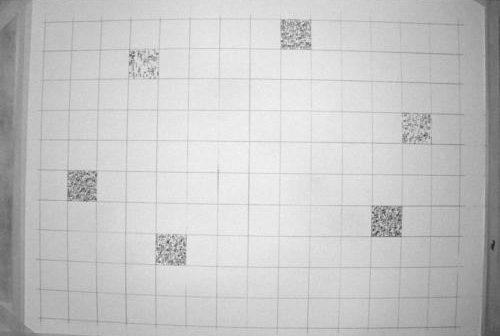
Well, “Fred 45″ is coming along, slowly. Approx 15 x 21 inches, ink & pencil on paper. Last time I blogged it, it was just a pencil grid.
All this traveling I’ve been doing recently has KILLED my productivity, at least in this department… I’m looking forward to a long, quiet winter, to say the least.
now what?

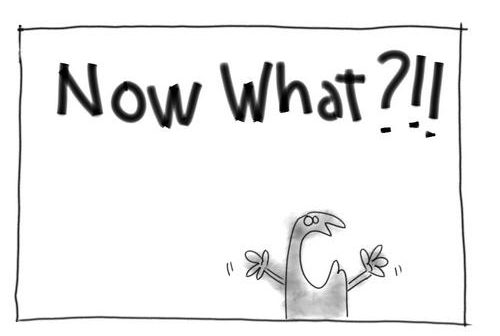
This is a cartoon I designed for Jerry Colonna’s business card, about 2 years ago. He’s still using it. Rock on.
wine as commodity

The relatively small, southern French province of Languedoc produces more wine than the entire State of California. Thousands and thousands and thousands of vineyards. Italy alone boasts 500,000 vineyards, and 50,000 individual wine brands. That’s roughly one vineyard for every one hundred people!
This is one of the great things about wine is, of course. There’s so much choice out there, that once you get the wine bug, you easily can spend the rest of your life sampling thousands of them, and never get even close to sampling them all.
But on the other side of the coin, this makes your job as a wine producer VERY TOUGH. If for example, you have all your money sunk into an Italian wine farm, Congratulations, you’ve got half a million other Italians in the same boat as you. That’s a pretty crowded boat, to say the least.
The other day I showed the above cartoon to the owner of a large American wine importer.“What a lovely grain of sand you are. Too bad you’re lying on the beach.”
My thesis that came out of that conversation: Wine has become a commodity. But most people in the wine trade are too self-absorbed with their own wine schtick to acknowledge the fact. OTHER PEOPLE’S WINE may already be a commodity, but NOT OUR WINE, no no no no… Our wine is SPECIAL, yes yes yes yes…
If you want to remove the “commodity factor” from your wine, you first have to admit that yes, you too are also selling a commodity. And then work from there.
To quote a phrase I probably use far too often: “We’re not in the wine business. We’re in the decommodification business.”
So how does one “decommodify” wine? I have no idea. If I knew, I’d be a billionaire.
But what HAS worked well for me so far, is to stop thinking so much about the product– the grapes, the vineyards, the terroir, the hummingbirds gathering nectar in the early morning sun yak yak yak. Instead, I find it far more useful to be interested in the actual people drinking it. Who are they? What do they need? What’s their schtick? What works for them?
What’s true in life is also true in marketing: If you want to be boring, talk about yourself. If you want to be interesting, talk about other people.
June 6, 2008
10 things I hate about web 2.0

1. Reconciling the huge gap between how interesting and important you tell your clients it all is, versus how interesting and important you actually find it all yourself.
2. The endless train of online armchair quarterbacks endlessly trying to engage you with endless rounds of mental masturbation.
3. The same usual suspects whining endlessly on about the same usual suspects.
4. The idea that spouting endless hyperbole about the latest doohickey widget is actually an interesting, compelling and worthy way for a grown man to spend his free time.
5. The well-intentioned but misguided belief that anonymous loser douchebags are actually entitled to an opinion.
6. People at conference panels, pretending that the only reason they’re attending is to offer valuable insight to their fellow man, as opposed to just pimping their wares and/or scouting for consulting gigs.
7. The pervasive use of the term, “2.0″ to describe anything other than internet software e.g. “Love 2.0″, “Women 2.0″, “Breakup 2.0″, “Food 2.0″, “Religion 2.0″, “Music 2.0″, “Poetry 2.0″, yak yak yak…
8. Any blogger with higher traffic than my own.
9. The popular but mistaken belief that there is a vast, unstoppable army of people in the world who actually care about this shit.
10. The sophomoric conceit that “The Conversation” is two-way. To quote Fran Leibowitz, “The opposite of Talking is not Listening. The opposite of Talking is Waiting”.
June 1, 2008
“fred 45″ begun…

[Click on image to enlarge etc.]
Started on “Fred 45″ this afternoon. So far it’s just a pencil grid on paper, approx 15 x 21 inches.
I have a pretty neat idea where this is headed. Watch this space.
random shit

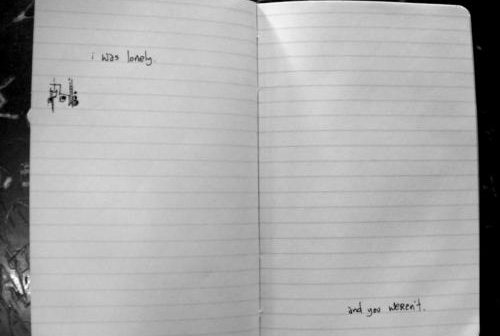
[Another one from my Moleskine… Click on image to enlarge etc.]
“fred 44″ is finished!

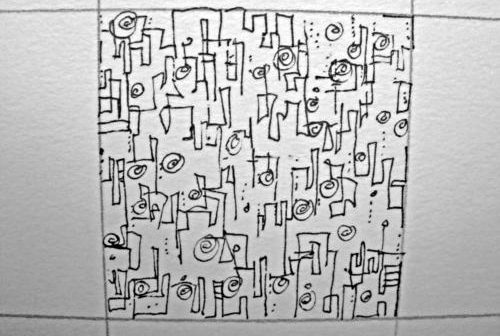
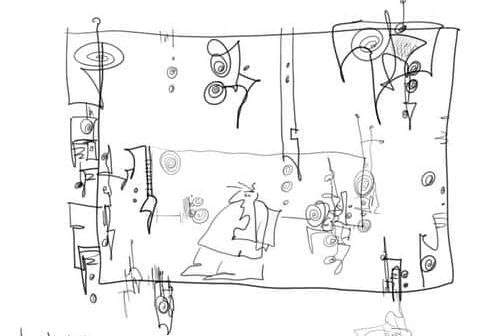
[Fred 44. 18 x 24 inches. Ink & pencil on paper. Click on image to enlarge etc.]
Got in early this morning and put the final touches onto Fred 44.
OK. So now it’s done. Over. Basta. Finito.
I feel good about it. Rock on.
social object: “sweaty betty”

Sweaty Betty. Though I’m not exactly their target market, I love this brand. They have a store next door to one of my regular London watering holes, which is how I first came across them. From the moment I read their sign, I just “got it”.
The name is fun, it’s memorable, it describes what they’re selling perfectly, and it’s so… English. It doesn’t take itself that seriously. Though Sweaty Betty is going for the upper end of the market, this isn’t gym wear for the uptight, self-important crowd.
And yes, it’s a social object. Their story is easy to relay at a cocktail party, even after a couple of drinks. Some nicely designed gear, a good vibe and a fun name; sometimes that’s all you need.
June 25, 2008
creating “blue monsters”

[BACKSTORY: A year and a half ago, I created the Blue Monster cartoon, which with the help of Microsoft’s Steve Clayton, took on a life of its own inside the Microsoft Corp. It was fun, interesting, Steve and I were well pleased etc.]
A few weeks ago, I talked about “Blue Monster 2.0″. I alluded to a new direction I was taking; I thought I’d elaborate further:
Creating Blue Monsters, I believe, is a fine way for a marketing guy to spend his time. Especially as I’m fond of saying that Blue Monsters are “The Future of Marketing”.
[NB. In its simplest form, a Blue Monster is my pet name for a “Social Object” designed to bring about cultural change within an organization. It certainly worked well enough at Microsoft etc.]
Can another Blue Monster be created? Can lighting strike twice? Can lighting strike outside of Microsoft? I believe it can. Only, there has to be some ground rules. The client in question has to be ready for it, has to want it see it happen.
Ideas within companies are like people within companies. It doesn’t matter how good thy are, there has to be a cultural fit or else it’s a complete waste of time; you’re just fighting a losing battle.
I have an evil plan. Weighing options…
meaning scales, people don’t.

[More thoughts on “How To Be Creative”:]
38. Meaning Scales, People Don’t.
From my blog: “Meaning Scales”. February, 2005:
As Buddha says, there is no one road to Nirvana. Enlightenment is a house with 6 billion doors. While we’re alive, we intend not to find THE DOOR, not A DOOR, but to find OUR OWN, UNIQUE DOOR.
And we’re willing to pay for the privilege. We’re willing to give up money and time and power and sex and status and certainty and comfort in order to find it.
And guess what? It’ll be a great door. It’ll add to this life. It’ll resonate. Not just with us, but with everybody it comes in contact with. The door will useful and productive. Alive and kicking. It’ll create wealth and laughter and joy. It’ll pull its own weight, it’ll give back to others. It’ll be centered on compassion, but will be intolerant of dullards, parasites and cynics.
It may be modest, it may not. It could be a little candle shop; it could be a software company with the GNP of Sweden. It could involve politics or working with the elderly. It could be starting a design studio or opening a bar with Cousin Mike. It could be a screenplay, oil paints, or discovering the violin. It doesn’t matter. Meaning Scales.
Sure, I was pretty drunk on the Kool-Ade when I wrote that, but I think the main point is still valid. The size of the endeavor doesn’t matter as much as how meaningful it becomes to you.
But given a choice between two paths, both valid, how do you know which one to take? How do you know which one has the meaningful payoff?
The answer, of course, is that you don’t. Whether we’re talking about moving to New York to become an “Art Star”, or opening up a humble coffee shop in Alpine, Texas, that’s why they’re called “adventures”. Because you don’t how it’s going to end.
All you can do is admit to yourself that yes, this is an adventure, and to accept it as such, surprises and all. With a little bit of practice you eventually get into the flow of it.
Yes, anything worth doing takes lots of practice. Adventures included.
And when I say “People don’t scale”, I’m stating the obvious: that no matter how meteoric your rise to the top [or not], you are still beholden to the day-to-day realities as any living creature.
Birth, sickness, death, falling in love, watching TV, raising families, mowing the lawn, going to the movies, taking your nephew to a ball game, drinking beer, hanging out with your buddies, playing frisbee on the beach, painting the house, tending the garden. No matter where your adventure takes you, most of what is truly meaningful is still to be found revolving around the mundane stuff you did before you embarked on your adventure. The stuff that’ll be still be going on long after you and I are both dead, long after our contribution to the world is forgotten.
But often, one needs to have that big adventure before truly appreciating this. Going full circle. Exactly.
June 24, 2008
when your dreams become reality, they are no longer your dreams

[More thoughts on “How To Be Creative”:]
37. When your dreams become reality, they are no longer your dreams.
If you are successful, it’ll never come from the direction you predicted. Same is true if you fail.
[A Brief History Of The “Cartoons Drawn On The Back Of Business Cards” Format.]
As this book reaches its end, I’m thinking how it’s been OVER TEN YEARS since I first came up with the “cartoons drawn on the back of business cards” format. And it seems like I’VE ONLY JUST got them to the commercially successful level I thought they were capable of reaching.
Better late than never, I suppose.
A friend asked me recently, had I known it would take this long, would I have bothered in the first place? I have in my mind this fantasy version of myself that makes reasonable and sensible decisions, more often than not. This reasonable and sensible person, if he existed, would probably have answered, “No. Definitely not.”
But none of this is sensible. None of it ever was. So yeah, knowing what I know now, I probably wouldn’t have behaved any differently. I’m not proud of that; I’m not ashamed, either. It just is.
Was it worth the cost? Not really. It never is. Van Gough once told his brother, “No painting ever sells for as much as it cost the artist to make it.” I’ve yet to meet in the flesh any artist who could prove him wrong.
Though looking on the bright side, it IS nice after years of struggling away in obscurity, to have a body of work that you’re actually proud of, one that [A] makes you a good living, [B] exceeds your earlier expectations of what you thought you were capable of achieving as a human being, and perhaps most importantly, [C] has given a lot of other people a lot of joy and value.
When I was a kid in college, there very few avenues a cartoonist could take, if she wished to be successful. There was no internet. There were only newspapers, magazines, books, TV, movies, comic books, merchandising, and little else. A world I find hard to imagine now, only a couple of short decades later. And besides, I never saw my work as particularly commercial, so even if I did give it my best shot, I never thought it would ever realistically pay off.
So in my last year of college, feigning maturity, I turned my attention to landing a job that would pay my bills upon graduation. From what I could then tell, writing TV commercials seemed to use the same part of the brain it took to draw cartoons, and I wasn’t a bad cartoonist, so I decided to give Madison Avenue a go. It looked like it could be interesting.
Somehow I managed to get a job as an advertising copywriter, straight out of school. Some skill was needed, most of it was luck, but when you’re in your early twenties and entering the serious job market for the first time, you’ll take whatever you can get.
Though I was in the ad industry off-and-on for over a decade, I don’t think about it too much, now. Some part of me has blacked it out. Besides being VERY hard work, it wasn’t much fun. I was very much in the ranks of what I would call the “In-Betweenies” i.e. those good enough to get and keep a pretty well-paid position in an ad agency, but not good enough to really get ahead in it; not good enough to enjoy it properly. This was the world I lived in, in 1998 New York, when I started drawing the cartoons with a vengeance. And like every other In-Betweenie my age, it was a tiring, stressful time for me.
[And then the internet happened…]
Over the next couple of years, yes, I drew a lot of cartoons, but I didn’t do much with them. They were just a hobby. Besides, I had a lot going on at the time, with the job and the New York lifestyle to maintain. Most of my cartoon audience back then consisted of fellow New York barflies that I had foisted them upon.
But all good things must come to an end. One day I found myself under-employed, broke and pissed off with life in general. With nothing better to do besides waiting for the phone to ring, in May, 2001 I started my blog, gapingvoid.com.
I would like to say that the website took off soon after, the cartoons were a smash hit, and things improved dramatically right away, but sadly that didn’t happen. I just kept at it, day after day, building it up slowly. That’s still how it happens, for the most part.
The million-dollar contract has yet to arrive in the mail. That’s OK, somewhere along the line I figured how to make good money off of them, INDIRECTLY.
How? It’s pretty straightforward, in retrospect. I posted the cartoons online, and because I had a lot of free time on my hands, I then spent a log time tracking what happened to them, once they went out into the ether. This was 2002, just as blogs were beginning to hit the scene. This was the beginning of Google’s rise to the top of the search market. This was the era of Technorati.com, when people wanted to start seeing what was happening on the web RIGHT NOW, not just historically.
Over the next year or two watching the cartoons traveling about, watching what other bloggers were up to, I started getting a pretty good feel for how the internet ACTUALLY worked, not just how the journalists and marketing folk told people how it worked. After a while I started posting my thoughts about this brave new world online. And after a while people started e-mailing me, offering to pay me good money if I would share more of what I had learned online with them.
Sharing this information for me was A LOT MORE FUN and better paid than trying to sell ads to clients, so hey, I went for it.
So far I’ve managed to turn it into a pretty nice business. A lot more money, for a lot let stress and time than Madison Avenue ever offered me. Not a bad outcome.
The thing is, none of it happened on purpose. It just kinda sorta happened, one random event at a time.
I find having two strings to my bow, cartoons and internet, helps the business out a lot. I like to play them off each other. Sorry, I can’t draw you a cartoon; I’m too busy doing internet stuff. Sorry, I can’t help you with your internet problem; I’m too busy drawing something for a client. I totally believe that if I gave one of them up for good, the other one would crash and burn overnight. It’s keeping the creative tension between the two, an extension of the aforementioned “Sex & Cash Theory”, that keeps things interesting. For both me and the good folk paying my bills.
I never intended to be a professional cartoonist. I never intended to become an internet jockey. But somehow the two got mashed up to create this third thing. That’s what I mean by “If you are successful, it’ll never come from the direction you predicted.”
It’s good to be young and full of dreams. Dreams of one day doing something “insanely great”. Dreams of love, beauty, achievement and contribution. But understand they have a life of their own, and they’re not very good at following instructions. Love them, revere them, nurture them, respect them, but don’t ever become a slave to them. Otherwise you’ll kill them off prematurely, before they get the chance to come true.
Good luck.
June 23, 2008
hugh & the rabbi, episode 6
![]()
Download the Podcast
Podcast RSS feed

Johnnie Moore, Mark Earls, Rabbi Pinny and myself all met the other week and talked for 70 minutes. It was fun. It was rambling. It was all good. Hope you have a listen etc.
June 19, 2008
new mistake
When I briefly met Esther Dyson the other day, I gave her the above cartoon, which I had drawn there, right on the spot. It was, of course, inspired by her classic maxim, “Always make new mistakes”.
What a total honor to meet her. People like Esther always remind me of what Loic and I talked about once: That the best thing about being a blogger is the people you get to meet. Exactly.
June 15, 2008
hello from san francisco
[Close-up on Fed 45. Approx 1.5x1.5 inches square. Click on image to enlarge etc.]
[UPDATE: You can follow my goings on at Supernova over on my Twitter page. Also, they have their own Twitter page here.]
Blogging this from a neat cafe here in San Francisco. Heading over to Supernova in a little while, where I’ll be speaking on a panel Wednesday morning.
It’s great being back in town; it’s amazing how many friends I have in San Francisco, even if I’ve spent less than a total two weeks in my entire life here.
But I feel the same way here as I did in New York last week– the Big City doesn’t do much for me any more. It did once, then one day the feeling vanished. I can’t wait to get back to Alpine and crank out some more big drawings.
That being said, this regular traveling stuff is important for me. I think I’d go nuts if all I did was hang out in West Texas. Variety is the spice of life etc.
Besides the cartooning, I’ve got a couple of interesting project stewing in the background. Waiting for a few more planets to line up before going public with them. It’s all good. I’ll let you know how I get on. Cheers.
June 14, 2008
the puck
“The Puck”. Pencil on paper, approx. 16 x 21 inches.
“Aim for where the puck is headed, not for where it is”, is a line that my friend, Fred Wilson once quoted to me. It’s his personal mantra for the Venture Capital business. Not hard to see why; it’s a superb thought.
[UPDATE:] Some commenters below kindly tell me that this is a paraphrase of something originally said by the hockey great, Wayne Gretzky. Rock on.
June 13, 2008
“fred 45″ update
[Click on image to enlarge etc.]
Well, “Fred 45″ is coming along, slowly. Approx 15 x 21 inches, ink & pencil on paper. Last time I blogged it, it was just a pencil grid.
All this traveling I’ve been doing recently has KILLED my productivity, at least in this department… I’m looking forward to a long, quiet winter, to say the least.
now what?
![]()
This is a cartoon I designed for Jerry Colonna’s business card, about 2 years ago. He’s still using it. Rock on.
wine as commodity
![]()
The relatively small, southern French province of Languedoc produces more wine than the entire State of California. Thousands and thousands and thousands of vineyards. Italy alone boasts 500,000 vineyards, and 50,000 individual wine brands. That’s roughly one vineyard for every one hundred people!
This is one of the great things about wine is, of course. There’s so much choice out there, that once you get the wine bug, you easily can spend the rest of your life sampling thousands of them, and never get even close to sampling them all.
But on the other side of the coin, this makes your job as a wine producer VERY TOUGH. If for example, you have all your money sunk into an Italian wine farm, Congratulations, you’ve got half a million other Italians in the same boat as you. That’s a pretty crowded boat, to say the least.
The other day I showed the above cartoon to the owner of a large American wine importer.“What a lovely grain of sand you are. Too bad you’re lying on the beach.”
My thesis that came out of that conversation: Wine has become a commodity. But most people in the wine trade are too self-absorbed with their own wine schtick to acknowledge the fact. OTHER PEOPLE’S WINE may already be a commodity, but NOT OUR WINE, no no no no… Our wine is SPECIAL, yes yes yes yes…
If you want to remove the “commodity factor” from your wine, you first have to admit that yes, you too are also selling a commodity. And then work from there.
To quote a phrase I probably use far too often: “We’re not in the wine business. We’re in the decommodification business.”
So how does one “decommodify” wine? I have no idea. If I knew, I’d be a billionaire.
But what HAS worked well for me so far, is to stop thinking so much about the product– the grapes, the vineyards, the terroir, the hummingbirds gathering nectar in the early morning sun yak yak yak. Instead, I find it far more useful to be interested in the actual people drinking it. Who are they? What do they need? What’s their schtick? What works for them?
What’s true in life is also true in marketing: If you want to be boring, talk about yourself. If you want to be interesting, talk about other people.
June 6, 2008
10 things I hate about web 2.0
![]()
1. Reconciling the huge gap between how interesting and important you tell your clients it all is, versus how interesting and important you actually find it all yourself.
2. The endless train of online armchair quarterbacks endlessly trying to engage you with endless rounds of mental masturbation.
3. The same usual suspects whining endlessly on about the same usual suspects.
4. The idea that spouting endless hyperbole about the latest doohickey widget is actually an interesting, compelling and worthy way for a grown man to spend his free time.
5. The well-intentioned but misguided belief that anonymous loser douchebags are actually entitled to an opinion.
6. People at conference panels, pretending that the only reason they’re attending is to offer valuable insight to their fellow man, as opposed to just pimping their wares and/or scouting for consulting gigs.
7. The pervasive use of the term, “2.0″ to describe anything other than internet software e.g. “Love 2.0″, “Women 2.0″, “Breakup 2.0″, “Food 2.0″, “Religion 2.0″, “Music 2.0″, “Poetry 2.0″, yak yak yak…
8. Any blogger with higher traffic than my own.
9. The popular but mistaken belief that there is a vast, unstoppable army of people in the world who actually care about this shit.
10. The sophomoric conceit that “The Conversation” is two-way. To quote Fran Leibowitz, “The opposite of Talking is not Listening. The opposite of Talking is Waiting”.
June 1, 2008
“fred 45″ begun…
[Click on image to enlarge etc.]
Started on “Fred 45″ this afternoon. So far it’s just a pencil grid on paper, approx 15 x 21 inches.
I have a pretty neat idea where this is headed. Watch this space.
random shit
[Another one from my Moleskine… Click on image to enlarge etc.]
“fred 44″ is finished!
![]()
[Fred 44. 18 x 24 inches. Ink & pencil on paper. Click on image to enlarge etc.]
Got in early this morning and put the final touches onto Fred 44.
OK. So now it’s done. Over. Basta. Finito.
I feel good about it. Rock on.