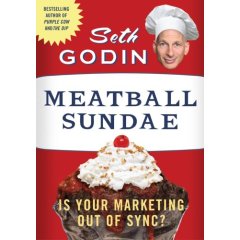
I’ve just got done finishing my friend, Seth Godin’s new book, “Meatball Sundae”, which his publishers kindly sent me a complimentary copy. I loved it. It was just great. Seriously.
As is our usual custom, I sent him ten questions [shown in italics], which he answered. Rock on.
1. For the benefit of gapingvoid readers: What’s a Meatball Sundae?
Meatballs are commodity products, built in a factory, advertised all over. Stuff we need. All the same. Average products for average people. Unremarkable, but important. The backbone of our world so far.
The sundae is the new marketing. Blogs and Facebook and google and crowdsourcing and all the stuff that we get excited about. It works great if you’ve got a social object or a purple cow. But put the sundae on a meatball and…
But the book is not so much a negative rant about the combination that DOESN’T work as much as it is a realization that we are in the midst of a revolution, the new industrial revolution, one that changes the two basic rules of business of the 1900s: Factories and advertising. Now, neither one matters so much. That’s the biggest change any of us has ever seen. What you going to do about it?
2. I may be wrong, but this book kinda reminds me of another book of yours, “Free Prize Inside”, in that a big part of its schtick seems targeted to people already working in [large] organizations. Am I the only one who’s spotted that?
Here’s my challenge: I want to change things. Sometimes, the best way to do that is to reach out to committed individuals and give them some ideas to run with. On the other hand, big changes, sea changes… those happen in larger organizations with leverage. So, my books have sort of struck a balance, sometimes emphasizing one more than the other. In this case, it’s clear that the digerati ‘get’ what’s going on with the new marketing. But we’re frustrated. I wrote this book to help us out. The phrase, “meatball sundae” is designed as a rallying cry, something to sneer at in a big meeting.
The book, in other words, is a tool.
3. There is a myth that all a writer has to do is sit at his keyboard, crank out some chapters, send them over to his publishers, maybe do an edit or two, and then wait for the checks to arrive. But as we’ve talked about before, there’s so much more to being a book author than just the book. Would you care to elaborate?
I think it’s possible, and for some people, even desirable to write a book the way you said. That might be a nice break! I view the book as the souvenir, the appropriately priced artifact of the idea. But it represents just a piece of fruit on the whole tree. The blogging and speaking and most of all, the endless conversations are the real work, the real craft and the part that I love to do. Even if books didn’t exist, I’d still do the rest of it.
4. As “Brand Seth” keeps on growing, how do find dealing with the “public” side of things? “Seth as Social Object”? Is it getting harder?
Facebook is pretty much the only hassle right now. I joined to check it out, but I don’t use it, and I end up disappointing a lot of people I don’t ‘friend’. I should just turn it off, I guess. (Once you friend someone, I figure, you really owe them quite a bit of interaction). Other than that, the challenge for all of us (not just me) is to make appropriate promises. Permission marketing goes both ways. If you hold yourself out there, at some level you’re giving people permission to contact you, to ask for things, to converse. I try to have bright lines (no consulting, no boards, no investing) so I don’t mislead people.
The thing is, I really enjoy the interactions. I just worry about overpromising and undelivering.
5. The fact that blogging changed your book writing style over time is well documented. Has anything come down the pike recently that’s affected your blogging style?
I have to be careful that I don’t watch the trackbacks and stumbles too closely. If I did, I’d write nothing but short posts about blogging!
6. A lot of your books seem to be continuations of conversations you started with your seminal book, “Purple Cow”. Meatball Sundae I’d say would qualify, as would “Free Prize Inside” and “All Marketers Are Liars”. But then your last book, “The Dip”, was about something relatively unrelated. Do you find yourself, as an author, often feeling pulled in two different directions?
I worry about Neal Stephenson and I worry about Robert Parker.
Snowcrash and Diamond Age were brilliant books, seminal stuff that actually changed the world. That gave Neal the power to pretty much write what he wanted, but what he wants to write, it turns out I don’t want to read. I think he lost a great opportunity and I feel the loss.
Robert Parker hit it big with Spenser novels, but every one is so similar, I can’t remember which ones I’ve read and which ones I haven’t.
I don’t want to be in either camp. So, I write what’s important to me, I write what I think will reach an audience and I write what I think will cause change. I honestly don’t worry a bit about sales. The selling of the book is just a tool to spread the idea to people who like buying a book.
7. With your book writing, your speaking gigs, Squiddoo and the myriad of cool free stuff you like to put other there on the internet, you’re a very busy guy. Because you’ve got so much going on, do you ever find that sometimes you don’t have enough time to fully investigate all the cool stuff you like to write about? Seems to me an author, if he wants to be successful, has really got to learn how to multi-task. Discuss.
Actually, I’m a multi-tasker who discovered that he could get away with it by being an author!
The web is like crack for someone with ADD, I’ll tell you that.
Jim Collins is the guy to go to if you went serious research and depth. I’m the guy who notices things.
8. A common complaint I hear is, most business books say everything they need to say within the first two chapters, with the rest being filler. You seem to like fighting this trend tooth and nail. Has it been an easy fight?
It’s a lot easier now, I’ll tell you! I won’t take full credit for the great business book diet, but for anyone who ever slogged through Michael Porter, I think you owe me one.
The last vestige of this is some of the second-tier book publishers who insist on books being long, organized, boring, vetted by peer reviewers and tiresome. They won’t last so long, I think.
9. With the advent of certain Web 2.0 media coming along in 2007- Facebook, etc, suddenly the “Blogging is Dead” meme keeps popping up all over the place. I think they’re kind of missing the point. You?
Who the hell knows what ‘blogging’ means? People say, “that’s not a blog because” it doesn’t have comments or because it has three authors or because it’s got video or who knows what… What’s a book? a blog? a speech? Who knows?
I think it’s entirely possible that the ego-driven, comment-driven water-cooler blog is being replaced by Facebook and Twitter. I don’t think, not for one second, that the inherently closed communities of social networks are a replacement for the idea-driven blog designed to be read by surfers, strangers and the masses.
10. Besides the fact that you pretty much OWN the word, “Remarkable”, I think if there’s one big idea you’ve gotten across to me, it would have be the fact that yes, when you think about it, Marketing is one of the most powerful things we human beings have ever invented, and yes indeed, it can be a force for good. Is perhaps one of the reasons the web attracts you is, it’s a place that validates this idea more quickly than other parts of the business world?
If I had real talent, I’d probably be a computer programmer (what I studied, but failed to understand, in college). Programmers need computers and compilers because without them, they can’t see if the program works. The web is a giant compiler for marketers. You can experiment here for less money, in less time, than anywhere else. If Al Gore hadn’t invented it, I’d be seriously bummed out.
[Seth’s Amazon.com page, for all his books can be found here.]