October 27, 2007

thoughts on de-commodification

Send to Kindle

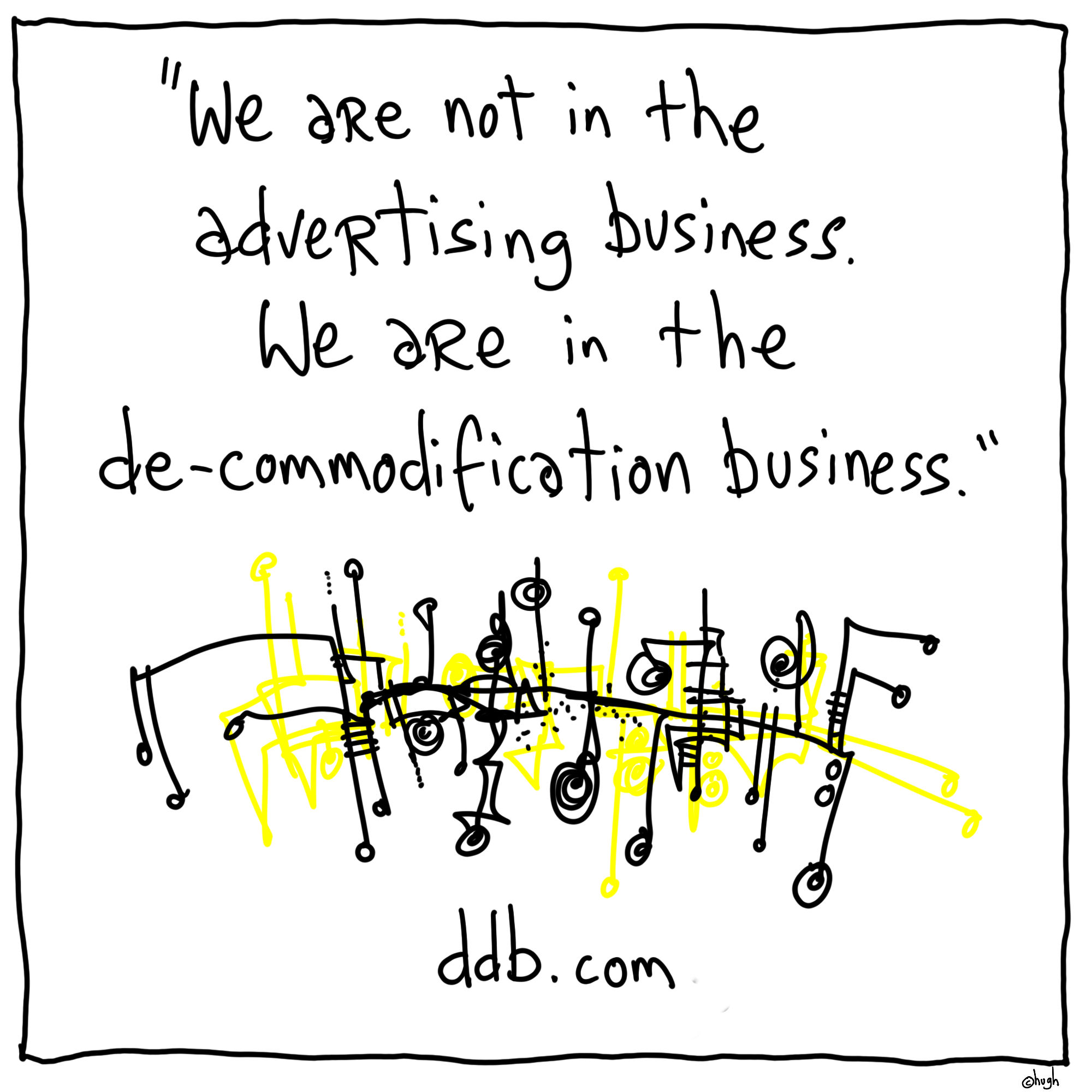
ddbcartoon554.jpg
Some ran­dom thoughts on “De-Commodification”, in no par­ti­cu­lar order:
1. Last year I did the above t-shirt design for an adver­ti­sing buddy of mine in Chi­cago. He’s no lon­ger at DDB, but what the heck.
2. Being in the $10 wine busi­ness, “De-commodification” is a sub­ject dear to my heart. One thing the world is not short of is… vast lakes of unsold wine.
3. When I hit a cer­tain age, I also lear­ned the hard way that the the world was not short of thirty-something jour­ney­man adver­ti­sing crea­ti­ves, either. Nothing like fee­ling a com­mo­dity one­self, to pique one’s inte­rest in de-commodification. Heh.
4. You know the phe­no­me­non when a com­pany gets too big and too rich, and the next thing you know, the middle-manager poli­tics take over? Starts suc­king the life blood out of the com­pany? The start of ine­vi­ta­ble and per­ma­nent dec­line? Know what I mean? The more time I spend on this side of the pond, the more I think this com­pany alle­gory applies to these Uni­ted Sta­tes, as well.
5. Last week I was on the phone to an old friend of mine, a guy in his late for­ties, who was born and bred in Michi­gan, and is living there now. He was telling me about his uncle, who, about four deca­des ago, got his highschool sweetheart preg­nant. So ins­tead of going off to college, he found him­self with a new wife, a child on the way, and an assembly-line job at Gene­ral Motors. But even though this situa­tion clip­ped his wings con­si­de­rably, he still ended up having a nice life in the end, with a home, a big yard, two cars, a steady paycheck, wee­kends fishing or hun­ting deer, and vaca­tions in Hawaii every year or so. “The days where a blue collar guy like my uncle could have a nice life without doing much,” my friend said, “those days are gone. Gone fore­ver.“
And in the back of my mind, I’m thin­king the same is star­ting to hap­pen to white collar guys more and more, as well. But it’s not quite out in the open yet. Society’s not quite ready to have that con­ver­sa­tion.
6. The best way to off­set one’s own com­mo­di­fi­ca­tion is to build one’s own per­so­nal “glo­bal mic­ro­brand”, irres­pec­tive one own emplo­yer. “Brand You”, as the great Tom Peters called it way back in 1997. A good blog works about as well as anything. And no, you don’t have to be an A-Lister. Just look at what peo­ple like James Gover­nor or Tho­mas Mahon are doing.
7. I wish I could think of a bet­ter term than “De-Commodification”. It’s an unwieldy word.

Be Socia­ble, Share!

"Hugh's Daily Cartoon" Newsletter. A new cartoon sent out every weekday morning to your inbox [RSS version here.]. A wee chuckle to start your day off right etc.

Tags: , , , ,

19 Responses to “thoughts on de-commodification”

  1. Jeremy says:

    #5 Made me stop. I live in Michi­gan, right in the auto­mo­tive heart, and see what your friend sta­ted every­day. I have friends with blue collar jobs and white collar jobs, all being greatly affec­ted in many dif­fe­rent ways.
    Your sta­te­ment regar­ding society not being ready to dis­cuss the effect on the white collar wor­kers — so true. Igno­rance is bliss and most peo­ple, espe­cially Ame­ri­cans, like it that way.

  2. jeremy says:

    #5 really got to me too. Being a twenty something crea­tive, I some­ti­mes yearn for sta­bi­lity, but I’m coming to rea­lize it may never hap­pen. Everyone’s gotta be quic­ker on their feet and ready to move where the money is, which doesn’t pro­mote having a healthy family life at all.

  3. tarun bhatia says:

    #5 was the first time I saw someone openly bring up this sub­ject. Star­ting new in the production/wholesale busi­ness, I am slowly rea­li­zing that peo­ple don’t want to buy something because it’s pretty! As money is har­der to get by, they want func­tio­nal and dura­ble com­mo­di­ties. But there are lot of peo­ple out there who believe that they can last, without ever crea­ting a ‘glo­bal mic­ro­brand’, or a way for the cus­to­mer to relate to the brand itself. Many have been des­tro­yed by that igno­rance and until they start rea­li­zing the impor­tance of esta­blishing a aesthe­tic con­nec­tion with their cus­to­mers, more will follow.

  4. Dra­ma­tise your dif­fe­ren­tia­ting idea (Jack Trout).
    Dif­fe­ren­tiate or die (Jack Trout)
    If you don’t have a dif­fe­ren­tia­ting idea you’d bet­ter be cheap (Jack Trout)
    Don’t follow the curve, jump the curve (Guy Kawa­saki)
    All about De-Commodification.
    As ever so much in life is about emo­tio­nal attach­ment, whether it be to friends, family or product/logo.
    Door bell .…

  5. Dave Armstrong says:

    Dr. Joyce Brothers made a com­ment in an article of hers many years ago where she said you should take advan­tage of and nur­ture your uni­que com­bi­na­tion of skills when deve­lo­ping and mar­ke­ting your­self. For ins­tance, if you are an avid out­doors sports enthu­siast and majo­red in mana­ge­ment which you enjo­yed, com­bine the two and become a mana­ger for a spor­ting goods com­pany. You will have more depth in your skill set than others and become a more valua­ble com­mo­dity.
    Many other authors about per­so­nal skill deve­lop­ment point out that you should follow your ‘Bur­ning Desire’ as that will set you apart from others in their quest for mar­ke­ta­bi­lity.
    This all made sense to me 30 years ago when I was just out of college, had not gone to Gra­duate School yet, and wan­ted to set myself apart from the crowd by being a ‘Uni­que Me’ that emplo­yers or cus­to­mers just had to have.
    I follo­wed Dr. Brothers advice more than any other and deve­lo­ped a skill set that is hard to find, got really good at it because I was pur­suing my ‘Bur­ning Desire’ (I tur­ned my favo­rite hobby into my focus), put myself in a big city mar­ket, and have no trou­ble sup­por­ting myself and family in a sta­ble envi­ron­ment where I can con­trol where I live, my per­so­nal satis­fac­tion, and earn top dollar.
    Both my next door neigh­bors did the same thing with their careers and skill set as did the woman across the street. It seems like a healthy but vague path when you are young. Later in life you find your­self surroun­ded by like min­ded peo­ple who ‘Bran­ded’ them­sel­ves with their uni­que com­bi­na­tion of talents and skills that make them stand out in their field and pro­vide them not only with a sta­ble income but a voca­tion that pro­vi­des them with satis­fac­tion in their daily lives. There is nothing like loving your work because you are doing what you enjoy and what you are uni­quely good at.
    I think De-Commodification desc­ri­bes this very well.
    Best Wishes,
    Dave

  6. John says:

    Hugh Mac­Leod = Joyce Brothers 2.0
    I didn’t see that one coming ;O)

  7. Jon Husband says:

    I think your prog­nos­ti­ca­tions are pretty much bang-on .. and yes, society is pretty much not ready to have that white-collar middle mana­ge­ment “work is gonna change a lot” conversation.

  8. wtf says:

    uni­quify

  9. Paul says:

    De-commoditization as it is a trans­for­ma­tion rather than a modi­fi­ca­tion; still blechingly unwieldy.
    Thanks for the point to Tho­mas Mahon, beau­ti­ful blog.

  10. KT says:

    Point #5 is sit­ting like a grem­lin on everyone’s shoul­der in my office, we are all blue or white collar and receive wor­king fami­lies tax credits…

  11. John Stavely says:

    Ouch! How about “uncom­mo­dity?” We all nod and smile hoping its not true. Nice lawn, Fred…great bean dip, Alice. Meanwhile the price of everything rises and our sala­ries don’t. We’re afraid to stick out and get ham­me­red down yet if we don’t stick out we’re repla­ced. Sweet.

  12. Kimber Chin says:

    Great Post.
    The early sta­ges of de-commodification
    can be darn lonely though.
    And a giant leap of faith.
    Like right now,
    some of my romance wri­ting bud­dies
    think I’m crazy to be “spe­cia­li­zing“
    in busi­ness based roman­ces.
    But I think it’d be cha­llen­ging to write a me-too novel and do well.
    (plus, lets face it, busi­ness IS sexy)

  13. Hugh,
    You nai­led it with your glo­bal mic­ro­brand post in Octo­ber 2005, but the idea is so power­ful that it bears repea­ting every year or so.
    Com­mo­dity or glo­bal mic­ro­brand?
    One is a com­plete abdi­ca­tion of res­pon­si­bi­lity.
    The other means taking res­pon­si­biity for one’s life.
    Being a com­mo­dity is ine­vi­tably dehu­ma­ni­zing, no mat­ter how much they pay you.
    Crea­ting your own mic­ro­brand brings out the very best in you.
    Nobody who has done it says it is easy, but we wouldn’t have it any other way.
    Keep up the good work.

  14. Peter James says:

    Ins­tead of de-commodification how about impro­ve­ment. Or pro­gress. Or uni­que pers­pec­tive. Or daring. Or bold­ness – or diver­sity – or VALUE. How about uni­que and mea­ning­ful con­tri­bu­tions to a group, a firm, an industry, or a society at large?
    Yes, some time ago the world deci­ded it was just about done with the tech­no­lo­gi­cal revo­lu­tion. Infor­ma­tion is out there, and it’s digi­tal. The whole world is out there, and ever­yone wants to eat your lunch. You asked for it and you got it.
    You’re wel­come.
    Com­fort is for the pam­pe­red, not the pros­pe­rous. And I, for one, am exci­ted at the pros­pect of having to fight – to use my wits at every turn – to thrive. Anyone who isn’t, as you note, will soon be obso­lete.
    But seriously, best of luck out there. It’s time to split some noses.

  15. I like the notion of going ‘thru’ a de-commodification (like a rebirthing) to get to the glo­bal mic­ro­brand self(perhaps a neces­sary pro­cess to rid your­self of the stench of com­mo­di­fi­ca­tion!)
    From your #3 it appears that you are pain­fully aware as well as going through a period of trans­for­ma­tion, reflec­tion, ulti­ma­tely becoming/discovering, and ‘being’ your own mic­ro­brand!
    Ohhh, another stage of growth
    Sweet­ness, you’ll be alright! (At least you ‘pee­ped’ the future)
    Adrienne Zurub
    (overachiever,Aries,author,moody,speaker,oldest of 9 kids,striving,i>u,comedian,cardiacbitch,longing,i=u,awesome,creative,iconoclast,living da dream,selfish,pOet,grrl,disturbed,writer,seeker,author,grown-azzed WOMAN!)

  16. Krista says:

    Great post! #6 is something that I have recently star­ted to think a lot about.
    When I first thought of myself as a “brand” about 3 months ago I did a quick Goo­gle search of myself and rea­li­zed that if anyone was loo­king to learn about me they were most likely to find:
    1. Myspace/Facebook pro­fi­les full of party pic­tu­res and ran­dom fun with my friends.
    2. A ran­dom blog I star­ted, with topics pri­ma­rily cove­ring Vani­lla Ice, Chuck Norris and my explo­ra­tions of ame­ri­can cul­ture.
    Del­ving in to my “online pro­file” prom­ted me to make some chan­ges… I chan­ged the theme of my blog — I still write funny/random things, but I try to mix it with posts about mar­ke­ting and some of the pro­jects that I work on.
    We’re all kind of like $10 wine.… The ques­tion is what is your point of dif­fe­rence that makes someone choose you? A witty label? A cool bottle design? Great wine inside? Strong reviews in maga­zi­nes? Cool bottle design? Having the right back­ground?
    .…maybe mar­ke­ting peo­ple and $10 wine isn’t that different.….

  17. R.A. Swigert says:

    #5 — I think it’s more like Machi­nes repla­ced the Blue-Collar Wor­kers, and now Soft­ware is repla­cing the White-Collar Wor­kers.
    In the past, you had to go to a law­yer to get your Will done. Now, you can buy a soft­ware pro­gram for $14.95 that does 90% of the work for you. Sure, you go to the law­yer to com­plete the Will. But ins­tead of having the law­yer work on it for 8 hours, the law­yer only works on it for 2 hours.
    Dan Pink (www.danpink.com) has some inte­res­ting ideas on this type of thin­king.
    All the best,
    R.A. Swigert

  18. […] drew this car­toon this mor­ning, while thin­king about a con­ver­sa­tion I had a cou­ple of […]